Publications /
Research Paper

Back
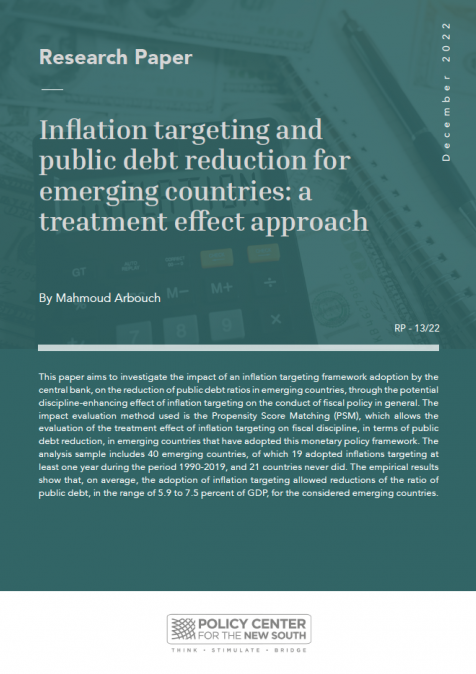
Inflation targeting and public debt reduction for emerging countries: a treatment effect approach
Authors
May 11, 2023

This paper aims to investigate the impact of an inflation targeting framework adoption by the central bank, on the reduction of public debt ratios in emerging countries, through the potential discipline-enhancing effect of inflation targeting on the conduct of fiscal policy in general. The impact evaluation method used is the Propensity Score Matching (PSM), which allows the evaluation of the treatment effect of inflation targeting on fiscal discipline, in terms of public debt reduction, in emerging countries that have adopted this monetary policy framework. The analysis sample includes 40 emerging countries, of which 19 adopted inflations targeting at least one year during the period 1990-2019, and 21 countries never did. The empirical results show that, on average, the adoption of inflation targeting allowed reductions of the ratio of public debt, in the range of 5.9 to 7.5 percent of GDP, for the considered emerging countries.

RELATED CONTENT

  • Authors
    Mouhamadou Moustapha Ly
    April 6, 2020
    Covid-19 has a far-reaching impact and is imposing a slowdown on the world economy, raising fears of the worst consequences on production, jobs and the immediate future of developing economies. Fiscal and monetary authorities around the world are engaging in policies to support their economies with unprecedented funds and initiatives. The African continent, also affected by the pandemic, is pursuing courageous economic (fiscal and monetary) policies, but the main question is what ne ...
  • Authors
    April 3, 2020
    Using a Structural vector auto-regression analysis, this paper attempts to answer the question of the feasibility of a currency union in the Economic community of West African states (ECOWAS). The study focuses on a particular criterion of the theory of optimum currency area (OCA) i.e. the similarity of business cycles. The main results suggest important discrepancies between countries that are already within the WAEMU (CFA Franc) arrangement and countries that have their own arrang ...
  • Authors
    Seleman Kitenge
    March 30, 2020
    Illicit financial flows (IFFs) have become a serious threat to the attainment of global development goals. On February 28th, 2020, the President of the United Nations General Assembly, Tijjani Muhammad-Bande, and the President of ECOSOC, Mona Juul, have announced a high-level panel on international financial accountability, transparency, and integrity (FACTI) as a means to address this challenge, which inhibits financing for the Sustainable Development Goals. This paper provides an ...
  • Authors
    Mouhamadou Moustapha Ly
    March 25, 2020
    Le Covid-19 marque les esprits et impose à l’économie mondiale un ralentissement qui fait craindre les pires conséquences sur la production, les emplois et sur le futur immédiat des économies en développement. Les autorités budgétaires et monétaires à travers le monde s’engagent dans des politiques de soutien aux économies, avec des fonds et des initiatives inédits. Le continent africain, également touché par la pandémie, mène lui aussi des politiques économiques courageuses (budgét ...
  • March 9, 2020
    The Moroccan diaspora contributes in major ways to Morocco’s economic development. Moroccan migrants ease the country’s chronic unemployment and underemployment problems, send remittances, invest in the home country, and typically visit Morocco frequently as tourists. In addition to that migrants usually retain close links with Morocco, and help in less direct ways to forge trade and third-party investment links between Morocco and their host countries. Drawing on the relatively sma ...
  • Authors
    Françoise Nicolas
    January 24, 2020
    Les relations économiques entre la Corée et l’Afrique ont commencé à se développer à compter de 2006, année qui a marqué un tournant avec le lancement de l’année de l’amitié avec l’Afrique et l’Initiative coréenne pour le développement de l’Afrique. Aujourd’hui, bien que les flux d’aide coréenne à destination de l’Afrique soient en constante augmentation celle-ci reste un partenaire économique de second rang pour Séoul. Ni le commerce, ni les investissements directs étrangers (IDE) ...
  • Authors
    Pierre Jacquemot
    December 26, 2019
    Depuis 2000, selon une approche et un calendrier qui ont été maintes fois modifiés, les 15 membres de la Communauté Économique des États de l’Afrique de l’Ouest (CEDEAO) ont exprimé leur volonté d’accélérer le processus d’intégration monétaire dans la région. Le récent débat autour de la Zone franc et sa réforme, désormais décidée avec la France, mais également l’enthousiasme manifesté autour de la création de la Zone de libre-échange continentale (ZLEAf) formellement créée le 30 ma ...
  • December 19, 2019
    Emerging market and developing economies: Engine of the global economic growth despite some vulnerabilities1 After a long spell of slow growth post-crisis, the global economy’s recovery was mainly supported by the improvement of emerging markets and developing economies growth. However, this recovery is subject to wide-ranging uncertainties and is now in some danger. According to the IMF, the global economic growth is expected to fall to 3 % in 2019, the lowest level since 2008. Th ...
  • Authors
    Numéro spécial du cahier du plan - Volume 2
    December 18, 2019
    Lors du colloque autour du thème « Croissance économique au Maroc : théories, évidences et leçons des expériences récentes », organisé conjointement par le Haut-Commissariat au Plan (HCP) et le Policy Center for the New South et accueilli par le HCP en mai 2017 dans ses locaux à Rabat, des experts et praticiens de près de 30 institutions académiques et non académiques ont échangé et débattu de la croissance économique au Maroc dans un framework transverse alliant le théorique au pra ...
  • Authors
    November 22, 2019
    Le rêve d’un monde en développement qui voit ses inégalités se réduire, la condition de vie de ses populations s’améliorer significativement, tout en profitant du bonheur procuré par une population jeune, reste à portée de main. Les macro-économistes ne diront certainement pas le contraire quand on soutient que la plus grande invention de Robert Mundell a sans doute été l’idée du triangle d’incompatibilité. Le concept de Mundell consiste en l’impossibilité de voir coexister de faço ...