Publications /
Policy Brief

Back
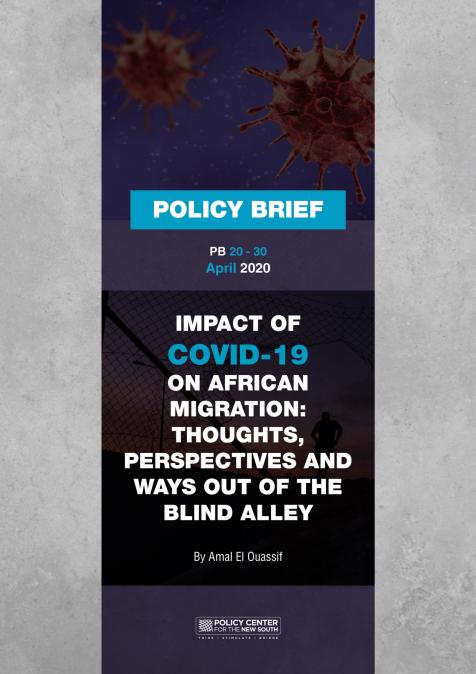
Impact of Covid-19 on african migration: Thoughts, perspectives and ways out of the blind alley
Authors
April 14, 2020

Africa has not been spared from the economic and political consequences of the COVID-19 pandemic. Acting as a catalyst for decreased job opportunities at home and increased foreign-born unemployment rates in host economies, COVID-19 will most likely affect the overall economic conditions of migrants and reinforce the root causes of irregular mobility. On the political side, narratives that feed the fear of ‘outsiders’ can be easy to disseminate in times of crisis when the economy slows and inward-looking social and economic policies appear to be the safest. Escaping the blind alley will require coordinated policy approaches. First, immediate protection for migrants and asylum seekers at the closed borders of countries should be provided. Then long-term policies to tackle the social and economic vulnerabilities in these countries should be developed.

RELATED CONTENT

  • January 29, 2026
    Le Mali, le Burkina Faso et le Niger, réunis au sein de l’Alliance des États du Sahel (AES), affirment l’ambition de bâtir une souveraineté nationale qui leur permettrait de s’émanciper de la domination et des influences extérieures et de se doter d’une liberté d’action dans les choix de développement politique et économique. Cependant, cette ambition se heurte à de nombreuses contraintes économiques et sécuritaires.La souveraineté ne peut se construire sans une base économique soli ...
  • January 23, 2026
    The post-1945 international order, an architecture born of war-weariness and colonial twilight, is now a majestic but empty shell. Its foundational promise—a universal system of rules administered impartially—has been hollowed out by decades of selective enforcement, instrumentalized law, and a chasm between the rhetorical ideals of its custodians and their geopolitical practice. This is not a temporary dysfunction, but a systemic failure of legitimacy. From the invasion of Iraq und ...
  • January 23, 2026
    This episode of AfriCAFÉ examines how Africa’s development aid landscape is shifting amid major cuts by traditional donors and changing global priorities. Through a discussion with Stephen Klingebiel and Andrew Sumner, it questions whether aid has truly driven development or fostered de...
  • January 6, 2026
    La création de l’Alliance des États du Sahel (AES) symbolise une rupture politique et géostratégique majeure, appuyée sur un discours souverainiste et anti-occidental. Deux ans après, Mali, Burkina Faso et Niger peinent à assurer leur intégrité territoriale, à stabiliser leur sécurité intérieure et à bâtir une gouvernance solide. L’intégrité territoriale est un problème commun aux trois États, car dans ces pays, la cohésion de l’État et le contrôle du territoire sont directement men ...
  • January 2, 2026
    Ce Policy Paper analyse les enjeux politiques, économiques et opérationnels du Fonds pour les pertes et dommages, créé pour répondre aux impacts climatiques irréversibles subis par les pays les plus vulnérables. Il clarifie d’abord la notion de pertes et dommages, qui mêle effets économiques et non économiques, et souligne les défis d’attribution liés à la superposition entre chocs climatiques et fragilités structurelles. L’analyse met ensuite en lumière les tensions d’économie poli ...
  • Authors
    Niccola Milnes
    December 30, 2025
    Fuel access has become a strategic pressure point across Mali and its neighbors. In 2025, Jama’t Nusrat al Islam wal- Muslimeen (JNIM) shifted from sporadic interdictions to a deliberate fuel-blockade strategy intended to pressure Bamako without holding territory. By selectively constraining movement along the Sikasso–Kayes–Bamako corridor, the group turned fuel scarcity into a tool of coercion, governance, and narrative control—shaping behavior in the capital while remaining largel ...
  • Authors
    December 3, 2025
    La résolution 2797 du Conseil de sécurité des Nations Unies ne marque pas la fin d’un dossier, mais l’aboutissement d’une gestion magistrale du temps. Le Maroc n’a pas seulement gagné des appuis, il a gagné le tempo.
En combinant le Chronos de la constance et le Kairos de l’opportunité, il a démontré qu’une politique étrangère pouvait s’appuyer sur la philosophie du temps autant que sur la géopolitique.Cette diplomatie du temps maîtrisé peut aujourd’hui être considérée comme une doc ...
  • Authors
    December 1, 2025
    This Paper was originally published on transatlantic.org The contemporary maritime domain is increasingly recognized as a geopolitical and economic space, but also as an environment intertwined with human, social, ecological, and governance systems ashore. The United Nations Institute for Disarmament Research (UNIDIR 2024) report argues that maritime security has evolved from a narrow naval and state-centered concern into a multidimensional issue embedded in global human s ...