Publications /
Policy Brief

Back
The Impact of Coronavirus on the Global Economy
Authors
June 22, 2020

COVID-19 brought the global economy to a sudden stop, causing shocks to supply and demand. Starting in January 2020, country after country suffered outbreaks of the new coronavirus, with each facing epidemiological shocks that led to economic and financial shocks as a consequence. How quickly and to what extent will national economies recover after the pandemic has passed? This will depend on success in containing the coronavirus and on exit strategies, as well as on the effectiveness of policies designed to deal with the negative economic effects of the coronavirus. The impact of coronavirus on the global economy will extend beyond 2020. According to forecasts from the International Monetary Fund and World Bank, GDP per capita at the end of 2021 is still expected to be lower than December 2019 in most countries. Emerging markets and other developing countries, in addition to facing difficulties in dealing with their own coronavirus outbreaks, have suffered additional shocks from abroad. In their cases, the new coronavirus brought a perfect storm. One can foresee a post-coronavirus global economy marked by higher levels of public and private debt, acceleration in digitization processes, and less globalization.


RELATED CONTENT

  • February 22, 2016
    If one opens the newspapers nowadays, Brazil will come out as a melting opportunity. The country is currently facing its largest economic crisis, mostly resulting from a negative political environment where the current Administration has been deeply swollen by Brazil´s largest corruption scandal, the so-called Lava Jato (Car Wash) Operations, whose investigations have brought to light the fact that billions of US$ dollars were being used for campaign financing, illicit enrichment an ...
  • Authors
    Russel Dinh
    January 27, 2016
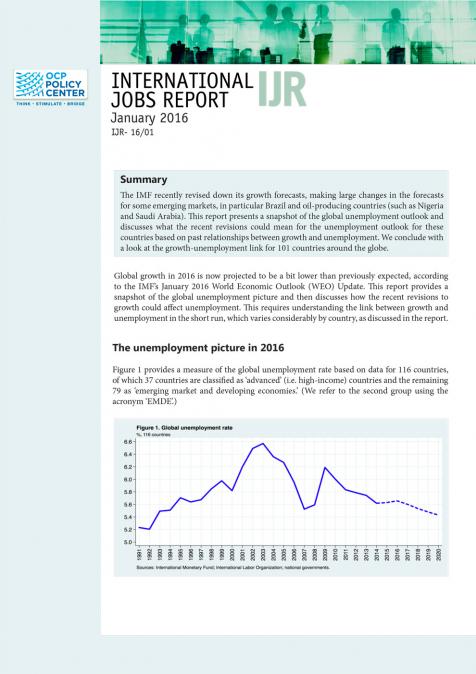
    The IMF recently revised down its growth forecasts, making large changes in the forecasts for some emerging markets, in particular Brazil and oil-producing countries (such as Nigeria and Saudi Arabia). This report presents a snapshot of the global unemployment outlook and discusses what the recent revisions could mean for the unemployment outlook for these countries based on past relationships between growth and unemployment. We conclude with a look at the growth-unemployment link f ...
  • Authors
    January 12, 2016
    Q: The U.S. Federal Reserve on Dec. 16 raised interest rates, ending what Fed Chairwoman Janet Yellen called an “extraordinary seven-year period” during which policymakers kept the federal funds rate near zero in an effort to support the economy. How will the Fed’s action affect Latin American economies, many of which are struggling with anemic growth and low prices for their commodity exports? How will the interest rate hike affect Latin American countries’ ability to pay off ...
  • Authors
    December 23, 2015
    Global economic growth is likely to be a little better in 2016 than this year’s lackluster outcome. The ongoing slow recovery in the United States and Europe is likely to continue. However, weakness in China as well as several large emerging markets, and sluggishness of world trade, mean that risks are weighted on the downside of this forecast. Morocco, which is reliant on European markets, is a heavy importer of oil, and whose currency has devalued in effective terms, should find t ...
  • Authors
    Karim El Mokri
    Aziz Ragbi
    Said Tounsi
    November 23, 2015
    The issue of a powerful fiscal policy comeback is not only being debated in Europe. It is also interesting for Morocco, in many respects. If in Europe there is controversy between the proponents of the structural budgetary balance rule and critics of restrictive policies in the context of major financial and recessive shocks, in the South of the Mediterranean fiscal policy is caught between the multiple social and economic requirements and the constraint of sustainability. ...
  • Authors
    Edité par:
    Karim El Mokri
    Aziz Ragbi
    Said Tounsi
    November 23, 2015
    Depuis le déclenchement de la crise économique et financière internationale, la politique budgétaire a connu un vif regain d’intérêt dans les arènes académiques et dans les débats des policy-makers, aussi bien dans les pays avancés que ceux en voie de développement. Pour un pays en voie de développement comme le Maroc, l’importance de la politique budgétaire réside dans le potentiel qu’elle offre en matière de stabilisation du cycle économique et de relance de l’activité en période ...