Publications /
Policy Paper

Back
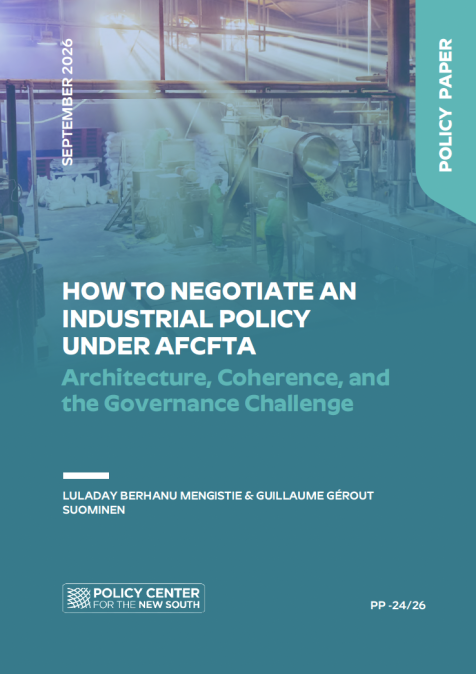
How to Negotiate an Industrial Policy Under AFCFTA : Architecture, Coherence, and the Governance Challenge
Authors
Luladay Berhanu Mengistie
Guillaume Gérout Suominen
September 21, 2026

The African Union Summit of February 2026 instructed the African Continental Free Trade Area (AfCFTA) Council of Ministers to negotiate a Protocol on Industrial Policy and Development. This work, handled without adequate preparation, is likely to reproduce the weaknesses it is meant to remedy. This paper is a conceptual mapping exercise, written to raise the preparatory questions before drafting begins, rather than to prescribe outcomes.

It proceeds in five sections:

1. It works towards a definition of industrial policy narrow enough to be drafted into treaty language and broad enough to capture the instruments that actually drive industrialization, anchoring that boundary work in the AfCFTA’s own objectives.

2. It maps the landscape the Protocol will enter: the AU’s continental instruments, the Regional Economic Community industrial policy frameworks that predate AfCFTA, and the provisions already inside AfCFTA that operate as industrial policy, whether or not they are labelled as such, from tariff schedules and exclusion lists, to product-specific rules of origin, infant-industry and general exceptions, special economic zones, services commitments in industrial-enabling sectors, and the unratified Phase II disciplines.

 3. It sets out what is realistically negotiable: shared principles, a safe-harbor catalogue of permitted instruments, positive harmonization in targeted areas, and governance and coordination mechanisms, together with the negotiating dynamics that will determine which of these receives binding treatment.
RELATED CONTENT

  • February 8, 2024
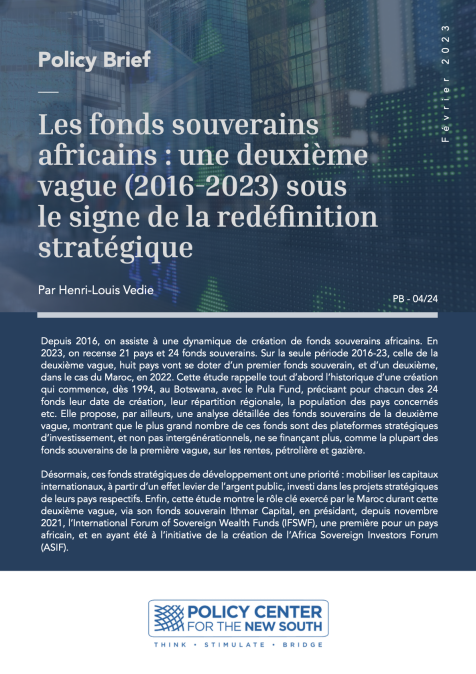
    Depuis 2016, on assiste à une dynamique de création de fonds souverains africains. En 2023, on recense 21 pays et 24 fonds souverains. Sur la seule période 2016-23, celle de la deuxième vague, huit pays vont se doter d’un premier fonds souverain, et d’un deuxième, dans le cas du Maroc, en 2022. Cette étude rappelle tout d’abord l’historique d’une création qui commence, dès 1994, au Botswana, avec le Pula Fund, précisant pour chacun des 24 fonds leur date de création, leur ...
  • Authors
    Ilham Najib
    January 29, 2024
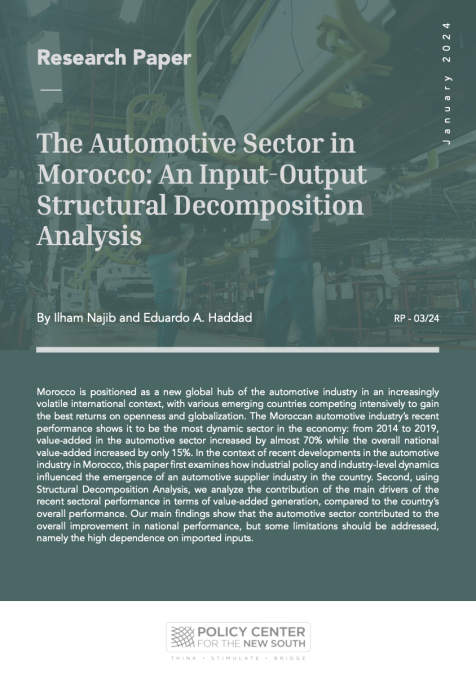
    Morocco is positioned as a new global hub of the automotive industry in an increasingly volatile international context, with various emerging countries competing intensively to gain the best returns on openness and globalization. The Moroccan automotive industry’s recent performance shows it to be the most dynamic sector in the economy: from 2014 to 2019, value-added in the automotive sector increased by almost 70% while the overall national value-added increased by only 15%. In the ...
  • Authors
    January 2, 2024
    This paper was originally published on The South African Institute of International Affairs (SAIIA)Industrialisation is crucial for Africa to improve its standard of living, create productive jobs for its young work force and diversify its exports. ...
  • December 28, 2023
    In this episode, we interviewed Mr. Arkebe Oqubay Metiku, British Academy Global Professor, SOAS University of London around Africa's industrial policies and their impact on growth. We discussed key elements such as innovation, regional collaboration, sustainability, and intellectual pr...
  • November 30, 2023
    In this episode, we dive into the pressing necessity for climate initiatives in Africa. Despite its minimal global emissions, Africa grapples with severe climate challenges and a substantial funding shortfall. Yet, as obstacles persist, including the disconnect between investor expectat...
  • Authors
    Ali Elguellab
    Elhadj Ezzahid
    November 1, 2023
    The role of the production network in shock propagation has been an issue of considerable interest since the Great Recession. However, the empirical literature has only focused on advanced and emerging countries. This paper aims to contribute to filling this gap by examining the case of Morocco, a developing country belonging to the lower-middle-income group. The question is whether its production network is a factor in amplifying idiosyncratic industry-level shocks or, conversely, ...
  • Authors
    Jean Louis-Sarbib
    October 18, 2023
    Addressing inequalities in all their forms has emerged as one of the major global challenges faced by numerous countries across the globe, particularly in Africa. In a context where Africa faces many pressing challenges that are the subject of much analysis (Sarbib et al. 2022), there is a clear gap in conducting comprehensive reviews focused on inequalities, partly due to the lack of available data. Inequalities, which are both consequences and partial causes of poor development o ...