Publications /
Policy Paper

Back
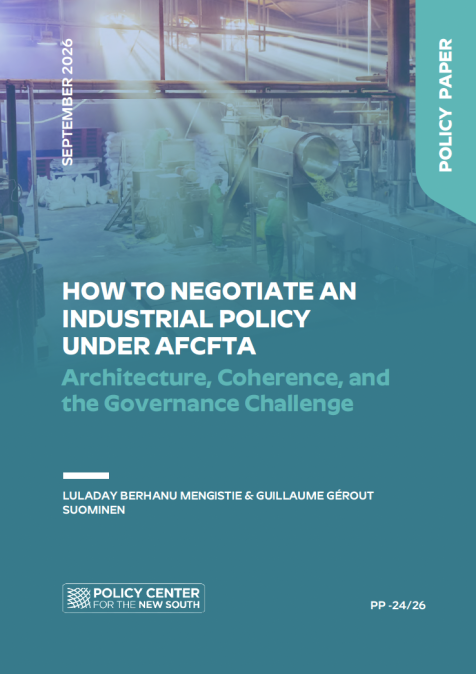
How to Negotiate an Industrial Policy Under AFCFTA : Architecture, Coherence, and the Governance Challenge
Authors
Luladay Berhanu Mengistie
Guillaume Gérout Suominen
September 21, 2026

The African Union Summit of February 2026 instructed the African Continental Free Trade Area (AfCFTA) Council of Ministers to negotiate a Protocol on Industrial Policy and Development. This work, handled without adequate preparation, is likely to reproduce the weaknesses it is meant to remedy. This paper is a conceptual mapping exercise, written to raise the preparatory questions before drafting begins, rather than to prescribe outcomes.

It proceeds in five sections:

1. It works towards a definition of industrial policy narrow enough to be drafted into treaty language and broad enough to capture the instruments that actually drive industrialization, anchoring that boundary work in the AfCFTA’s own objectives.

2. It maps the landscape the Protocol will enter: the AU’s continental instruments, the Regional Economic Community industrial policy frameworks that predate AfCFTA, and the provisions already inside AfCFTA that operate as industrial policy, whether or not they are labelled as such, from tariff schedules and exclusion lists, to product-specific rules of origin, infant-industry and general exceptions, special economic zones, services commitments in industrial-enabling sectors, and the unratified Phase II disciplines.

 3. It sets out what is realistically negotiable: shared principles, a safe-harbor catalogue of permitted instruments, positive harmonization in targeted areas, and governance and coordination mechanisms, together with the negotiating dynamics that will determine which of these receives binding treatment.
RELATED CONTENT

  • Authors
    August 5, 2026
    This paper addresses the persistent challenge of resource dependence in the world's poorest countries, focusing on the ten poorest African nations where natural- resource rents average 14% of income. It argues that four decades of conventional policy advice, which treated resource dependence primarily as a revenue management problem, have failed to help these countries. While stabilization funds and permanent-income frameworks aim to smooth consumption, they do not answer the fundam ...
  • August 3, 2026
    This policy paper explores how China’s economic development model—rooted in pragmatism, long-term planning, and civilizational renewal—has become its most compelling soft power asset, particularly in the eyes of the Global South. While critically engaging with Joseph Nye’s original conception of soft power as a primarily cultural and normative force, the paper argues that China’s ability to transform itself from an impoverished postimperial state into the world’s largest trading nat ...
  • Authors
    Fatima Berahou
    July 28, 2026
    This Paper was originally published on cairn.infoL’insertion professionnelle des jeunes, et particulièrement des diplômés de l’enseignement supérieur, constitue un enjeu majeur pour le développement économique et la cohésion sociale de toute nation. Au Maroc, cette question revêt une acuité particulière et s’attache à un paradoxe persistant : malgré une démocratisation et une progression notable de l’accès à l’enseignement supérieur au cours des deux dernières décennies, le tau ...
  • Authors
    Edited by
    July 13, 2026
    Available soon on livremoi. The 2026 edition of the Annual Report on the African Economy examines the issue of the valorization of Africa’s natural resources, particularly its mineral wealth. While the continent holds some of the world’s largest known reserves of a wide range of minerals and metals, the objective is not merely to catalogue these resources, but rather to explore the conditions under which natural resource endowments can be transformed into drivers of Africa’s in ...
  • July 3, 2026
    Este Policy Paper también ha sido publicado en inglés y francés por Le Grand Continent La economía marroquí constituye un caso ilustrativo entre las economías de renta media, en un contexto marcado por una creciente fragmentación del entorno internacional, un crecimiento mundial anémico y una desaceleración de la convergencia. Desde 2022, su trayectoria se caracteriza por una relativa solidez, con un crecimiento superior a la media de las economías de la misma categoría. Superi ...
  • July 3, 2026
    This Policy Paper has also been published in French and Spanish by Le Grand Continent Morocco offers a compelling example of how a middle-income economy can navigate a more fragmented global environment, characterized by weak growth and slower convergence. Since 2022, economic activity has remained relatively strong, with growth exceeding that of many comparable economies. Non-agricultural growth has averaged 4.4% since 2022, around 1.3 percentage points above its historical av ...
  • July 3, 2026
    Ce Policy Paper a également été publiée en anglais et en espagnol par Le Grand Continent Le Maroc offre un exemple éclairant parmi les pays à revenu intermédiaire, dans un contexte marqué par une fragmentation croissante de l’environnement international, une croissance mondiale atone et un ralentissement de la convergence. Depuis 2022, sa trajectoire se distingue par une certaine robustesse, avec un rythme d’expansion supérieur à celui des autres économies de même catégorie. Dé ...
  • Authors
    July 2, 2026
    Africa is facing a massive electricity deficit that is impacting its economic and social development, and its ability to catch up with the rest of the world. It is imperative that the continent increase its electricity production to connect the 600 million people who are currently without access and to improve the quality of service for the millions who are suffering from frequent blackouts and load-shedding. Economic development in the 21st century will crucially depend on the digi ...