Publications /
Policy Brief

Back
The Grand Ethiopian Renaissance Dam : Between the Burdens of Sovereignty and the Constraints of Neighborhood
August 17, 2020

Against the backdrop of mutual accusations of a lack of political will to bring the tripartite negotiations on the commissioning of the “Grand Ethiopian Renaissance Dam” (GERD), to a successful conclusion, Egypt and Ethiopia continue to alternately send signals of provocation and appeasement. This tension is growing in intensity as the rainy season (July to September) draws nearer. On the one hand, Ethiopia intends to seize this opportunity to fill the dam; on the other hand, Egypt and Sudan consider the conclusion of a final and binding agreement as a precondition. While Egypt, for which the Nile is a matter of life and death, claims “historic rights” on the waters of the Nile in accordance with the 1929 and 1959 Agreements, Ethiopia, which does not consider itself bound by these instruments, claims its sovereign right to exploit its natural resources for the benefit of its socio-economic development. In this crisis, Sudan is trying to play a role of appeasement and rapprochement to avoid having to take sides with one or the other neighbor. In order to avoid an escalation that could lead to open conflict, the three countries have embarked on a negotiation process that has been going on since 2011, when the GERD was launched. This process, which has made significant progress, has now reached an impasse. According to the Sudanese mediator, the June 2020 meetings between the three countries have resulted in trade-offs being reached on 95% of the outstanding issues. The remaining points concern the duration of filling (5 to 7 years, according to Addis-Ababa, or 12 to 20, for Egypt), the dispute settlement mechanism, the nature of the legal framework in which the agreed arrangements will be recorded and the presence of Egyptian observers at the dam site to supervise the implementation of the Final Agreement. The Security Council meeting on 29 June, at the request of Egypt, and the Summit organized on 27 June by the current Chairperson of the African Union succeeded in bringing the three countries back to the negotiating table. The next three weeks offer a last chance for the parties to reach a full and final settlement and open a new page of cooperation in the tumultuous history of relations between these two former Empires. Such an agreement could set a precedent for other similar situations. It could, for example, serve as a source of inspiration for the nine states of the Congo River, to make their Basin, whose potential is greater than that of the Nile, a vector of development for the entire region.
RELATED CONTENT

  • Authors
    with Sâ Benjamin Traoré
    December 31, 2025
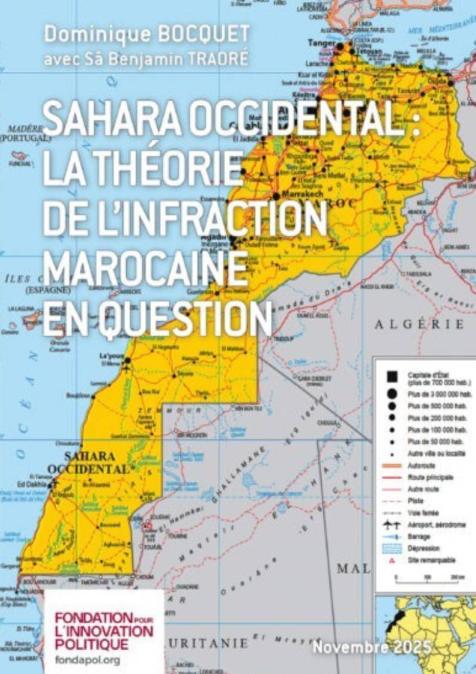
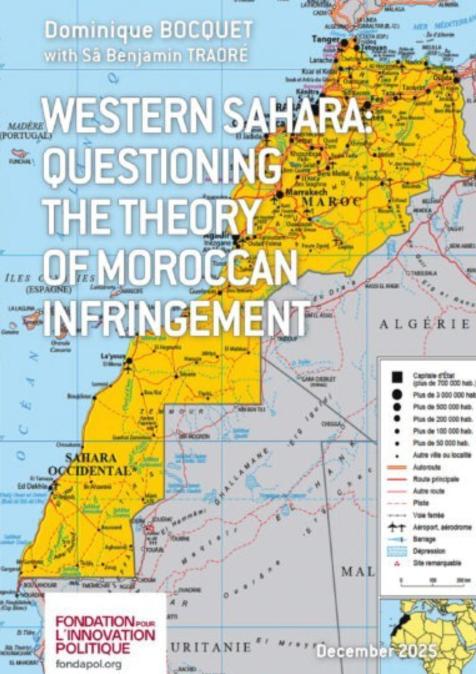
    This report was originally published on fondapol.org For 50 years, the Western Sahara conflict has been pending before the international fora.In 1975, Morocco claimed sovereignty over this vast desert territory – which had previously been a Spanish colony – as it considered this territory had previously belonged to her. This view is contested by the Polisario Front, an independence movement supported by Algeria. The international community has adopted an ambivalent attitude, ac ...
  • Authors
    December 3, 2025
    La résolution 2797 du Conseil de sécurité des Nations Unies ne marque pas la fin d’un dossier, mais l’aboutissement d’une gestion magistrale du temps. Le Maroc n’a pas seulement gagné des appuis, il a gagné le tempo.
En combinant le Chronos de la constance et le Kairos de l’opportunité, il a démontré qu’une politique étrangère pouvait s’appuyer sur la philosophie du temps autant que sur la géopolitique.Cette diplomatie du temps maîtrisé peut aujourd’hui être considérée comme une doc ...
  • Authors
    December 3, 2025
    Resolution 2797 of the United Nations Security Council does not mark the end of an issue, but the culmination of masterful time management. Morocco has not only won support, it has won the tempo. By combining the Chronos of constancy and the Kairos of opportunity, it has demonstrated that a foreign policy can be based on the philosophy of time as much as on geopolitics.This diplomacy of controlled time can today be seen as an implicit doctrine of the Kingdom: a strategy in which pat ...
  • Authors
    November 7, 2025
    « Désormais, il y aura un avant et un après 31 octobre 2025 ». C’est en ses termes forts que c’est adressé Sa Majesté le Roi à son peuple quelques minutes après l’adoption par le Conseil de sécurité des Nations-Unies de la résolution 2797 qui demande clairement aux parties au différend sur le Sahara de participer aux discussions sans conditions préalables et sur la base exclusive du plan d’autonomie proposé par le Maroc. Ce Momentum stratégique devrait constituer une raison pro ...
  • Authors
    November 7, 2025
    "From now on, there will be a before and after October 31, 2025". These were the strong words spoken by His Majesty the King to his people a few minutes after the adoption by the United Nations Security Council of resolution 2797, which clearly calls on the parties to the Sahara dispute to take part in discussions without preconditions and on the exclusive basis of the autonomy plan proposed by Morocco.This strategic Momentum should be a source of deep satisfaction for national dipl ...
  • November 05, 2025
    Cet épisode revient sur la trajectoire politique et économique de l’Algérie depuis le mouvement du Hirak en 2019. Il analyse la consolidation du pouvoir militaire, les limites de la trans ...
  • Authors
    avec le concours de Sâ Benjamin Traoré
    October 31, 2025
    Ce rapport a été initialement publié sur fondapol.org Depuis 50 ans, le conflit du Sahara occidental est pendant devant les instances internationales.En 1975, le Maroc a fait acte de souveraineté sur ce vaste territoire désertique, jusque-là colonie espagnole. Il estime qu’il lui avait antérieurement appartenu. Ce point de vue est contesté par le Front Polisario, mouvement indépendantiste soutenu par l’Algérie. La communauté internationale a adopté une attitude ambivalente, ret ...
  • Authors
    Fatim Zohra Azouzou
    October 29, 2025
    Ghana’s President John Dramani Mahama has made pragmatism the orienting principle of his foreign policy to reach a dual goal: (a) economic recovery, and (b) containment of the terrorist threat. Two recalibrations illustrate this shift. First, strategic convergence with Morocco: on January 7, 2025, Accra suspended recognition of the so-called ‘Sahraoui Arabe Democratic Republic’ and endorsed Morocco’s Autonomy Plan for the Moroccan Sahara. This opened the door to expanded economic co ...
  • Authors
    Fatim Zohra Azouzou
    October 29, 2025
    Le Président ghanéen Dramani Mahama fait du pragmatisme le principe directeur de la politique étrangère de son pays pour répondre à un double impératif : redressement économique et endiguement de la menace terroriste. Deux recalibrages en constituent les preuves empiriques. D’abord, la convergence stratégique avec le Maroc : le 7 janvier 2025, Accra suspend sa reconnaissance de la pseudo-« rasd » et endosse le Plan d’autonomie marocain, ouvrant la porte à de nouvelles pistes de coop ...