Publications /
Paper in Academic Journals
Back
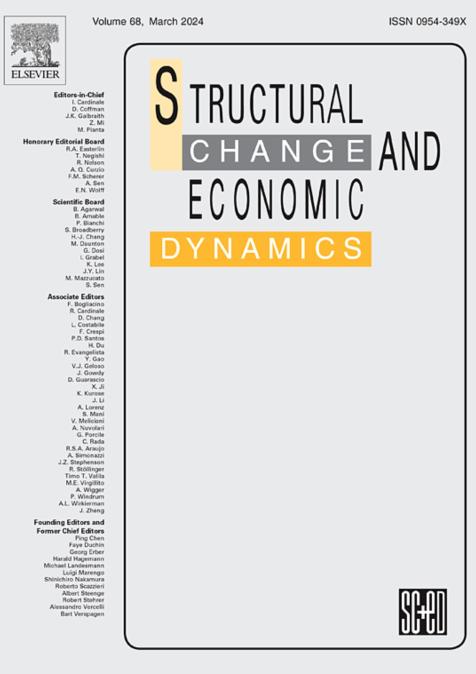
Geographical proximity and technological similarity
Authors
Inácio F. Araújo
Fernando S. Perobelli
December 11, 2023

This Paper was originally published on sciencedirect.com


From a time-space perspective, we assess the effects of geographical proximity on technological convergence over time identifying proximity dimensions associated with countries’ technological similarities. We compare a time series of input-output coefficients for 66 different countries extracted from the 2021 edition of OECD Inter-Country Input-Output to verify whether nearby countries are more likely to share similar technologies. Our results reveal that geographical technological spillovers are important since closer economies tend to be more similar than distant ones. This is particularly evident for the European economies in the sample, suggesting that institutional proximity also matters for technological convergence. Over time, closer economies are becoming structurally more similar; however, this trend seems to have slowed down after the 2008–9 financial crisis. Conjectures on how informational gaps are filled in the consolidation of the databases – encountered in an environment of limited information – based on known practices of using regional and global average structures may add a layer of uncertainty to our results.

RELATED CONTENT

  • November 9, 2026
    Cette interview examine les perspectives d’une éventuelle adhésion du Maroc à l’OCDE à l’horizon 2040, en revenant sur les conditions économiques, institutionnelles et réglementaires qu’un tel processus pourrait impliquer. Elle met en perspective les réformes engagées par le Royaume, le...
  • Authors
    Aziz Ajbilou
    Ouidade Sabri
    November 4, 2026
    School dropout remains a major challenge for education systems and public policy, with lasting consequences for human capital, labor market integration, social cohesion, and long-term economic growth. Despite sustained efforts to expand access to schooling, many countries continue to experience high dropout rates, particularly at key transition points in lower- and uppersecondary education. Policy responses have often relied on fragmented, sector-specific interventions—addressing ed ...
  • Authors
    Bambang Brodjonegoro
    November 2, 2026
    This policy note was published as part of the T20 U.S. 2026 Workstreams, under the workstream “Fostering Trade and People-Centered Economic Growth,” which brings together policy experts to develop recommendations for G20 policymakers. The Group of Twenty (G20) accounts for most of the world’s output, yet its decisions shape the prospects of 174 United Nations Member States without G20 membership, among them the great majority of least developed countries and small states. Many ...
  • October 22, 2026
    تتناول هذه الحلقة من «حديث الثلاثاء» تأثير تقلبات أسعار النفط والغاز في الأسواق العالمية على الاقتصاد المغربي، وانعكاساتها على القدرة الشرائية للأسر وتنافسية المقاولات. ونناقش مع ضيفنا السيد أمين سامي كيف تنتقل هذه التقلبات إلى أسعار السلع والخدمات، ولماذا لا تنخفض الأسعار دائمًا مع ترا...
  • October 22, 2026
    Strategic hedging is rational when it preserves a worthwhile choice at a tolerable cost while respecting existing commitments. Drawing on the literature on hedging and Latin American autonomy, this Policy Brief examines contrasting illustrations of that proposition. It distinguishes ambiguity about future alignment from uncertainty about existing obligations and explains how clearly bounded commitments can reconcile autonomy with credibility. The cases reveal different vulnerabiliti ...
  • October 15, 2026
    The Policy Center for the New South, in partnership with The Asian Network, is organizing a webinar titled “Emerging Powers and the Remaking of Global Order” to examine the growing role of emerging powers and the Global South at a time of profound transformation in the international sys...
  • Authors
    Florent Parmentier
    October 12, 2026
    Cet article soutient que le Chief Geopolitical Officer (CGO) doit être repensé à partir de l’expérience des entreprises africaines. Dans un environnement multipolaire et fragmenté, leur principal défi n’est pas seulement la gestion des risques, mais la préservation de plusieurs options stratégiques simultanément selon une logique de hedging. Trois modèles de CGO sont à distinguer : l’intermédiation (Office chérifien des Phosphates (OCP), Tanger Med), l’intégration régionale (Ethiopi ...