Publications /
Research Paper

Back
A Framework to Assess Services as a Driver for Economic Growth and Structural Transformation
Authors
March 12, 2026

Historically, manufacturing has served as the primary pathway to economic development, offering strong scale economies, learning-by-doing effects, and the capacity to generate the foreign exchange necessary to import capital goods and technology. However, advances in robotization and artificial intelligence (AI) are fundamentally undermining manufacturing’s traditional role, making it increasingly skill- and capital-intensive while limiting its ability to absorb labor. This technological transformation forces developing countries to consider service-led development strategies, but most services exhibit low productivity, limited tradability, and minimal capacity to generate foreign exchange. 

This paper is the first in a series to develop a methodology to identify and assess which specific services can serve as drivers for growth and structural transformation for the Global South. It proposes an analytical framework that classifies services into three categories: i) Knowledge Services (ICT and professional business services) which exhibit manufacturing-like characteristics such as tradability and foreign exchange generation capacity; ii) Enabling Services (transport, logistics, finance) which facilitate trade but generate limited independent value capture; and iii) Local Services (retail, hospitality, health, education, arts, and personal services) which absorb labor but cannot drive export-led growth. Critically, the paper addresses the education and health sectors separately, recognizing that, while they function as Local Services, they constitute essential foundational investments that enable the development of Knowledge Services. A companion paper applies this framework to assess the performance of the services sector of three North African countries: Egypt, Morocco, and Tunisia. 

To establish a benchmark against which developing countries can be assessed, we apply this framework empirically to EU15 economies over the period 2010–2022 using OECD Trade in Value Added (TiVA), Trade in Employment (TiM), and inter-country input-output tables, measuring performance across sectoral GDP and employment shares, productivity levels, external integration indicators, employment embodied in external demand, Hirschman-Rasmussen backward and forward linkages, and Leontief employment multipliers. The EU15 evidence shows that successful service-led development is not simply about expanding services in aggregate, but about shifting the internal composition of services toward Knowledge Services while maintaining efficient Enabling Services—precisely the pattern absent in countries that participate in GVCs without capturing significant value. 
RELATED CONTENT

  • Authors
    December 23, 2015
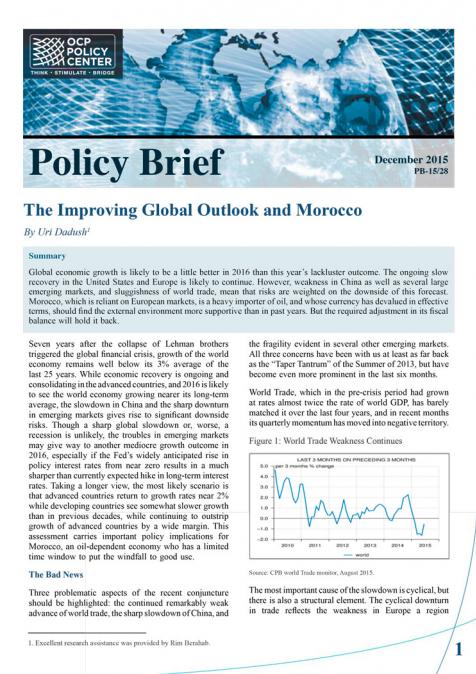
    Global economic growth is likely to be a little better in 2016 than this year’s lackluster outcome. The ongoing slow recovery in the United States and Europe is likely to continue. However, weakness in China as well as several large emerging markets, and sluggishness of world trade, mean that risks are weighted on the downside of this forecast. Morocco, which is reliant on European markets, is a heavy importer of oil, and whose currency has devalued in effective terms, should find t ...
  • Authors
    Clémence Vergne
    November 19, 2015
    Au cours de la dernière décennie, le Ghana a enregistré des taux de croissance moyens supérieurs à 7 % par an, ce qui lui a permis d’accéder au statut de pays à revenu intermédiaire de la tranche inférieure. Toutefois, la croissance a récemment marqué le pas pour s’établir à 4,2 % en 2014, ce qui soulève la question de la pérennité du modèle de développement du pays. Le Ghana se trouve désormais à un stade critique de son processus de développement. Une transformation structurelle ...
  • Authors
    Rabah Arezki
    Akito Matsumoto
    September 22, 2015
    “It was the best of times, it was the worst of times.” With these words Charles Dickens opens his novel “A Tale of Two Cities”. Winners and losers in a “tale of two commodities” may one day look back with similar reflections, as prices of metals and oil have seen some seismic shifts in recent weeks, months and years. This blog seeks to explain how demand — but also supply and financial market conditions — are affecting metals prices. We will show some contrast with oil, where suppl ...
  • Authors
    Roger Nord
    September 18, 2015
    Sub-Saharan Africa’s trade flows increased sharply, multiplying by a factor of five over the past 20 years. Is this boom built on commodities only?  My answer is no ! Many countries have increased their integration in global value chains. But, it is also clear that sub-Saharan Africa still has some way to go. Increased trade boosts for growth Over the last two decades, the export-to-GDP ratio in sub-Saharan Africa increased from 20½ percent in 1995 to 27½ percent in 2013. Thi ...
  • July 21, 2015
    The 16th Annual Global Development Conference has been dedicated this year to the theme of ‘Agriculture for Sustainable Growth: Challenges and Opportunities for a New ‘Green Revolution’.  One of the sub-themes that has been addressed during this event is related to the design of the optimal agricultural policy supposed to lead towards development, especially in low-income countries. The objective of this blog is to cover the key elements that make an agricultural policy su ...
  • Authors
    Karim EL MOKRI
    July 6, 2015
    « Les asymétries et l’instabilité du marché des matières premières dans les pays en développement : politiques et impacts sur le développement », une problématique d’un intérêt particulier pour ces pays, a fait l’objet d’un séminaire de recherche organisé par la Fondation pour les Etudes et Recherches sur le Développement International (Ferdi), les 24 et 25 juin 2015 à Clermont-Ferrand. Cet évènement a été tenu la veille du workshop co-organisé par la Ferdi et OCP Policy Center ...