Publications /
Book / Report

Back
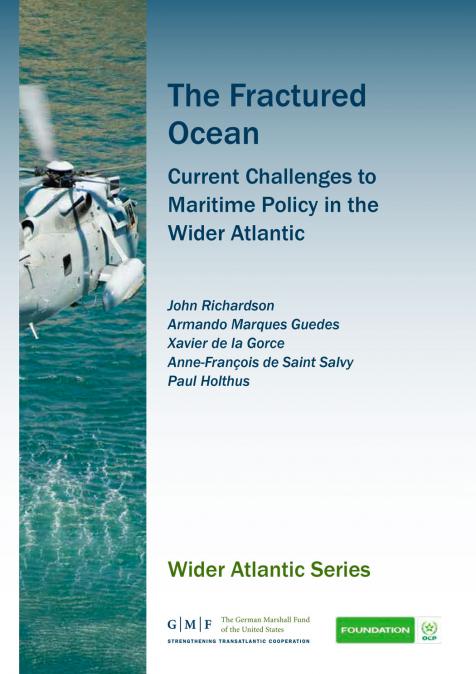
The Fractured Ocean: Current Challenges to Maritime Policy in the Wider Atlantic
Authors
John B. Richardson
Armando Marques Guedes
Xavier de la Gorce
Anne-François de Saint Salvy
Paul Holthus
November 29, 2012

This paper examines the challenges posed by human activity on the Atlantic Ocean itself, and around its coasts, looking at it not so much as a vast expanse separating the Americas from Africa and Europe but rather as a shared resource and an important connector. All littoral states face a common challenge in maintaining its value as a foundation for sustained “blue growth” in the years to come. In Chapter 1, Armando Marques Guedes traces the evolution of the economic activities that have determined the geoeconomic development of the Atlantic and of the complex web of international relations that have grown up as a result. In Chapter 2, Xavier de la Gorce and Anne-François de Saint-Salvy examine the development of illegal activities on the Atlantic. Chapter 3, written by Paul Holthus, de la Gorce, and de Saint Salvy, takes a look at fisheries in the Atlantic Basin. It paints a picture of the overexploitation of one of the planet’s most valuable living resources and shows how this has led to the decline of fish and shellfish stocks in the northern hemisphere and is now threatening to do the same in the South Atlantic. Chapter 4, written by Holthus, investigates the exploitation of the resources of the Atlantic, both living and mineral, including renewable energy. The paper concludes that a forum needs to be created within which the southern countries can share their own ideas on ocean governance and maritime policy and profit from the experience of the North.
RELATED CONTENT

  • Authors
    Meryam Amarir
    August 13, 2026
    Recent crises in the Middle East, particularly attacks targeting commercial vessels in the Red Sea and tensions surrounding the Strait of Hormuz, have highlighted the vulnerability of the main strategic corridors of global trade. Rather than fundamentally disrupting the organization of trade flows, these crises are accelerating an ongoing transformation driven by the search for more resilient connectivity chains, the diversification of trade routes, and the development of logistics ...
  • Authors
    Meryam Amarir
    August 13, 2026
    Les crises récentes au Moyen-Orient, notamment les attaques ciblant les navires commerciaux en mer Rouge et les tensions autour du détroit d'Ormuz, ont mis en évidence la vulnérabilité des principaux corridors stratégiques du commerce mondial. Plus qu'un bouleversement de l'organisation des échanges, elles accélèrent une transformation déjà engagée, fondée sur la recherche de chaînes de connectivité plus résilientes, la diversification des itinéraires commerciaux et le développement ...
  • Authors
    Sofia Formigli
    February 13, 2026
    There is a story told by Václav Havel, the Czech dissident writer who later became president after the fall of communism. In his essay The Power of the Powerless, Havel describes a shopkeeper who, every morning, places a sign in his window reading: “Workers of the world, unite!” He does not believe in it. Nor do the people around him. Yet the sign remains. ...
  • January 23, 2026
    The post-1945 international order, an architecture born of war-weariness and colonial twilight, is now a majestic but empty shell. Its foundational promise—a universal system of rules administered impartially—has been hollowed out by decades of selective enforcement, instrumentalized law, and a chasm between the rhetorical ideals of its custodians and their geopolitical practice. This is not a temporary dysfunction, but a systemic failure of legitimacy. From the invasion of Iraq und ...
  • Authors
    January 21, 2026
    In response to developing countries’ dissatisfaction with the New Collective Quantified Goal (NCQG) of $300 billion, which was decided at the Twenty-Ninth Conference Of the Parties (COP29) to the United Nations Framework Convention on Climate Change, in 2024 in Baku, Azerbaijan, the COP29 and COP30 presidencies promised to develop a roadmap to achieve $1.3 trillion in external climate finance that developing countries need, and to present it at COP30 in Belém, Brazil[1]. The two pre ...
  • Authors
    Fadoua Ammari
    September 12, 2025
    The Atlantic Initiative, announced by King Mohammed VI in November 2023 to provide landlocked Sahelian countries with access to the Atlantic Ocean via Moroccan territory, promises to profoundly reshape the bilateral relationship between Rabat and Nouakchott. This research paper examines how this unprecedented project creates new strategic opportunities while raising shared challenges for Morocco and Mauritania. Diplomatically, the rapprochement around the Atlantic Initiative unfolds ...
  • Authors
    Fadoua Ammari
    August 28, 2025
    L’Initiative Atlantique, annoncée par le Roi Mohammed VI en novembre 2023, visant à offrir aux pays sahéliens enclavés un accès à l’océan Atlantique via le territoire marocain, promet de redessiner en profondeur la relation bilatérale entre Rabat et Nouakchott. Cet article examine comment ce projet inédit crée de nouvelles opportunités stratégiques tout en soulevant des défis partagés pour le Maroc et la Mauritanie. Sur le plan diplomatique, le rapprochement autour de l’Initiative A ...
  • June 09, 2023
    In this podcast episode, we delve into the complex and diverse topic of migration and integration in Atlantic Latin America. As we explore the historical events and patterns of migration ...