Publications /
Opinion
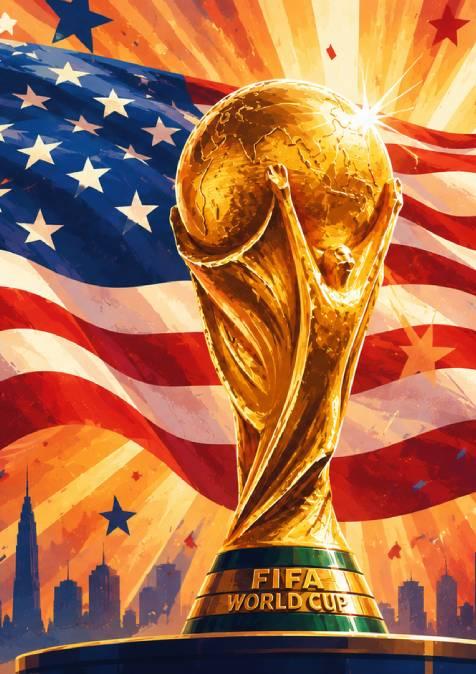
It is a golden object—shining, impressive, 36.8 centimeters tall, crafted from 18-carat gold and bronze. A replica of a monumental four-meter-high work of art standing in Geneva’s Ariana Park, near the United Nations Office, it bears the title Reflections and Dreams, created by Azerbaijani artists Salhab Mammadov and Ali Ibadullayev. Hands rise from the earth, supporting a globe, reaching toward eternity.
This replica has now become part of football history. FIFA President Gianni Infantino presented it to Donald Trump as a special “FIFA Peace Prize” on December 5, 2025 ; the day the football world learned the draw for the 2026 FIFA World Cup and the identity of the opponents awaiting the 48 qualified teams. Ahead lies an unprecedented tournament: 104 matches played over 39 days, the largest World Cup ever staged. A gigantic event, historic in scale, opening in Mexico City on June 11 and concluding on July 19 at MetLife Stadium on the East Coast of the United States. There, the most exclusive grandstand seats are already changing hands for between 40,000 and 50,000 U.S. dollars per person. No typo, no mistake. A gin and tonic or a glass of champagne is included, promise.
The MetLife Stadium clash between Brazil and Morocco on June 13, one of the marquee matches of the group stage, commands ticket prices reaching $4,195. Corporate and “Luxury Field-Level Hospitality” packages marketed by FIFA as “Ultra Premium” are offered for $32,970. The journey from Manhattan to the stadium and back is almost an afterthought by comparison—a mere $150. The United States–Paraguay match in Inglewood, California, on June 12 offers hospitality packages starting at $6,050. Semi-final tickets in Arlington, Texas, on July 14 are advertised at $14,000, while seats for the Atlanta semi-final a day later are available for $9,660.
In other words, this football spectacle is no longer opium for the masses. It resembles an athletic opera for Wall Street tycoons, corporate executives, and industrialists arriving on private jets from Rome, Dubai, or São Paulo. There will be little dancing in the streets of Atlanta or Inglewood. Immigration enforcement agencies, the masked symbols of state authority, remain on high alert around the eleven U.S. venues hosting the tournament.
The captain of the winning team ; why not Morocco? ; may lift football's most coveted trophy, yet he will take home only a gilded replica. Donald Trump received similar treatment. According to reporting by The New York Times (May 5, 2026), the White House suggested modifications to the trophy prepared for him, reflecting the President's preference for scale. His award, advisers reportedly argued, should be at least as large as the World Cup trophy itself. Trump advisers had initially requested that a detachment of U.S. Marines flank the President during the group-stage draw at the Kennedy Center and assist in presenting the trophy. FIFA allegedly rejected the proposal, unwilling to militarize an event dedicated to peace and football's supposedly universal values.
But does football truly unite the world, or does it merely provide a stage upon which nations project pride, ambition, and dreams of grandeur, each goal serving as a small declaration of national significance?
The U.S. President, who claimed during his second term to have ended six, seven, perhaps even eight wars and to have saved "tens of millions of lives," considered the Infantino-inspired award "one of the greatest honors of my life." The FIFA President, who relocated with his family and more than one hundred planners, programmers, and advisers from FIFA headquarters in Zurich to Miami in preparation for the tournament, embellished the ceremony further with a heavy gold medal that Trump could wear around his neck.
"What is the FIFA Peace Prize and why did Donald Trump win it?" CNN's Ben Church (article of December 5, 2025). Infantino appeared to have little difficulty identifying a recipient. There were no visible competitors, no public nomination process, and no jury deliberations. Trump, after all, had promised voters that he would end the war in Ukraine within twenty-four hours of his election and had simultaneously threatened to bomb Iran should the Islamic Republic continue pursuing nuclear weapons capabilities.
Several human-rights organizations expressed concern. CNN reported that critics feared Infantino was sacrificing political neutrality in favor of proximity to power. Minky Worden, Director of Global Initiatives at Human Rights Watch, stated that her organization had contacted FIFA seeking clarification regarding the selection process. No answer was received.
"There is no process," Worden argued. "There are no other nominees. There was no judging."
Nick McGeehan of FairSquare was equally critical, arguing that Infantino's decision to align FIFA so closely with Trump's political project might make short-term commercial sense but risked damaging the credibility and reputation of the sport itself. [1]
Barely two months after receiving the tailor-made Peace Prize, Trump aligned with Israel in military action against Iran. Thousands of targets were reportedly struck. At the same time, his administration intensified efforts to deport migrants residing illegally in the United States. While Trump has not directly sabotaged the World Cup, his rhetoric and policies have dampened some of the enthusiasm surrounding the tournament. The image of masked immigration agents detaining supporters near stadiums has alarmed local authorities, particularly in cities governed by Democratic administrations. Trump's repeated threats to deploy National Guard units and federal forces to "unsafe" cities have only reinforced those concerns.
The administration has declared the United States off-limits to citizens from several countries, including Eritrea, Laos, Yemen, and Somalia. Two nations that qualified for the World Cup—Iran and Haiti—have faced particularly stringent restrictions affecting supporters hoping to travel to the tournament. Additional measures have been discussed regarding Senegal and Côte d'Ivoire.
"I really don't believe it is appropriate for them to be here, for their own life and safety," Trump reportedly said regarding Iran.
Iran's Sports Minister, Ahmed Donyamali, expressed similar reservations, arguing that the national team could not reasonably participate in a tournament hosted by a country he accused of supporting attacks against Iranian leadership.
Questions surrounding Iran's participation have persisted ever since military operations involving the United States and Israel began. Yet by mid-May, the Iranian national team had established an early training camp in Antalya, Turkey, while still awaiting visa decisions.
Iran qualified for the World Cup after a 2-2 draw against Uzbekistan and was drawn into Group G alongside Belgium, New Zealand, and Egypt. The team's match against Egypt is scheduled to take place in Seattle, Washington.
Replace Iran with Italy?
Should the Trump administration attempt to exclude Iran from the tournament, FIFA would retain the authority under Article 6 of the 2026 World Cup regulations to designate a replacement, regardless of qualification results.
Paolo Zampolli, a longtime Trump associate who famously introduced the New York real-estate developer to his future wife Melania more than two decades ago, reportedly suggested that FIFA replace Iran with Italy—a four-time World Cup champion that failed to qualify after losing a decisive match against Bosnia and Herzegovina.
Trump appeared largely indifferent to the debate. "I couldn't care less whether they were ready to play or not," he reportedly remarked.
Iran's embassy in Mexico City attempted to persuade FIFA to schedule all Iranian group-stage matches in Mexico rather than the United States. According to The Athletic, those requests were rejected.
Los Angeles may nevertheless feel like a home match. Thousands—perhaps tens of thousands—of Iranian expatriates have settled in Southern California since the 1979 Islamic Revolution. Persian restaurants line streets near UCLA, serving familiar dishes and preserving memories of another Iran.
For many members of the diaspora, "Iran" remains their team, carrying the glory of the past and the hope of a different future. Spectators are prohibited from displaying certain pre-Islamic flags featuring the lion and sun, symbols embraced by many exiles. Yet football allows dreams to survive. Flags wave. Memories return. Hope competes with disappointment.
The enthusiasm generated by the World Cup has not entirely captured the American mood. The United States celebrates its 250th anniversary this year, and a July 4 match in Philadelphia is intended to symbolize the American dream. Yet war, inflation, political polarization, and immigration disputes have tempered the festive atmosphere.
A headline in The Telegraph on May 15, 2026 posed a provocative question: "Is the FIFA World Cup Going to Be a Washout?"
Data cited from aviation analyst Cirium suggested that advance bookings for July were down roughly 14 percent compared with the previous year—hardly the indicator one would expect before one of the world's largest sporting events.
For FIFA, for Infantino, and perhaps even for Trump, that may be the most troubling statistic of all.
[1]. https://www.rnz.co.nz/news/top/581069/what-is-the-fifa-peace-prize-and-why-did-donald-trump-win