Publications /
Policy Brief

On January 27, 2026, the Spanish government adopted a Royal Decree for the extraordinary regularization of persons in an irregular administrative situation or involved in an international protection procedure. The choice of a royal decree allows for the rapid implementation of the measure, without the need for parliamentary debate, in a political context that is highly polarized on migration issues.
Regularization applies to people who can prove their presence on Spanish territory before December 31, 2025, with a minimum requirement of five months' effective residence, or those who have applied for international protection before this date. The absence of a criminal record is a central condition of eligibility. According to government estimates, up to 500,000 people could be affected by this scheme.
Entry into force is scheduled for spring 2026, with an application period spread over several months. Legally, the measure falls within the Spanish national framework, and does not as such automatically modify rights of movement within the Schengen area, which remain governed by European law applicable to third-country nationals. The decision does, however, raise the question of its indirect implications for the Schengen area, both in terms of mobility management and political debates on solidarity and migration governance at European level.
Introduction
In a European context marked by a general tightening of migration policies, the decision adopted by the Spanish government has attracted particular attention. While many EU member states favor approaches focused on border control, accelerating returns and outsourcing migration management, Spain has chosen to use an instrument rarely mobilized on such a scale for over a decade. This choice immediately gave rise to contrasting interpretations, oscillating between humanitarian interpretations, security criticisms and suspicions of political opportunism.
In fact, the singularity of the Spanish decision lies as much in its scope as in its timing. Taking place against a backdrop of economic recovery and demographic recomposition, the 2026 regularization comes at a time when tensions on the labor market coexist with an improvement in macroeconomic indicators. It is also taking place in a European institutional environment marked by persistent debates on solidarity between Member States, the division of responsibilities and the capacity of common frameworks to absorb differentiated national approaches.
This Policy Brief therefore proposes an analytical reading of the measure, based on an examination of its legal, economic and demographic foundations. The aim is to understand the rationales that led the Spanish authorities to mobilize this instrument, as well as the potential implications of this choice on a national and European scale.
The analysis is structured on several complementary levels. First, it reviews the legal and procedural features of the decree adopted in January 2026, before examining the links between regularization, the functioning of the labor market and long-term demographic constraints. It then examines the European resonance of the measure, as well as the difficulties of its implementation, and finally places the initiative in the longer history of regularization campaigns in Spain since the democratic transition.
In this sense, the present paper views the regularization of 2026 as a choice of governance set within structural constraints. It aims to assess the measure in terms of its dynamics and limits, in a European context characterized by growing interdependence between migration policies.
FACTUAL AND LEGAL BENCHMARKS FOR THE 2026 REGULARIZATION.
The regularization measure adopted by the Spanish government on January 27, 2026 is based on the adoption of a royal decree (real decreto), a legal instrument within the regulatory power of the executive. Under Spanish constitutional law, recourse to this type of act enables the rapid entry into force of the provisions adopted, without prior passage through parliament, as long as the measure is justified by considerations of urgency or general interest. In the context of migration, this procedure has already been used in the past to respond to situations characterized by a structural mismatch between the reality of migratory flows, the needs of the labor market and existing legal frameworks (Gobierno de España, 2026).
The decree establishes an extraordinary and temporary regularization system, designed as a one-off measure limited in time. It is aimed at people in an irregular administrative situation, as well as some applicants for international protection, provided their presence on Spanish territory predates December 31, 2025. The text sets a minimum threshold of five months' effective residence and also includes people who applied for asylum before the reference date. The absence of a criminal record is a central criterion, reflecting an explicit desire to maintain a clear distinction between administrative regularization and criminal tolerance (BOE 2026).
In operational terms, the decree calls for the scheme to come into force in spring 2026, with a time-limited application period. The processing of applications will be entrusted to the relevant immigration and social security authorities, giving the measure a scope that goes beyond the sole field of residence, to include a logic of socio-economic formalization. Estimates put forward by the Spanish government put the number of potential beneficiaries at up to 500,000, a figure which will depend very much on the ability of those concerned to produce the required documentation, particularly in terms of proof of residence.
From a legal point of view, regularization falls strictly within the framework of Spanish national law, and as such does not automatically modify the regime for movement within the Schengen area. Consequently, residence rights remain governed by European provisions applicable to third-country nationals. However, because of its scope and the volume of legal statuses it is likely to produce, the measure raises questions about its indirect effects on the management of mobility within this area. As such, it provides a relevant entry point for examining the interactions between national decisions and European dynamics in terms of migration governance.
REGULARIZATION AS AN INSTRUMENT OF LABOR MARKET GOVERNANCE.
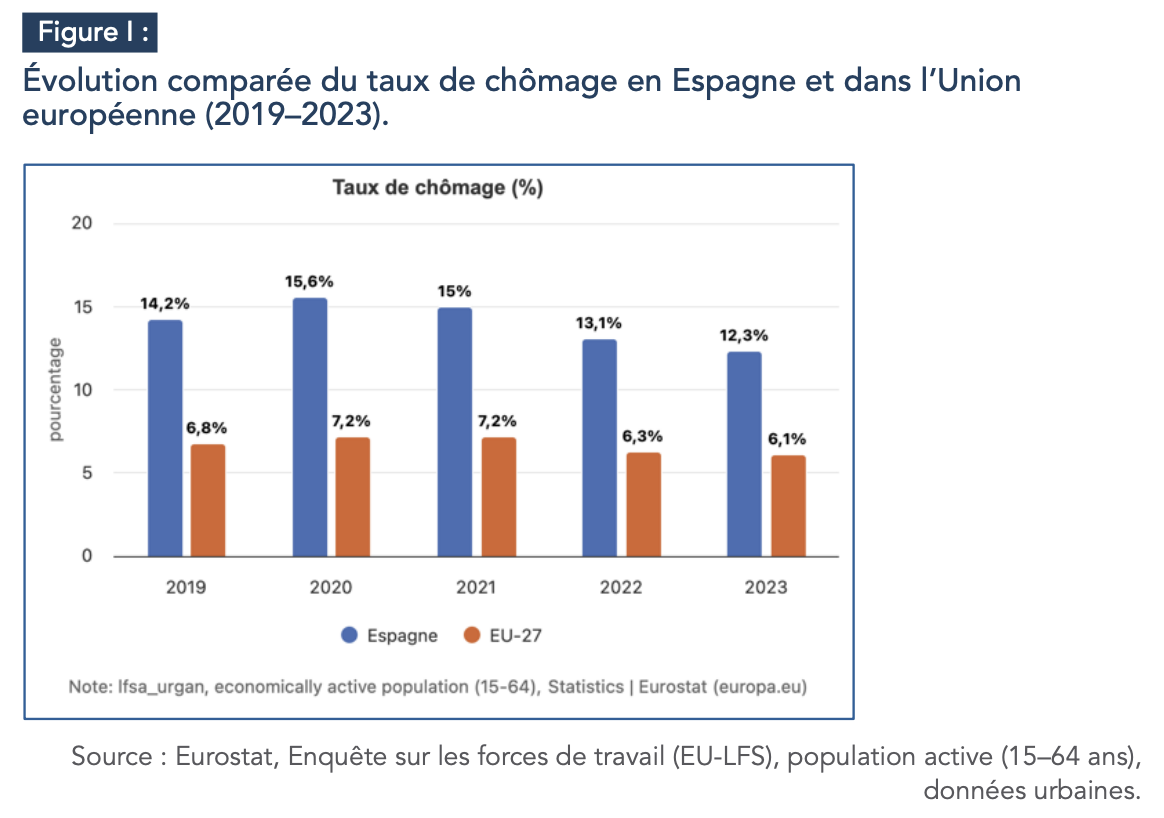
It is essential to place the regularization decision adopted in the country's economic context, marked by a sustained improvement in the labor market, despite its persistent structural imbalances. In fact, by the end of 2025, Spain's unemployment rate had fallen below 10%, reaching a level not seen since the 2008 financial crisis, while the number of people in work exceeded 22 million. This dynamic reflects a more favourable job creation phase than that observed over the previous decade, and supports the idea that the Spanish economy is in a greater capacity to absorb labour, including foreign labour (Eurostat 2026).
However, this aggregate improvement masks lasting tensions in certain sectors of the economy, which have historically relied on a weakly protected and partially regulated workforce. In these segments, the presence of migrant workers with irregular administrative status is a structural element, predating the 2026 decision. Regularization thus appears less as a lever for transforming the labor market than as an adjustment mechanism designed to reduce the gap between existing economic practices and the legal framework in which they operate.
The graph below puts this improvement into perspective by comparing the evolution of the unemployment rate in Spain with that observed in the European Union between 2019 and 2023. It illustrates both the gradual decline in unemployment in Spain since 2021 and the maintenance of a structural differential with the European average, underlining both the cyclically favorable and structurally constrained nature of the Spanish labor market.
The logic of compliance plays a central role in the discourse of the Spanish authorities. By integrating regularized people into official employment and social security systems, the measure aims to strengthen the financial sustainability of the social system, while limiting the situations of vulnerability associated with informality. Available evaluations of previous regularizations in Spain indicate that these schemes have contributed to an increase in social security affiliations and an improvement in declared working conditions, without causing any significant macroeconomic imbalance (International Labour Organization (ILO) 2015; Eurofound, 2005).
From this perspective, regularization can be interpreted as a pragmatically rational instrument of labor market governance. It is based on the assumption that formalizing workers who are already present and de facto integrated into the economy helps consolidate essential sectors, rather than acting as a pull factor for new migratory flows. This reading is consistent with some of the economic and migration literature, which stresses that migration trajectories are primarily shaped by economic structures, community networks and employment opportunities, rather than by one-off administrative measures (OECD 2025; Migration Policy Institute 2023). However, the effectiveness of this approach will depend on its ability to be articulated around sustainable policies to combat informality and improve working conditions. Failing this, regularization risks producing effects that are limited in time, without calling into question the economic mechanisms that favor the use of a legally and socially vulnerable workforce.
The decision thus opens up a privileged field of analysis for assessing the interactions between migration policy, labor regulation and social cohesion in the contemporary Spanish economy.
WHEN DEMOGRAPHIC CONSTRAINTS RECONFIGURE MIGRATION CHOICES.
Beyond the economic imperative, the 2026 regulation cannot be fully understood without placing it in the context of the profound demographic transformations that have been affecting the country for over a decade. Today, Spain is one of the European countries facing one of the most rapid ageing processes, combining a sustained decline in fertility, longer life expectancy and a gradual contraction in the working-age population. According to European Commission projections, the old-age dependency ratio is set to rise significantly by 2050, putting increasing pressure on pension, healthcare and social protection systems (European Commission 2024).
Against this backdrop, migration is gradually being incorporated into the Spanish public and institutional debate as a structural adjustment factor, and no longer merely as a cyclical phenomenon to be contained. The authorities' discourse increasingly emphasizes the need to ensure partial renewal of the working population in order to preserve macroeconomic equilibrium and the financial sustainability of the welfare state. This shift is all the more pronounced given that the recent economic recovery has been accompanied by an increased demand for labor in sectors where the national population is no longer sufficient to meet demand (Eurostat 2026).
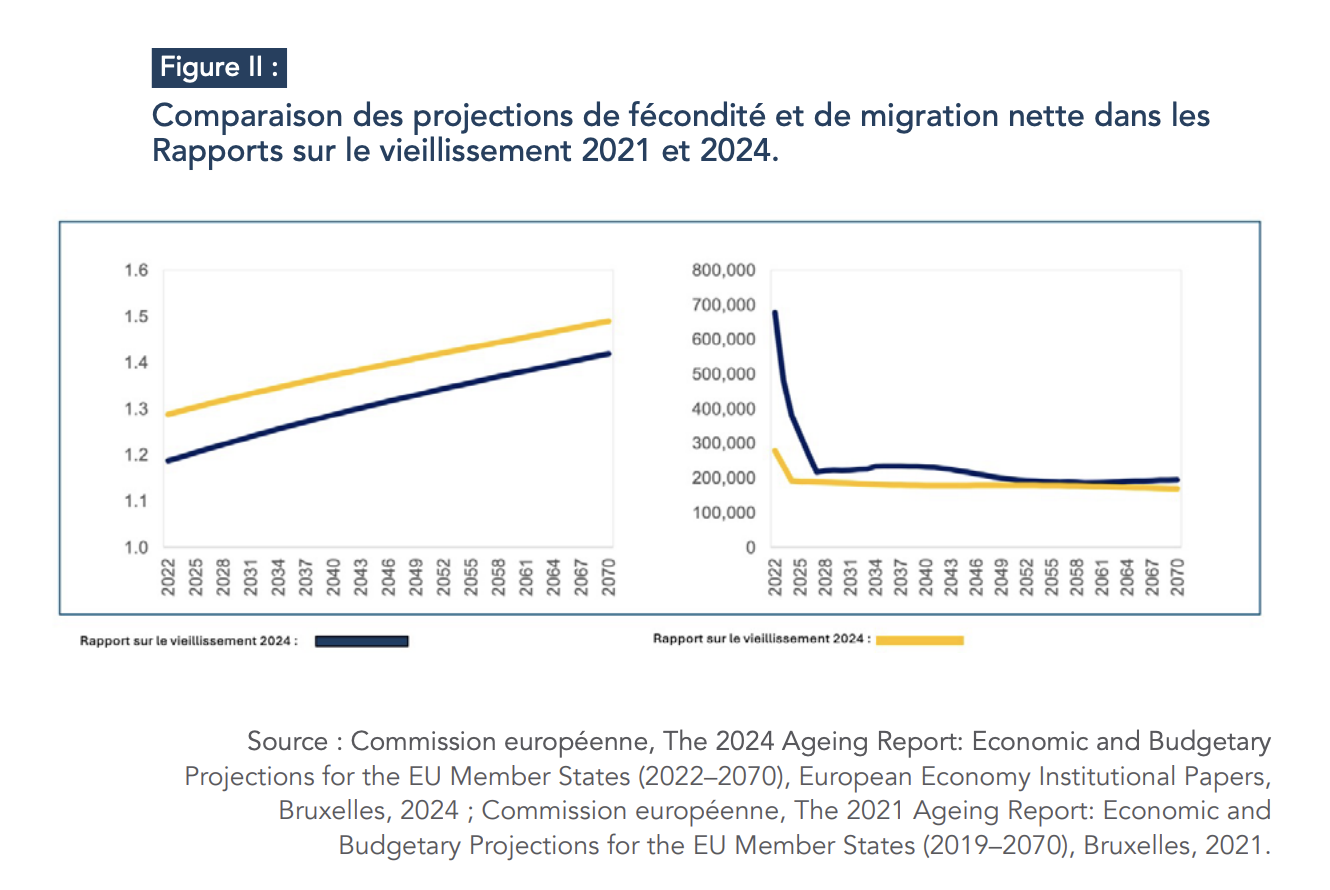
The latest European demographic projections confirm the growing role of migration in the long-term demographic balance. The 2024 edition of the European Commission's Ageing Report anticipates significantly higher net migration than in the 2021 projections, contributing an additional 2.3 million people to the European population in 2070. While this revision does not reverse the aging trend, it does partially mitigate its effects in the medium term.
The regularization of 2026 is therefore part of this long-term demographic analysis. It aims to transform a migratory presence already established in the territory into a legally-recognized active population, fully integrated into the mechanisms of fiscal and social contribution. The challenge is not so much to increase the number of immigrants as to stabilize existing professional and residential trajectories, in a context where administrative exclusion undermines the tax-paying capacity of certain categories of workers. In this sense, regularization appears to be an instrument for consolidating the social model, by seeking to broaden the base of contributors rather than increasing the burden on solidarity schemes.
However, history underlines that the demographic and budgetary impact of regularization policies is closely linked to their articulation with sustainable integration policies, such as effective access to formal employment and the reduction of precarious situations. Failing this, regularization risks remaining confined to a one-off administrative response, with no lasting impact on underlying demographic trends (OECD 2025).
A NATIONAL DECISION WITH EUROPEAN RESONANCE.
Although adopted within a strictly national framework, the regularization of 2026 cannot be analyzed in isolation from its resonances on a European scale. The measure comes at a time when migration policies are one of the main points of tension within the European Union, particularly with regard to solidarity between member states, external border management and return mechanisms. As such, any major national decision taken by a state at the heart of the Schengen area is likely to fuel debates that extend far beyond its immediate legal perimeter.
In terms of positive law, regularization does not automatically entail any change in the rules governing movement within the Schengen area. Regularized immigrants acquire the right to live and work in Spain, while their travel to other member states remains governed by European provisions applicable to third-country nationals. This legal distinction is essential, as it reminds us that regularization does not create a new right to intra-European mobility, contrary to what certain political or media interpretations suggest.
However, the absence of a direct legal effect does not rule out indirect implications. By conferring legal status on a significant number of people previously in an irregular situation, the measure modifies the conditions of visibility and traceability of existing mobility. It can thus contribute to better administrative knowledge of migratory trajectories, while reducing certain forms of vulnerability associated with irregularity, particularly in the field of employment and access to rights. These developments are likely to have different effects depending on the region and the profile of the people concerned, without calling into question the fundamental principles of Schengen.
In political terms, Spain's regularization decision runs counter to the dominant trends observed in several member states, where migration debates are largely structured around the reinforcement of controls, the externalization of borders and the acceleration of return procedures. In this sense, the 2026 decision helps to raise a recurring question at European level, that of the place of regularization policies in the arsenal of migration governance instruments. It calls into question the European Union's ability to articulate differentiated national approaches around a common framework based on shared responsibility.
Finally, the Spanish measure is likely to be used as a benchmark, by both its supporters and detractors, in future European debates. For some, it can be presented as an illustration of a pragmatic approach reconciling integration and orderly migration management. For others, it fuels fears of precedent-setting effects in a political context marked by growing polarization. At this stage, these interpretations have more to do with politics than with empirical analysis, which underlines the need for careful monitoring of the concrete effects of regularization on mobility and European balances.
IMPLEMENTATION CONSTRAINTS AND STRUCTURAL LIMITS OF THE MEASURE.
While the regularization of 2026 is based on a relatively clear legal framework, its actual scope will depend very much on the conditions under which it is implemented administratively. Previous regularization campaigns in Spain have shown that the sheer scale of the system, combined with limited filing deadlines, can quickly put a strain on the capacities of the relevant administrations. The simultaneous processing of many applications raises issues of deadlines, harmonization of practices and legal certainty, particularly when procedures mobilize several administrative levels (Eurofound 2005; ILO 2015).
The issue of proof of residence is a key point of weakness. The system relies on the ability of those concerned to document an actual presence on the territory before the reference date set by the Royal Decree.
However, for some migrants are involved in informal employment or housing schemes, and it can be difficult to produce formal proof of this. This discrepancy between administrative requirements and social realities risks introducing selection effects, effectively excluding the most precarious profiles, without this exclusion being the result of an explicit political choice (El País, 2026).
Beyond access to status, regularization does not guarantee lasting socio-economic integration. Obtaining a residence permit is a necessary but not sufficient condition for access to stable employment, decent housing and public services. In a context marked by persistent housing tensions and significant territorial disparities in terms of social services, the effects of regularization will largely depend on local absorption capacities and the complementary policies implemented by the autonomous communities. In the absence of appropriate support, there is a risk that regularization will result in incomplete formalization trajectories, leaving forms of economic and social vulnerability to persist.
Finally, the very temporality of the measure constitutes a structural limitation. As an extraordinary, one-off measure, the regularization of 2026 does not, on its own, address the economic and institutional mechanisms that fuel the reproduction of irregularity. Comparative analyses show that, in the absence of structural reforms of the labor market and channels of access to residency, the positive effects of regularizations tend to erode over time, paving the way for new situations of irregularity (OECD 2025; Migration Policy Institute 2023). So, while these constraints do not invalidate the logic of the measure, they do limit its scope. They also, and above all, invite us to consider the regularization of 2026 as one instrument among others in a broader strategy of migration governance. Analysis of the results will therefore have to focus as much on the methods of implementation as on the actual trajectories of those regularized, in order to assess the effects beyond the initial political announcement.
HISTORICAL CONTINUITY IN THE USE OF REGULARIZATIONS IN SPAIN.
The announced regularization is in fact part of a longer historical trajectory, marked by the recurrent use of regularization measures as instruments for managing misalignments between legal frameworks, migration dynamics and economic needs. Since the democratic transition, Spain has implemented several regularization campaigns, under governments of different political orientations, which testifies to a certain transversality of this tool in the arsenal of public migration policies.
In this sense, the 2005 campaign remains the most frequently cited reference in contemporary debates. Set against a backdrop of strong economic growth and increased demand for labor, it led to the regularization of almost 580,000 people. Available evaluations indicate that it led to a substantial increase in social security enrolments and a measurable improvement in declared employment conditions for a significant proportion of beneficiaries. These effects were particularly visible in the short and medium term, especially in sectors characterized by structural recourse to migrant labor (Eurofound 2005; International Labour Organization 2015).
However, retrospective analyses also highlight the limits of these measures when they are not part of a broader strategy of structural reform. The absence of regular channels of access to residence and work, combined with the persistence of highly informalized economic segments, encouraged the emergence of new situations of irregularity in the years following the 2005 regularizations. These dynamics have led some of the literature to consider regularizations not as definitive solutions, but as corrective mechanisms intervening a posteriori to resolve imbalances already in place (Finotelli and Arango 2011; OECD 2025).
From this perspective, the regularization of 2026 appears less as a break with the past than as a reactivation of a tried-and-tested instrument, mobilized in a different economic and demographic context but faced with comparable structural constraints. The continuity lies in the use of regularization to formalize a migrant presence that already existed and was de facto integrated into the economy. The difference lies rather in the European context in which this measure has been adopted, marked by an increased politicization of migration issues and a reduced collective room for maneuver in terms of integration policies.
Recalling this historical trajectory thus invites a nuanced reading of the Spanish decision of 2026. It suggests that the assessment of the measure cannot be limited to its immediate effects but must focus on its capacity to fit into sustainable policies of labor market regulation, social integration and orderly migration management. In this sense, the regularization of 2026 is both an object of analysis in its own right and an indicator of the persistent tensions structuring Spanish and European migration governance.
Conclusion
The extraordinary regularization adopted by the Spanish government in January 2026 should not be seen as an isolated break, nor as a legal anomaly in the European landscape. It is part of an accepted historical continuity, marked by periodic recourse to regularizations as corrective instruments in the face of persistent discrepancies between migration dynamics, labor market functioning and existing normative frameworks. A retrospective examination of campaigns carried out since Spain's democratic transition highlights the recurrence of this tool, mobilized in different economic contexts but faced with comparable structural constraints.
The analysis in this Policy Brief shows that the 2026 decision is based on an essentially pragmatic rationale. By seeking to formalize a migrant population already present and de facto integrated into the economy, regularization aims less to curb migratory flows than to stabilize existing trajectories and reinforce the sustainability of the Spanish social model. This logic is set against a backdrop of demographic ageing, economic recovery and the need to broaden the contributory base of the social protection system, while reducing the grey areas of informality.
However, the scope of the measure cannot be assessed in isolation from the conditions under which it is implemented, and its articulation with broader structural policies. Previous experiences show that regularizations, when not accompanied by sustainable reforms in labor market regulation, access to residency and social integration, tend to produce limited effects over time.
The 2026 decision is therefore a one-off lever whose effectiveness will depend on the State's ability to make this instrument part of a coherent migration governance strategy.
From a European perspective, Spain's regularization comes at a time when migration debates are becoming increasingly polarized. Without directly modifying the rules of movement within the Schengen area, it is helping to revive a wider discussion on the instruments available to reconcile the orderly management of migration, respect for rights and socio-economic imperatives. It highlights the persistent tensions between differentiated national approaches and common European frameworks, in an area characterized by growing interdependence between public policies.
Ultimately, the regularization of 2026 appears less as an exhaustive solution than as a revelation of the limits and trade-offs that structure contemporary migration policies. Its medium- and long-term evaluation should focus not only on the number of statuses granted, but above all on the actual trajectories of those regularized, and on the capacity of institutions to transform this administrative adjustment into a sustainable lever for social and economic cohesion.
Bibliography
Boletín Oficial del Estado. 2026. Disposición 2142 del BOE núm. 27 de 2026, por la que se establece un proceso de regularización extraordinaria. Madrid.
Commission européenne. 2024. The 2024 Ageing Report: Economic and Budgetary Projections for the EU Member States (2022–2070). Luxembourg: Publications Office of the European Union.
Commission européenne. 2024. 2024 Ageing Report – Country fiche: Spain. Luxembourg.
Commission européenne. 2024. State of Schengen Report 2024. Luxembourg.
Council of Europe, Parliamentary Assembly. 2007. Regularisation programmes for irregular migrants. Working document.
Eurofound. 2005. The regularisation of immigrants in Spain. Dublin.
Eurostat. 2026. Labour market statistics and unemployment data, Spain. Luxembourg.
Finotelli, Claudia, et Joaquín Arango. 2011. “Regularisation of unauthorised immigrants in Italy and Spain: Determinants and effects.” Documents d’Anàlisi Geogràfica 57 (3).
Government of Spain. 2026. Council of Ministers press conference, 27 January 2026. Madrid: La Moncloa.
Instituto Nacional de Estadística. 2026. Encuesta de Población Activa (EPA), cuarto trimestre 2025. Madrid.
International Labour Organization. 2015. Spain’s 2005 regularisation programme. Geneva.
Migration Policy Institute. 2005. Regularizing immigrants in Spain: A new approach. Washington, DC.
OECD. 2025. International Migration Outlook 2025. Paris: OECD Publishing.
PICUM. 2025. The impact of regularisation measures on people, institutions and wider society. Brussels.
Union européenne. 2016 (version consolidée 2024). Règlement (UE) 2016/399 établissant un code de l’Union relatif au régime de franchissement des frontières par les personnes (Codefrontières Schengen).
- Financial Times. 2026. “Spain’s unemployment rate falls to lowest level since 2008.” 27 January.
- Reuters. 2026. “Spain’s job creation brings unemployment rate to lowest level since 2008.” 27 January.
- The Guardian. 2026. Jones, Sam, et Ashifa Kassam. “Spain approves decree to regularise half a million undocumented migrants.” 27 January.
- The Guardian. 2026. Jones, Sam. “Spanish PM defends plans to regularise half a million undocumented migrants.”