Publications /
Policy Paper

Back
The European Neighbourhood Policy: A Bureaucratic Phoenix?
Authors
Vivien PERTUSOT
November 25, 2016

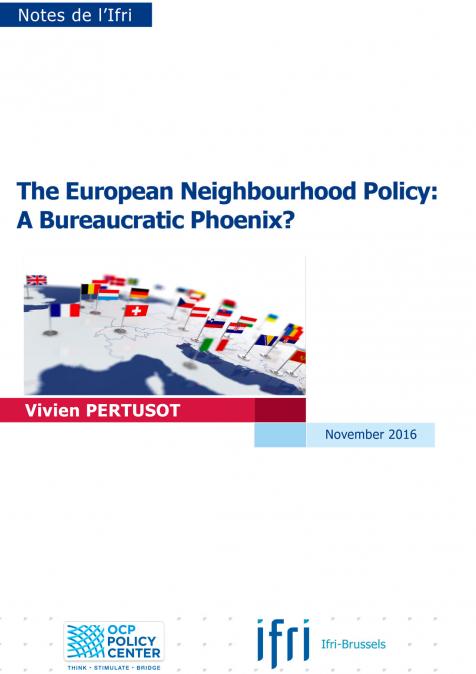
The European Neighbourhood Policy (ENP) was initiated in 2003 with regional variations in the south with the Union for the Mediterranean since 2008, and in the east, with the Eastern Partnership since 2009. The aim of bringing together countries as diverse as Egypt and Armenia under the same heading seems bold. The bureaucratic advantage in having a single framework is obviously understandable, but the political relevance is less so. However, the geopolitical unrest in the east and the south have created many uncertainties, both in terms of security and the European Union’s ability to be an influential and leading actor. Hence, the revision of the ENP in November 2015 and the publication of the EU’s Global Strategy in June 2016 to try to refocus European priorities.

They are based around three principles: selectivity, stability, and resilience. First of all, selectivity allows for a greater differentiation in the treatment of partners, particularly according to the willingness of these countries to co-operate with the EU. Then, stability takes on centrality in face of support for democracy; European security concerns have become a priority. Finally, resilience reinforces the idea that stability and security are fundamental principles of the ENP, although this concept remains fairly vague and difficult to export.

Gradually, the ENP is becoming a toolbox. The EU knows, rightly, that it cannot hope to transform all its neighbourhood, either at the same rate, or towards the same horizons. This is why the ENP needs to be based on a clear political framework so that its tools and its relations are governed by guiding principles. The Global Strategy can provide such a framework. The European institutions and Member States must ensure that there is coherence of action. It is all the more important as the ENP has suffered from its technocratic nature for a long time, which disconnected it from the broader foreign policy objectives. Nowadays, there is an opportunity to correct this design fault and to put the ENP at the service of the EU's foreign policy and make it more relevant in the eyes of Member States, who may then invest in it further.

RELATED CONTENT

  • Authors
    August 6, 2026
    With America's 250th anniversary, there will be many analyses of the country's history from domestic and international perspectives. But the meaning of the American story should also be assessed in key regional settings, from Asia to Latin America, and in transatlantic terms. In this vein, it is worth exploring the U.S. engagement in and with the Mediterranean world, one of the first places of U.S. international activism, and a setting where diverse aspects of U.S. foreign policy ha ...
  • August 3, 2026
    This policy paper explores how China’s economic development model—rooted in pragmatism, long-term planning, and civilizational renewal—has become its most compelling soft power asset, particularly in the eyes of the Global South. While critically engaging with Joseph Nye’s original conception of soft power as a primarily cultural and normative force, the paper argues that China’s ability to transform itself from an impoverished postimperial state into the world’s largest trading nat ...
  • Authors
    July 27, 2026
    Is Europe Prepared for War?European public opinion is moving from treating a major conflict as unthinkable to regarding it as a possibility for which governments must prepare. Attention is increasingly focused on Russian hybrid operations, vulnerabilities in critical infrastructure and the risk of fragmentation within NATO. European defence policy is consequently undergoing a rapid transition from post-Cold War complacency towards preparations for high-intensity warfare. Recent ...
  • Authors
    Fadoua Ammari
    July 27, 2026
    Cet article évalue la pertinence du paradigme de la réconciliation pour analyser la rivalité maroco-algérienne. À partir d’une démarche qualitative, historico-interprétative et interdisciplinaire fondée sur un corpus raisonné de travaux académiques et de sources institutionnelles, il montre que cette conflictualité ne se réduit ni au différend du Sahara ni à un simple antagonisme bilatéral. Elle se construit à l’intersection de mémoires concurrentes, de mécanismes de sécuritisation, ...
  • Authors
    July 15, 2026
    We Are Watching You In April 2026, the UK Ministry of Defence revealed that it had tracked a covert Russian submarine operation apparently intended to map critical undersea cables and pipelines in the North Atlantic and the North Sea. A Russian attack submarine and two specialised intelligence vessels operated by the Main Directorate of Deep-Sea Research, commonly known as GUGI, were reportedly monitored for four weeks by the Royal Navy, including HMS St Albans and P-8 Poseidon ...
  • Authors
    July 14, 2026
    Avec la capitale Pékin comme acteur principal de la politique étrangère chinoise, l’engagement de la Chine en Afrique ne peut plus être appréhendé à travers le seul prisme de l’État central. Suite aux réformes de décentralisation engagées en 1978, les gouvernements provinciaux de l’Empire du Milieu jouent un rôle de plus en plus visible et structurant, en s’affirmant en tant qu’acteurs à part entière de la coopération internationale. Ils interviennent, entre autres domaines, dans le ...
  • July 10, 2026
    For much of the post-war period, the Global South was framed as an object of history, defined by dependency, constrained by structural asymmetries, and confined to the margins of global decision-making. That narrative, once empirically grounded, is now no longer adequate. A profound yet uneven transformation is underway. The Global South is no longer only reacting; it is increasingly shaping rules, institutions, and narratives.This Policy Brief argues that the Global South is thus t ...
  • Authors
    July 9, 2026
    Cet essai analyse la guerre Iran–États-Unis–Israël de 2026 comme un révélateur de la transformation profonde de l’ordre international. À travers le prisme du droit de la mer, du détroit d’Ormuz, des alliances fragmentées, des câbles sous-marins et des flux énergétiques, il montre que le pouvoir mondial se déplace progressivement du contrôle des territoires vers la maîtrise des infrastructures de circulation. Loin de disparaître, la mondialisation entre dans une phase de connectivité ...