Publications /
Policy Paper

Back
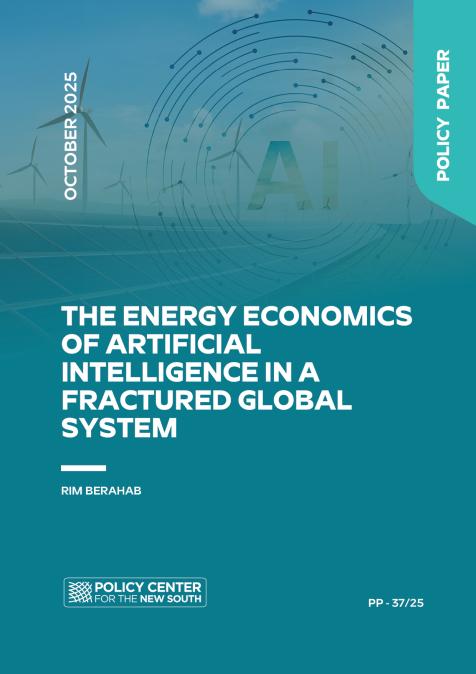
The Energy Economics of Artificial Intelligence in a Fractured Global System
Authors
October 3, 2025

Artificial intelligence (AI) is rapidly emerging as both an energy optimizer and a structural source of energy demand. While AI promises efficiency gains in forecasting, grid management, and emissions reduction, its expansion is already reshaping electricity systems: data center consumption could more than double by 2030. Beyond this techno-economic duality lies a deeper challenge: the sovereignty of digital and energy systems. AI rests on highly concentrated supply chains of chips, compute infrastructure, and critical minerals, as well as on access to abundant, low-carbon electricity. This concentration creates new dependencies and asymmetries, reinforcing the strategic control of a handful of actors. For Africa, the stakes are particularly high. The continent holds significant reserves of cobalt, manganese, rare earths, and other inputs indispensable to batteries and semiconductors, yet faces chronic electricity deficits, fragile grids, and limited compute capacity. Without deliberate investment in infrastructure, regional integration, and industrial upgrading, Africa risks remaining confined to raw-material supply while depending on foreign actors for digital infrastructure and cloud services.

RELATED CONTENT

  • May 19, 2023
    This Policy Paper was originally published on freiheit.org This study explores how Morocco can successfully develop a green hydrogen market and at the same time contribute to the global energy transition. Authors Rim Berahab and Afaf Zarkik show how Morocco’s bold strategies and investments in renewables can shape a promising future for green hydrogen. They chart a path to decipher the potential of this energy vector, while outlining the elements necessary for the emergence o ...
  • Authors
    Abdelmonim AMACHRAA
    May 17, 2023
    Nothing better illustrates the positive contribution of the integration of national economies into global value chains than the fact that in the 1990s, the automotive sector barely existed in Morocco. Now, it is the leading export sector, with a production and assembly capacity of 700,000 vehicles, making it an attractive and competitive hub linking Africa and Europe in the automotive value chain. However, the automotive industry is on the cusp of change, with advances in electric a ...
  • Authors
    April 10, 2023
    The contemporary global energy landscape is experiencing noteworthy changes in demand, supply, technology, markets, and investment. These developments transcend conventional oil and gas security considerations. Renewable energy sources, such as wind and solar power, have become increasingly cost-effective compared to fossil fuels, and the minerals required to produce them are gaining importance. Nevertheless, recent events such as the Covid-19 pandemic and the conflict in Ukraine ha ...
  • March 07, 2023
    انطلقت دول وتكتّلات جهوية كثيرة في تطوير قطاع الهيدروجين الأخضر، معتبرة إياه مورد أساسي لتلبية الطلب الدولي للطاقة في المستقبل، حيث يفرض تغير المناخ البحث عن بدائل للنفط والغاز الطبيعي وا ...
  • February 28, 2023
    انطلقت دول وتكتّلات جهوية كثيرة في تطوير قطاع الهيدروجين الأخضر، معتبرة إياه مورد أساسي لتلبية الطلب الدولي للطاقة في المستقبل، حيث يفرض تغير المناخ البحث عن بدائل للنفط والغاز الطبيعي والفحم المهيمنين حاليا ومنذ بداية العصر الصناعي على الاستهلاك العالمي للطاقة. فتم الاعلان عن استراتيجي...
  • Authors
    February 13, 2023
    The volatility in energy markets since the outbreak of the Covid-19 pandemic in 2019/2020 has continued, with unprecedented uncertainty about global energy supply developing over the course of 2022 in the wake of Russia's invasion of Ukraine, against a backdrop of weakening macroeconomic conditions and high inflation. While some perceived this as a potential setback for the energy transition, others saw it as an opportunity to move away from fossil fuels and accelerate the developme ...