Publications /
Book / Report

Back
D'une bipolarisation à une autre: promesses de l'interdépendance
May 4, 2023

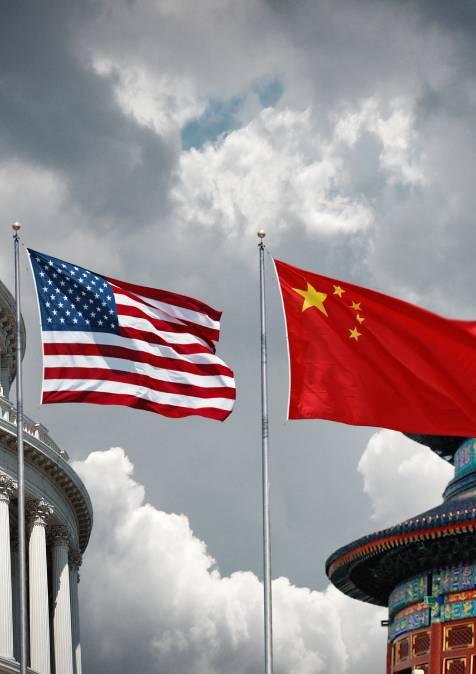
La première bipolarisation a appartenu au XX° siècle et opposé États-Unis et URSS. Avec la guerre froide, elle était l'expression de la rivalité entre deux systèmes antagonistes. La seconde est née de la montée de la Chine populaire qui est entrée en compétition avec les États-Unis. Une compétition au départ économique et technologique, devenue aussi, au fil du temps, culturelle et stratégique, dans un monde interdépendant et digitalisé, mais également segmenté, complexe et incertain.


Ce livre traite du changement de polarisation et les interrogations qu'il pose dans un monde qui se reconstruit sur de nouvelles bases. Un monde de plus en plus interdépendant porteur de promesses pour les pays émergents mais aussi d'inquiétudes légitimes pour toute l'humanité. Il se situe dans le sillage des derniers ouvrages de l'auteur : La Chine et nous (La Croisée des Chemins, 2017), La Mondialisation et nous (La Croisée des Chemins, 2020) et La Mondialisation et la pandémie: Chroniques de confinement (Policy Center for the New South, 2021).

RELATED CONTENT

  • Authors
    May 6, 2026
    Trump’s Strategy of Overriding Constitutional SafeguardsPerhaps bearing in mind that only a minority of voters in the United States support U.S. military action against Iran, President Donald Trump has called the war a “short term excursion” and a “little journey” that may be over “pretty quickly”. The war is thus not a war, although Trump has said the U.S. will take Iran “back to the stone ages, where they belong”, and the U.S. military has admitted to attacks on 14,000 Irania ...
  • Authors
    Stephan Klingebiel
    Andy Sumner
    May 4, 2026
    This Opinion was originally published on policyedge.in The weakening of global institutions creates both risk and opportunity, placing India at the center of debates on reform and renewal.The global order is not collapsing outright but is gradually hollowing out, as institutions lose normative coherence and great power contestation reshapes rules from within. This moment of transition creates both risks of fragmentation and opportunities for redesign. For India, rising economic ...
  • Authors
    February 12, 2026
    Divergent regulatory regimes for data, driven by different motivations, ranging from privacy protection in the European Union to information control in China, could eventually produce distinctively different, and possibly contradictory, bodies of data. Artificial-intelligence models trained on those datasets could produce differing and possibly even conflicting outputs. To the extent that AI outputs start to shape human perception and to influence decisions, in governments and ...
  • Authors
    February 11, 2026
    The U.S.–China technological rivalry has become a central axis of global economic and geopolitical competition. While the United States continues to lead in frontier innovation—most notably in advanced semiconductors and artificial intelligence (AI)—China has consolidated strengths in large-scale implementation, manufacturing capacity, and control over critical segments of global supply chains. These advantages are especially visible in clean energy technologies and in the processin ...
  • Authors
    December 16, 2025
    An unusual gesture indeed—the dictator, more often than not a recluse, withdrawn behind his fortress and protected by 1.2 million armed soldiers, finally admitted what had long been seen on the battlefield in Ukraine and by spy satellites far above. North Korean soldiers—possibly 12,000 of them—are fighting on front lines alongside Russian troops, and they are falling or being wounded; some 4,000 men so far, by current estimates.  ...
  • November 18, 2025
    The meeting between Donald Trump and Xi Jinping in Busan, South Korea, was more than an exercise in diplomacy. It was an emblematic performance of a world in transformation. Behind the formalities, the cameras, and the studied smiles lay an unspoken recognition: the world is no longer unipolar. The era of American supremacy, sustained for decades through its economic reach, military presence, and ideological projection, is giving way to a more diffuse, multipolar reality. ...