Publications /
Paper in Academic Journals
Back
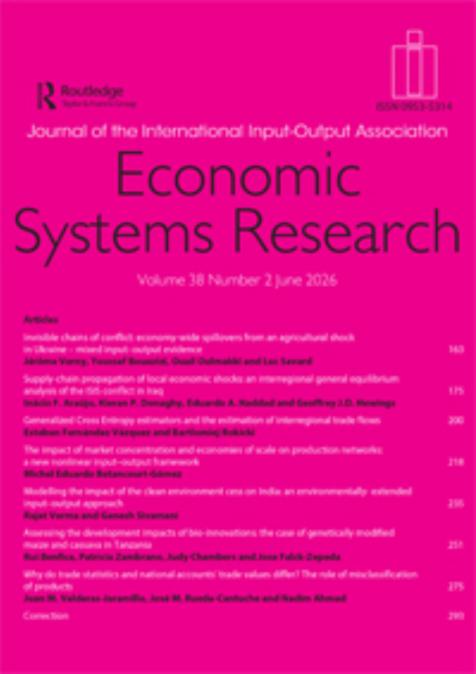
Disentangling regional economic and environmental impacts of transportation costs in Morocco: an inter-province CGE approach
May 29, 2026

This Paper was originally published on tandfonline.com


This paper examines how reductions in transportation costs reshape regional economic and environmental outcomes in Morocco. We simulate a reduction in delivered (purchasers’) costs via a transport-margin efficiency improvement – implemented as a margin-saving technical change in the transport sector – within a province-level Spatial Computable General Equilibrium (SCGE) framework. Simulating a 1% decline in transport costs, we assess the marginal impacts across regions. Results reveal uneven gains: coastal areas along the Casablanca-Tangier axis and emerging hubs like Béni Mellal-Khénifra and Dakhla-Oued Ed Dahab benefit from growth and lower emissions, while traditional centers such as Fès-Meknès and Marrakech-Safi experience stagnation and rising carbon intensity. The findings highlight a partial decoupling of economic and environmental convergence, driven by both production structure and scale effects. Our analysis stresses the importance of territorially differentiated infrastructure policies that balance spatial equity with sustainability, offering insights for place-based development and green transformation strategies.


RELATED CONTENT

  • August 28, 2023
    Le secteur informel joue un rôle crucial dans le développement économique et social du Maroc en tant que filet de sécurité pour de nombreux travailleurs. Cependant, sa concentration dans de petites entreprises qui manquent de moyens de production sophistiqués peut entraver la croissance...
  • July 18, 2023
    Le secteur informel est une composante essentielle de l'économie marocaine, employant une large partie de la population, mais nuisant à la productivité, aux recettes fiscales de l’État et à la croissance économique à long terme. Sur la base de la définition adoptée dans cette étude et qui définit les travailleurs informels comme étant ceux qui ne sont pas couverts par les régimes contributifs de sécurité sociale de la Caisse nationale de sécurité sociale (CNSS) et d ...
  • Authors
    Zakaria Elouaourti
    July 1, 2023
    This paper was originally published on erf.org.eg   The digital divide in the financial sector has occurred through the development of financial technologies. These latest “FinTech” refers to technological innovations that have emerged in the financial system in recent years, which are the new channels for providing financial services. These innovations have disrupted traditional financing models by making financial transactions more secure and by reducing spatiotemporal ...
  • Authors
    Gladys Lopez-Acevedo
    Marco Ranzani
    Nistha Sinha
    Adam Elsheikh
    June 23, 2023
    This report was originally published on openknowledge.worldbank.org The long-standing informality debate in the Middle East and North Africa (MENA) Region has taken on a new urgency as it looks for a pathway to more socially inclusive growth that is less reliant on fossil fuels. This is occurring against a backdrop of subpar labor market outcomes, further growth setbacks, and deteriorating fiscal and current account de ficits in the aftermath of the COVID-19 pandemic—and in the wak ...
  • June 13, 2023
    يعد ميثاق الاستثمار الجديد، الصادر، في دجنبر 2022، والذي تم تطبيق أول مراسيمه، في يناير المنصرم، خارطة الطريق الإستراتيجية لإعطاء نفس جديد للاستثمار بالمغرب، الذي من شأنه أن يعزز تنافسية ...
  • June 6, 2023
      يعد ميثاق الاستثمار الجديد، الصادر، في دجنبر 2022، والذي تم تطبيق أول مراسيمه، في يناير المنصرم، خارطة الطريق الإستراتيجية لإعطاء نفس جديد للاستثمار بالمغرب، الذي من شأنه أن يعزز تنافسية الاقتصاد الوطني، فضلا عن تثمين دور الفاعلين في القطاع الخاص، وكذا منظومة الإنتاج المغربية. م...
  • Authors
    Pierre Sauvé
    May 29, 2023
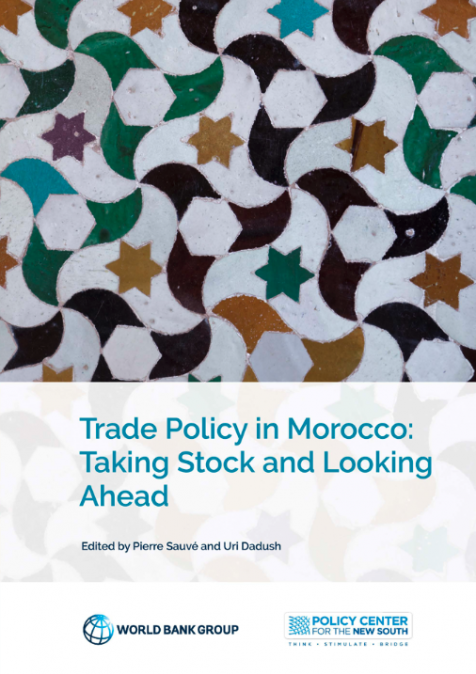
    Morocco has made important strides in reducing poverty in the last three decades, thanks in large part to trade and industrial policies aimed at durably inserting the country into world flows of goods, services, and cross-border investment. Since 1992, per capita incomes have tripled (in current US$), contributing to a threefold drop in the Kingdom’s poverty headcount. The country of 37 million features consistently as one of the better-performing and more stable economies in the No ...
  • Authors
    Inkyo Cheong
    Lillyana Daza Jaller
    Siwook Lee
    Jean-Christophe Maur
    Martin Molinuevo
    Sahar Sajjad Hussain
    Pierre Sauvé
    Shane Sela
    Aleksandar Stojanov
    Iryna Klytchnikova
    Edited by Pierre Sauvé and Uri Dadush
    May 23, 2023
    The broad thrust of Morocco’s trade and industrial policies over the last thirty years has been to anchor Morocco into world flows of goods, services, and cross-border investment. Despite the challenges posed by the COVID-19 pandemic, rising international prices, and a complex geopolitical environment, Moroccans continue to derive significant benefits from their economy’s openness. These include improved consumer choice and welfare, the growing insertion of Moroccan firms into cross ...
  • Authors
    Abdelmonim AMACHRAA
    May 17, 2023
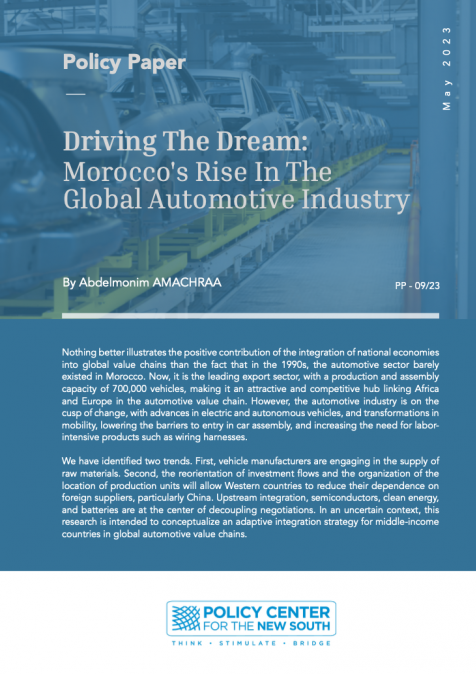
    Nothing better illustrates the positive contribution of the integration of national economies into global value chains than the fact that in the 1990s, the automotive sector barely existed in Morocco. Now, it is the leading export sector, with a production and assembly capacity of 700,000 vehicles, making it an attractive and competitive hub linking Africa and Europe in the automotive value chain. However, the automotive industry is on the cusp of change, with advances in electric a ...