Publications /
Policy Brief
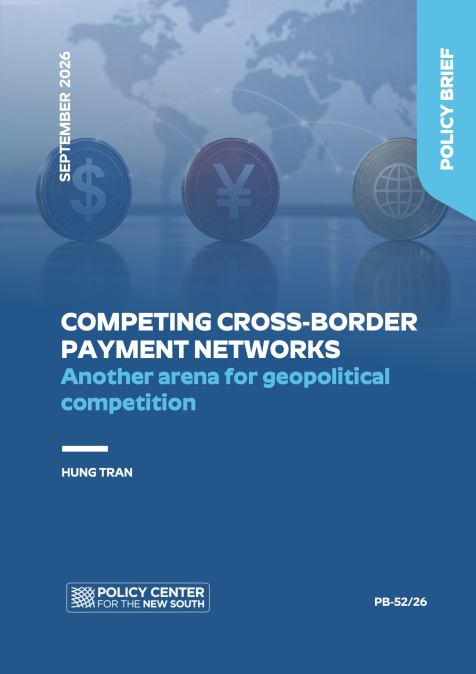
Various competing cross-border payment networks have become vehicles for geopolitical competition. As tensions have risen, many countries want to secure access to cross-border payment systems by joining with like-minded countries to form interoperable networks, either via tokenization or Instant Payment Systems (IPSs). Three major projects are under development, serving the strategic interests of the US, China and the Rest of the World—corresponding to the three trading spheres taking shape in the world trade architecture.
Cross-border payment networks have been transformed from financial infrastructures into vehicles for geopolitical competition. This process has been driven by major powers like China, Russia and others striving to enhance their economic resilience and national security by finding ways to reduce reliance on the current US dollar-based international financial and payment system. Recently, those efforts have gathered momentum as the US has increasingly used access to the dollar-based payment system (mainly via the SWIFT financial messaging network) as a statecraft tool to pursue its national strategic objectives.
Concretely, groups of neighboring or like-minded countries have collaborated on projects to test interoperable networks enabling cross-border payments among themselves, preferably using their own currencies instead of relying on the dollar. As part of this trend, China has launched its Cross-border Interbank Payment System (CIPS) and Russia its System for the Transfer of Financial Messages (SPFS)—as alternatives to SWIFT.
In response, to defend the preeminent role of the dollar, the US has taken measures to enhance its usefulness in international payment transactions and has threatened retaliation against countries active in de-dollarization attempts or trying to evade US sanctions. President Donald Trump has threatened to impose punitive tariffs on any countries attempting to undermine the dollar by promoting alternative currencies.
In addition to benefitting from the fact that the US has the largest economy and financial market in the world, specific dollar-support measures have been taken recently. These include proposed US currency swap lines with Gulf Cooperation Council countries; passage of the Genius Act to promote the use of stablecoins mostly backed by the dollar; and Treasury Secretary Scott Bessent threatening secondary sanctions on countries trading with Iran in contravention of US sanctions on that country.
Notwithstanding US efforts to deter de-dollarization, fragmentation of international payment systems is likely to proceed. In particular, payment fragmentation has been driven by countries’ search for national security and sovereignty over data and advanced technology such as artificial intelligence (AI). Regulatory divergence among major jurisdictions also contributes to the observed fragmentation, which has been enabled by advances in payment technology—such as the tokenization of money and IPSs.
In short, different and competing cross-border payment networks constitute another dimension of geopolitically driven fragmentation of the global economy—which has noticeably deepened since the Russian invasion of Ukraine in 2022. Since then, trade between geopolitically distant blocs has fallen by about 12% compared with trade within such blocs, and FDI has declined by 20% in similar comparisons.
At present, there are three important plurilateral projects, bringing together different groups of countries, pursuing different goals and following various technological approaches to cross-border payments. One (driven by China) makes use of wholesale central bank digital currencies (CBDCs); the second (driven by the US and other G7 countries) focuses on private tokenized money to modernize the current payment architecture by employing distributed ledger technology. The third (driven by Southeast Asian countries) aims to connect countries’ IPSs into interoperable networks for fast cross-border payments, largely using local currencies.
Eventually, as these projects progress and become operational, they would reinforce and institutionalize the geoeconomic fragmentation already evident in international trade and investment flows. World trade will likely continue to grow, but more slowly than it otherwise would, helping to reduce the potential growth of the global economy, with a long-term loss of up to 7% as estimated by the IMF.
This dismal prospect could be ameliorated somewhat if these payment projects are built on common standards—such as (Application Programming Interfaces) and ISO 20022 for financial messaging—so that they can be interoperable and thus avoid fragmenting the international system. The problem is that while this is technologically feasible, geopolitical contention would likely stand in the way.
The mBridge Project
The People’s Bank of China has driven the mBridge project, together with the Hong Kong Monetary Authority, the Bank of Thailand, and the central banks of the UAE and Saudi Arabia, to develop interoperability between settlement mechanisms for their wholesale Central Bank Digital Currencies (CBDCs). In 2024, the project reached the Minimum Viable Product (MVP) stage. In December 2025, the PBOC announced that the project had processed 4,000 cross-border transactions worth $55.5 billion that year, using the RMB as the routing currency for 95% of the settlement volume. This represented a big jump from 164 transactions totaling $22 million in 2022.
Since Project mBridge provides a shared blockchain ledger to clear CBDC transactions through atomic settlement, it does not involve SWIFT or intermediaries such as correspondent banks.
Given its narrow membership, Project mBridge has been viewed as a payment corridor for energy trade between China and the Middle East—the backbone of global energy trade. The project could play an important role in shielding this critical energy trade relationship from possible US sanctions. As such, it is essentially a specific defensive move, rather than one designed to compete against the dollar’s preeminent role in global finance. However, the nature of the project could change if more countries participate in it.
It is important to note that the BIS, which had been an original sponsor of the project, decided to withdraw from it in 2024, offering the official explanation that the project had progressed to the point that it no longer required BIS involvement. However, the BIS decision occurred following intense scrutiny over whether Project mBridge could facilitate the evasion of US financial sanctions. This has given rise to speculation that the BIS wanted to avoid being caught between US sanctions and countries opposed to them.
In any event, by providing participating countries with an alternative to the Western-dominated payment system, mBridge could weaken the central role of the dollar and the effectiveness of US sanctions, mainly for countries in the region. Moreover, mBridge provides international payment rails supporting China’s efforts to internationalize the Renminbi (RMB).
China’s Internationalization of the Renminbi
As an emerging geopolitical contender to the US, China has tried to internationalize the use of the RMB—especially in earnest after the West froze the Bank of Russia’s reserve assets held overseas and expelled Russian banks from the SWIFT network following Russia’s invasion of Ukraine in 2022. China has adopted a transaction-based approach to promote the internationalization of the RMB so that it can settle trade, investment, and financial cross-border activities in RMB, reducing reliance on the dollar.
Basically, China launched its Cross-border Interbank Payment System (CIPS) in 2015 to facilitate the overseas use of the RMB between Chinese and international counterparts. CIPS has attracted more than 1,700 international members (both direct and indirect) across 190 countries and territories, with daily transaction volume exceeding $180 billion—still modest in scale compared with SWIFT. Moreover, the People’s Bank of China has established bilateral currency swap lines with 40 foreign central banks, deploying an estimated $500 billion in total commitments to provide liquidity support for exchange transactions between the RMB and the local currencies of participating countries.
As a result of these developments, China has been able to settle up to 60% of its cross-border receipts and payments in RMB, basically on a bilateral basis—compared with 10% in 2017. Thus, China has progressed toward its strategic goal of reducing dependency on the dollar-based international payment system in its international financial transactions, rather than necessarily aiming to compete with the dollar’s global role. This observation seems to be borne out by the fact that global use of the RMB, especially between non-China third parties, remains much more limited. Its share of global payments has been around 3% according to SWIFT (which underestimates its true share since that metric does not capture non-SWIFT international transactions in RMB), while it accounts for 8% of global trade finance.
Project Agora
Project Agora has been led by the BIS in collaboration with the Institute of International Finance (IIF). It brings together the central banks of France (Eurosystem), England, Switzerland, Japan, Korea, the US (New York Fed) and Mexico, working with a group of 40 international banks organized by the IIF. The goal is to integrate tokenized commercial bank deposits with central bank reserves on a single, shared programmable platform, providing atomic settlement (both sides of a multi-currency transaction clear simultaneously, eliminating settlement delays and counterparty credit risk). Basically, the project will address the slow speeds, high costs and fragmented ledgers of the traditional cross-border payment system. This modernizes the incumbent payment architecture based on correspondent banking and preserves the current preeminent role of the dollar in the international financial system—by upgrading it, not replacing it.
Project Agora reached a real-value testing milestone in July 2026 when 28 financial institutions and central banks successfully completed real-value cross-border transactions worth CHF 800,000 (roughly $1 million), with settlement performed in 80 seconds on average. In addition, strict data privacy and compliance requirements were maintained.
As such, Projects mBridge and Agora can be viewed as competitors, developing opposing and non-interoperable international payment networks based on the RMB and CBDCs on the one hand, and mainly on the dollar and tokenized bank deposits and reserves, as well as stablecoins, on the other. These projects serve to promote the geopolitical interests of China and the US, respectively.
This leaves other countries that wish to remain nonaligned between the US and China looking for alternatives to develop multilateral payment networks. Project Nexus appears to fill this need—especially for retail payment transactions.
Project Nexus
Project Nexus has been coordinated by the BIS with the participation of the central banks of Singapore, Malaysia, Thailand, India and the Philippines, aiming to provide a single, multilateral hub to connect national IPSs around the world—using standardized API specifications and ISO 20022 messaging formats. In a significant development, in the past 18 months IPS transactions in BRICS’ eleven member countries have reached $10 trillion, surpassing the volume of Mastercards or Visa in their major markets—even though cross-border payment remains low. At present, on a 24/7 basis, providing cheap, fast and accessible payment services compared with traditional mechanisms—and providing a large pool of countries technologically prepared to join Nexus.
Nexus’ standardization architecture allows other countries to join by linking their IPS to the hub, becoming interoperable with all other participating members. The instant-payment nature of the network also enables accredited FX providers to provide fast and between any pair of national currencies competitively, without necessarily having to use the dollar as a vehicle currency—by minimizing (or eliminating) settlement and counterparty credit risks that would require hedging or pre-funding.
Fundamentally, Project Nexus aims to diversify international payment infrastructures, lessening dependence on the current dollar-centered correspondent banking system.
By linking its IPS to Nexus, a country can access a multilateral payment network and become interoperable with all members without the need to build up a series of bilateral connections. Importantly, Nexus explicitly removes SWIFT and the correspondent banking system from the payment pathway.
In March 2025, the five founding central banks incorporated Nexus Global Payment (NGP) as the scheme’s not-for-profit governing body, registered in Singapore. Indonesia officially joined the NGP on February 2, 2026. Importantly, NGP would facilitate the wholesale settlement of multi-currency transactions. The European Central Bank (Eurosystem/TIPS) is in discussion with a view to participating in NGP. If this materializes, NGP will connect the two major payment hubs in Asia and Europe. NGP has also signed an MOU with FLAR (the Latin American Reserve Fund) to explore future connectivity.
Basically, the progress of Nexus has made it one of the most concrete mechanisms for implementing the G20 Roadmap on Enhancing Global Cross-Border Payments, addressing problems of high costs, slow settlement times, lack of transparency and lack of access.
The basic problem the G20 Roadmap aims to tackle is that, despite progress by many countries in developing fast domestic payment systems, international payments still depend on correspondent banking networks, multiple intermediaries, different messaging standards, separate FX arrangements, different operating hours, and fragmented regulatory and compliance procedures.
Project Nexus creates a standardized multilateral bridge between domestic IPSs based on common standards for APIs and messaging, such as ISO 20022, substantially accelerating the expansion of instant cross-border payments. As such, Nexus addresses one of the three major priorities of the G20 Roadmap: payment system interoperability and extension—the other two being the harmonization of legal, regulatory and supervisory frameworks, and cross-border data exchange and privacy.
As a result, countries still need to address AML/CFT requirements, sanctions screening, FX liquidity, settlement arrangements, consumer protection, fraud, data privacy and regulatory differences. Countries need to speed up their efforts in these areas to meet the G20 Roadmap’s target date of end-2027 to have 75% of cross-border retail payments available to recipients within one hour; and to seek a global average retail payment cost below 1% of the transaction amount.
In principle, any regional cross-border payment networks or initiatives that meet the API and messaging standards can link up with Nexus. For example, Brazil, Mexico and Colombia have pursued PIX-Internacional to link Latin American IPSs based on Brazil’s PIX. India and Brazil have been working with BRICS member states to link their IPSs and CBDCs. These and other similar initiatives can be linked to Nexus to make it increasingly global.
Project Aperta
To complement Nexus, the BIS also coordinates Project Aperta with the central banks of the UK, Hong Kong, Brazil, India and the UAE, as well as other data-sharing organizations, to enable secure cross-border sharing of financial data (open finance). This would facilitate cross-border business account opening, expedite KYC/AML checks and facilitate trade-finance data flows.
The project addresses the current difficulties in moving financial data across borders because domestic frameworks use different technological standards, data formats and trust frameworks. This is increasingly important as international payment transactions have increasingly been automated on-chain.
Implications of mBridge, Agora and Nexus Projects
As these three major cross-border payment projects progress and become operational, they would change the current payment system—splintering it while also modernizing it.
Project mBridge provides the infrastructure for countries to settle international transactions using wholesale CBDCs—which have proved more popular and less controversial with central banks than retail CBDCs. Project Agora modernizes the incumbent payment system by tokenizing bank deposits and central bank reserves, facilitating transactions on a shared blockchain that offers atomic settlements (payments and foreign exchanges settle simultaneously “payment versus payment”—eliminating sequential processing and settlement/credit risk). The role of SWIFT pivots towards cross-chain messaging and meeting identity and compliance standards. Finally, Nexus bypasses correspondent banks completely by linking countries’ IPSs to a central hub for fast and atomic settlement.
While being modernized, the international payment system is being splintered into three spheres: China-centric, US-centric and Rest of the World (ROW). These correspond with, and serve, the three regimes taking shape in the new world trade architecture.
In other words, both the cross-border payment system and world trade have been divided into three distinct regimes or spheres—institutionalizing geoeconomic fragmentation and making it a structural feature of the global economy.