Publications /
Policy Brief

Back
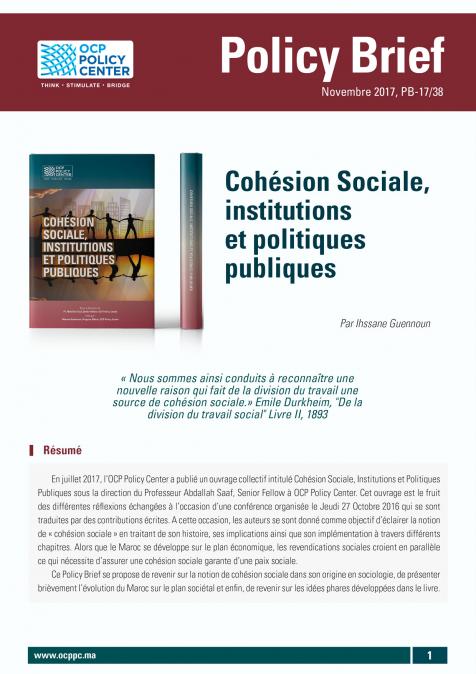
Cohésion Sociale, Institutions et Politiques Publiques
November 7, 2017

En juillet 2017, l’OCP Policy Center a publié un ouvrage collectif intitulé Cohésion Sociale, Institutions et Politiques Publiques sous la direction du Professeur Abdallah Saaf, Senior Fellow à OCP Policy Center. Cet ouvrage est le fruit des différentes réflexions échangées à l’occasion d’une conférence organisée le Jeudi 27 Octobre 2016 qui se sont traduites par des contributions écrites. A cette occasion, les auteurs se sont donné comme objectif d’éclairer la notion de « cohésion sociale » en traitant de son histoire, ses implications ainsi que son implémentation à travers différents chapitres. Alors que le Maroc se développe sur le plan économique, les revendications sociales croient en parallèle ce qui nécessite d’assurer une cohésion sociale garante d’une paix sociale. Ce Policy Brief se propose de revenir sur la notion de cohésion sociale dans son origine en sociologie, de présenter brièvement l’évolution du Maroc sur le plan sociétal et enfin, de revenir sur les idées phares développées dans le livre.

RELATED CONTENT

  • Authors
    November 27, 2025
    Once upon a time, freedom of the press was a beacon—a defining symbol of democracy, enshrined in the First Amendment to the United States Constitution. Freedom of speech. Freedom of the press. A democracy meant to endure forever. Hail the Constitution and the wise founders who laid the foundation for one of the most democratic powers on the globe. ...
  • Authors
    Imad Hajjaji
    November 27, 2025
    The artificial intelligence landscape is undergoing a fundamental shift that most people haven’t yet noticed. While “prompt engineering” has dominated conversations about optimizing AI interactions, a more sophisticated paradigm is quietly emerging: context engineering. This evolution represents more than a semantic change; it signals a transformation in how we architect intelligent systems.As Andrej Karpathy, former Director of AI at Tesla, explains: “In every industrial-strength L ...
  • November 25, 2025
    This Policy Paper analyses the Fourth Industrial Revolution (4IR) through the critical lens of technological colonialism. It argues that the fusion of physical, digital, and biological technologies is not merely a technical phenomenon but a civilizational shift reshaping the foundations of global power. The article traces a historical continuum from previous industrial revolutions, demonstrating how patterns of inequality and extraction persist, now transposed into the digital realm ...
  • Authors
    November 10, 2025
    An estimated 600,000 Haitians live legally on US soil, most of them in New York City and Florida. Another 500,000 are waiting—certainly in vain—for entry papers. In September, the Trump government ended a special “Temporary Protected Status” for an estimated 300,000 Haitian migrants, and possibly another 500,000 migrants temporarily settled in the U.S., including Afghans, Cubans, Nicaraguans, and Venezuelans. The Trump regime is claiming that the violence-plagued Caribbean nation of ...
  • November 05, 2025
    Cet épisode revient sur la trajectoire politique et économique de l’Algérie depuis le mouvement du Hirak en 2019. Il analyse la consolidation du pouvoir militaire, les limites de la trans ...
  • October 21, 2025
    في ظل النقاش حول إعداد مشروع قانون يؤطر تطوير واستخدام الذكاء الاصطناعي في المغرب، تناقش هذه الحلقة مدى حاجة البلاد إلى إطار قانوني خاص ينظم هذا المجال سريع التطور، والتحدي المتمثل في تحقيق التوازن بين التشريع والابتكار. كما تتناول المبادئ التي ينبغي أن يقوم عليها المشروع لضمان مساهمته ...
  • October 14, 2025
    تشهد المستشفيات العمومية في المغرب أزمة حادة تؤثر على جودة الخدمات الصحية بسبب نقص الموارد البشرية وضعف البنية التحتية، ما يزيد الفجوة مع المراكز الخاصة. تتناول الحلقة أسباب الأزمة، آثارها على المرضى، مع التركيز على الحلول الممكنة لضمان مستشفى عمومي فعال وعادل لجميع المواطنين ...
  • Authors
    Monsif Beroual
    October 8, 2025
    This Paper was originally published on menavex.org The fourth industrial revolution has catalyzed the adoption of artificial intelligence (AI) and digital technologies, providing states, communities, and individuals with innovative tools to address complex challenges. Governments, particularly in technologically advanced nations, leverage AI to enhance diagnostics, conduct sophisticated analyses, and strengthen predictive capabilities, which support regulatory functions, p ...