Publications /
Policy Brief
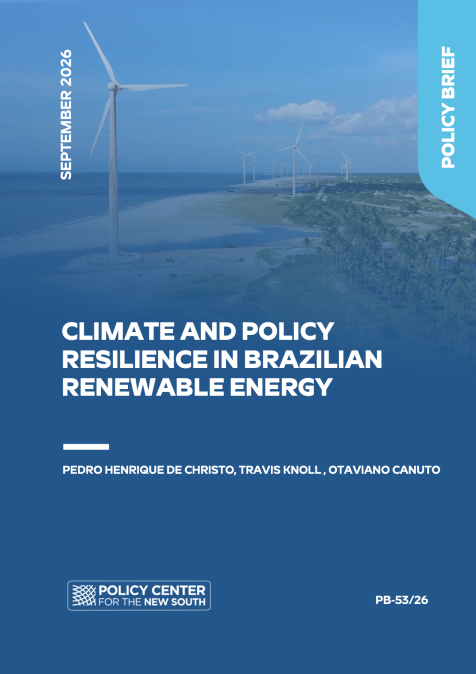
The Brazilian context involving a clean-electricity base, a more balanced lobbying landscape, and mounting climate and social pressure, makes it more difficult for the kind of abrupt and unrestrained energy policy swing seen in Colombia. The trend in Brazil tends to be more economically viable for renewables. However, these structural conditions by themselves will not guarantee the success of the transition. Fruition will depend on whether policymakers use this window to prepare for unavoidable climate disruption and the technological shifts of the coming decades, directing investment and infrastructure to real demand with disciplined allocation of scarce resources that can benefit communities and not just small segments of society.
Getting the build-out of AI infrastructure and of other decisive technologies right, alongside the sine qua non energy transition, is instrumental to position Brazil to compete in the next phases of the global innovation race in a way that can distribute democratically possible benefits to society and that preserves already stressed natural systems. Pairing the energy transition with adaptation and resilience investment is not simply Brazil's best opportunity, it is a precondition for the country's long-term prosperity and survival.
In June 2026, Latin America’s renewable energy advocates watched Colombia pivot sharply away from its ongoing fossil-fuel phaseout led by its former president Gustavo Petro. Newcomer Abelardo de la Espriella, winner of the May 31 presidential election, has pledged to aggressively expand oil and gas exploration to replace waning hydroelectric capacity, rather than to deepen the energy transition.
With another major election approaching—in Brazil on October 4, in which incumbent Luiz Inácio ‘Lula’ da Silva will be pitted against challenger Flávio Bolsonaro—observers are asking whether a similar reversal could happen. Even though there are considerable risks, the scenario is more complex, because of the conditions of the energy market in Brazil, which is Latin America’s largest economy, and has the cleanest electricity supply among the world’s major GDPs, differing from Colombia’s in three important ways.
First, Lula enters the race as a competitive incumbent, not a departing president with a high probability of handing power to an ideological opponent. Second, compared to Colombia, the balance of power between the fossil-fuel and clean-energy lobbies is more even in Brazil. Third, Brazil’s civil society and private sector are exerting considerable pressure to sustain renewable energy policy in response to greater cost-efficiency, vis-à-vis the robust growth of solar and wind generation and the galloping expansion of the electric car market, due to extreme events related to global warming, or, as is seen by the private sector specifically, to position the country at the forefront of building equitable and sustainable global artificial-intelligence infrastructure, which would give a competitive edge in an increasingly turbulent development landscape. Together, these conditions suggest Brazil’s trajectory is not prone to swing as dramatically as Colombia’s so easily.
A Transition Protected in a Certain Extent by Economic Logic
Brazil’s historic reliance on non-fossil electricity generation means its climb to a net-zero economy—in which carbon emissions are balanced by carbon removals—is far less steep than Colombia’s. In 2022, President Lula’s Brazilian Ecological Transition Plan allocated R$ 509 billion (roughly $98.8 billion) to green investments related to interconnected priorities including healthcare and affordable housing, a scale of ambition once dismissed as far-fetched by many economists, but now increasingly mainstream. Bloomberg noted that a full $6 trillion global transition to net zero would cost only 8% more than a transition driven purely by market-led technological development—a narrowing gap that makes the economic case for staying the course easier to defend.
As Brazil is increasingly one of the hardest hit countries by the impacts of the climate crisis, escalating extreme weather is gradually strengthening a growing common agenda between left-right civil society groups over climate policy. Popular demand for adaptation to a significantly more unstable climate is increasingly bridging political spectrums among constituents, which despite the existing divide between politicians, is decisive for how durable any given administration’s energy policy will be.
Policy Continuity due to Economic Advantages Guides the Outlook
Renewable energy’s standing in Brazil demonstrates strong economic and popular support, which is an obstacle for the opposition's markedly ideological rhetoric. A climate denier who defends expanding fossil fuels production strenuously as stated in the government plan for his presidential bid, Flávio Bolsonaro has called for growing energy subsidies in general, not prioritizing but also not excluding it for renewable energy as well. Whether this is mere campaign rhetoric or actual policy signaling is not known, but it is a fact that taking a position against clean energy in Brazil today is a misguided political move, even on the radical right (due to clean energy’s economic advantages).
While President Lula has focused on expanding Brazil’s clean energy matrix, and invested in both adaptation and environmental regeneration policies, his energy policy includes growth in both clean and fossil fuel energies. Lula argues that this strategy is a matter of national sovereignty, despite criticism by a considerable part of his political base.
For the opposition, the actual policy in office in a possible government remains uncertain and would likely be decided less by ideology than by which lobby—fossil or clean energy—proves more effective at influencing his government.
This modus operandi has precedent. In 2020, Jair Bolsonaro, the current opposition candidate’s father, also a climate denier and uncompromising defender of fossil fuel expansion blocked a proposed tax on solar in 2020 and signed a law expanding distributed generation incentives (including solar) in 2022. This indicates that the right-wing leadership adapts to whichever interests are best organized to lobby it, a neo-patrimonial pattern with echoes in the current Trump administration.
Although there was a critical propensity towards fossil fuels production, remarkably it was the dirtiest among them, coal, which grew during the Bolsonaro government. It can be seen that there is not much covariance in Brazilian energy policy regarding renewable energy expansion according to past examples. The greatest danger is the risk of an even greater radicalization by a possible, yet unlikely, new Bolsonaro government as observed in the US with President Trump’s second term. In this case, as is in the climate, “historical data” can become an outdated “cosmic candle” (measure of reference of past events for reading reality) for a “new climate”, both figuratively and literally, in Brazil’s politics.
As much as a Reversal, Resilience Constitutes a Great Risk
Even though possible, an equally consequential threat to Brazil as a possible abrupt policy U-turn is its energy insecurity and inadequate climate resilience. Hydroelectric dams have already lost between 2.5% and 10% of generating capacity due to climate change and rainfall patterns altered by deforestation, especially in relation to the Amazon and its flying rivers. That loss, combined with the falling cost of renewables, is why BNEF expects solar and wind to overtake hydropower in Brazil by 2050.
Extreme weather events in Brazil rose 223% between 2020 and 2023 compared with the entire 1990s decade, costing the country an estimated US$ 300 billion to US$ 500 billion in 2024 alone. Meeting that challenge will require new transmission infrastructure and better battery storage, investments that pay for themselves by making the system more resilient, independent of whether they are framed as climate policy.
Distributed solar offers a particular advantage for Brazil. The decentralized generation and logistics it offers provided real resilience during the 2024 Rio Grande do Sul floods, even as traditional energy installations struggled. In São Paulo, during recent floods and storms, electric vehicle batteries — not the city's damaged grid — kept houses and small businesses running for days. North American and African entrepreneurs are already developing plug-in mobile and nanogrid solar systems designed specifically for extreme-weather conditions, a model Brazil is well placed to adopt.
From Risk Mitigation to Economic Opportunity
Renewable infrastructure is not only a defensive move, however. Building out production, storage, and distribution capacity would help Brazil integrate its supply chains horizontally in sectors like value-added manufacturing and critical minerals. It would also help to deepen diplomatic ties with like-minded countries across Latin America and Africa, especially.
This intersects with Brazil's current conundrum. Its emerging role as a Latin American data center hub is growing — a shift accelerated by the need to reduce reliance on U.S. servers, which currently handle roughly 60% of the country's data processing. How it is brought to fruition can turn it either into a transformative opportunity or a massive scale destructive venture.
Brazil's abundant supply of distributed generation renewables (in the 1–10 MWp range, by Brazilian classification) makes it a strong testing ground for distributed AI and sustainable data center models, an urgent necessity. Distributed generation sidesteps the curtailment problems that have plagued centralized power, and smaller-scale plants can serve small and mid-sized cities with much less environmental and social disruption. While this is true, avoiding the same mistakes that have led data-center development to become a defining structural socioeconomic and environmental problem as in the US is not an option but an imperative.
Distributed AI's lighter dependence on hyperscaler infrastructure could also extend reliable computing to regions more isolated from the nation’s main grid, which are typically left behind by technological revolutions or forced to pay a high environmental cost for inclusion in those revolutions. If done right, Brazil could sidestep the infrastructure bubble now building in the U.S. and pursue a model of AI development more favorable to emerging economies and their communities. However, doing things right depends on renewable energy and AI projects that adhere from the outset to governance fundamentals: freely given, prior, and informed consent, and rigorous environmental assessment backed by strong regulation.
Conclusion
The Brazilian context involving a clean-electricity base, a more balanced lobbying landscape, and mounting climate and social pressure, makes it more difficult for the kind of abrupt and unrestrained energy policy swing seen in Colombia. The trend in Brazil tends to be more economically viable for renewables. However, these structural conditions by themselves will not guarantee the success of the transition. Fruition will depend on whether policymakers use this window to prepare for unavoidable climate disruption and the technological shifts of the coming decades, directing investment and infrastructure to real demand with disciplined allocation of scarce resources that can benefit communities and not just small segments of society.
Getting the build-out of AI infrastructure and of other decisive technologies right, alongside the sine qua non energy transition, is instrumental to position Brazil to compete in the next phases of the global innovation race in a way that can distribute democratically possible benefits to society and that preserves already stressed natural systems. Pairing the energy transition with adaptation and resilience investment is not simply Brazil's best opportunity, it is a precondition for the country's long-term prosperity and survival.