Publications /
Policy Brief
Resolution 2797 of the United Nations Security Council does not mark the end of an issue, but the culmination of masterful time management. Morocco has not only won support, it has won the tempo. By combining the Chronos of constancy and the Kairos of opportunity, it has demonstrated that a foreign policy can be based on the philosophy of time as much as on geopolitics.
This diplomacy of controlled time can today be seen as an implicit doctrine of the Kingdom: a strategy in which patience, predictability and responsiveness form an effective triptych in the face of international volatility. It also offers an exportable analytical grid: the same logic can be found in Morocco's Atlantic policy, in its African reintegration and in its management of regional crises.
Morocco has understood that power is not only what you do, but when you do it. In the Sahara issue, it has managed to turn time - that silent player in history - into a strategic weapon and an engine of legitimacy.
Introduction
Security Council Resolution 2797, adopted on October 31, 2025, has been widely presented and commented on - and rightly so - as a major diplomatic success for Morocco. Indeed, it marks a decisive turning point in international recognition of the centrality of the autonomy plan, under Moroccan sovereignty, presented by Rabat in April 2007, as the only serious and credible basis for settling the Sahara dispute. At the same time, the resolution renders obsolete all ideas of independence or referendum advocated by separatists and their supporters. But beyond the content of this resolution and the successes it enshrines, the analytical interest lies also, and perhaps above all, in the diplomatic and strategic management of time that Morocco has been able to operate for almost half a century.
While literature on the Sahara, in general, and on the Moroccan success of October 2025, in particular, is often limited to a descriptive approach - that of positions, balances of power and diplomatic support - it seems fruitful to introduce a reading and strategic management of time. For time, in diplomacy as in strategy, is not simply a neutral factor. Effective diplomacy and efficient strategy are not subject to time; they manage it and exploit it as an instrument of power.
Morocco's diplomatic victory is not the fruit of a single moment, that of the announcement of the results of the vote on resolution 2797 on October 31, 2025. It is part of a time strategy that has been mastered over almost half a century. It is therefore essential not to limit ourselves to describing Moroccan constancy, but also to analyse the strategic temporality that underpins this constancy.
In Greek thought, Isocrates already distinguished two figures of time:
- Chronos, linear time, that of duration, patience and maturation;
- Kairos, the opportune time, the decisive moment to act, to seize or prevent the other from acting.
The Isocratic distinction allows us to read the diplomatic and strategic management of the Sahara issue as a work of temporal mastery: Morocco has been able to play the Chronos of continuity and linearity, without losing sight of the Kairos of reactivity and opportunism. In its handling of the Sahara issue, it has managed to play both roles simultaneously. He has mastered the Chronos, by inscribing his action in duration, constancy and coherence; and he has seized the Kairos, by exploiting propitious moments, neutralizing the adversary's windows of opportunity, and transforming each crisis into a diplomatic springboard. This dialectic of time - strategic patience and tactical reactivity
- reinforces the explanation for the accumulation of diplomatic successes: it sheds light on a veritable doctrine of time in Royal diplomacy.
The present paper attempts to shed light on this issue through 4 chapters describing (1) the royal strategy in its management of Chronos time; (2) this same strategy in its anticipation and reactivity to Kairos time; (3) the synthesis of the two times in the moment of resolution 2797, and (4) the open road to a lesson in diplomacy: temporal strategy.
Chronos Time: the Strategy of Duration and Consistency
An unbroken political line (1975-2025)
Since the Green March in 1975, Morocco has chosen a strategy of extraordinary continuity. For fifty years, tumultuous and changing international circumstances have not altered the basic line of Moroccan policy towards its reclaimed territories. A policy whose main pillars have never wavered:
the affirmation of territorial integrity as a dogma of state policy; loyalty to the UN framework as the sole forum for settlement;
the rejection of any imposed solution;
the autonomy proposal as the expression of a balanced compromise.
This consistency has forged a temporal credibility that has imposed itself on both friends and enemies of Morocco. The Kingdom has never wavered in its position, while other players have oscillated. Morocco's resilience in the face of time confirms Raymond Aron's view that duration is an essential dimension of strategy:
"The continuity of an objective gives meaning to the sequence of means". By maintaining the same objective - recognition of its sovereignty over the Sahara within a framework of autonomy - the Kingdom has transformed the long term into a vector for reinforcing legitimacy. Where others have exhausted themselves, Morocco has waited, consolidated and capitalized.
Times of trial: resilience over time
The long time or Chronos of the Moroccan struggle for its southern provinces has not been a tranquil river. Certain periods have put this strategy of patience to the test.
Under the presidency of Jimmy Carter (1977-1981), American diplomacy adopted a more critical tone towards Rabat, marked by an ideological approach to human rights and a certain closeness to Algerian theses. Without breaking away, Morocco opted for silent resilience and waited for the return of a more pragmatic administration.
The Baker II plan (2003), which reopened the way for a referendum on self-determination (independence), was categorically rejected. Once again, Morocco resisted the time pressure trap: it refused to be pressured, counting on the natural wear and tear of an unrealistic plan.
Finally, in 2013, Washington proposed extending MINURSO's mandate to include human rights monitoring. This was a major strategic warning: a year in which patience had to be coupled with firmness. Morocco responded with an intense diplomatic campaign and the strengthening of its national human rights mechanisms, defusing the threat without breaking with the United States.
Bolton and the referendum obsession. During his tenure as head of the US Security Council (2018-2019), Bolton had an obsession with the Sahara referendum. He spared no effort to undermine Moroccan positions. No wonder when we know that he is a disciple of James Baker and also a close friend of David Keene, head of the lobbying firm Keene Consulting, with whom Algeria signed a contract in 2018. During the 17 months of Bolton's tenure, Morocco had shown serenity and wisdom, on the one hand, and resilience, on the other, to dissuade its adversaries from exploiting any opportunity offered to push through their theses.
These episodes demonstrate that the Moroccan Chronos is not inertia, but dynamic resilience. Morocco does not endure time: it absorbs it, transforms it, and emerges strengthened.
Development as a weapon of time
One of the pillars of this Chronos strategy is the development of the southern provinces. From the 2000s onwards, and particularly under the reign of His Majesty Mohammed VI, Morocco has invested massively in these territories, gradually transforming the image of its Sahara provinces. From a contested area, the Moroccan Sahara has become an area with a future. The Kingdom has not waited for international recognition before taking action, but has made time a factor in territorial consolidation. As Lucien Poirier noted, "time is not the enemy of strategy, it is its raw material". In developing its Saharan provinces, Morocco has turned time into an ally.
Gradual and cumulative diplomacy
The Moroccan Chronos can also be seen in the Kingdom's gradual diplomacy. Over the past two decades, the Kingdom has built up a network of African, Arab and Western supporters.
In Africa, Morocco rejoined the African Union in 2017, paving the way to reinvest the continental space and gradually marginalize opposing positions.
In the Arab world, strengthened ties with the Gulf monarchies helped stabilize ongoing support. In the West, American, then Spanish, recognition, on the one hand, and French and German (2023), then British, repositioning, on the other, marked the consolidation of a favorable consensus.
This slow but sure progress illustrates a diplomacy of accumulative time: each step prepares the next, each success makes another possible, reinforcing the logic of maturation that underpins Moroccan action.
Mastering UN time
Morocco has also understood that UN time - long, repetitive and procedural - can be transformed into an asset. By accepting the framework of the Security Council and the slow pace at which it evolves, Morocco has gradually normalized its position, taking the time to explain its case and advance UN semantics. The lexicon of the resolutions has evolved from "referendum" to "realistic, lasting and mutually acceptable political solution". This long-term semantic evolution bears witness to a war of lexical attrition won by Morocco. The diplomatic Chronos has become political capital.
Kairos Time: the Art of Seizing or Preventing the Seizing of a Decisive Moment
If Chronos illustrates strategic patience and resilience, Kairos represents timely reactivity. And this is undoubtedly where the finesse of royal diplomacy lies: knowing how to act at the right moment, neither too early nor too late, transforming every crisis into an opportunity, and every favorable moment into a lasting turning point. Kairos is a watchful eye on Chronos, on the lookout for a breach or window of opportunity. If Chronos is patience and resilience, Kairos is watchfulness and vigilance.
Guergarat: the Kairos of legitimacy
The Guergarat operation (November 2020) is a perfect illustration of this logic. Morocco waited several days before taking action, observing Polisario violations in the buffer zone, accumulating evidence and soliciting UN support. Then, just when its adversary thought it was imposing a fait accompli, Morocco launched a non-offensive operation, limited and controlled, but of considerable symbolic significance. In the space of a few hours, Morocco reversed the balance of legitimacy, imposing itself as a regional power to re-establish free movement and protect regional trade. It was a Kairos fully exploited: force used with restraint, within the framework of the law, at the exact moment when inaction would have cost more than action.
American recognition: a geopolitical Kairos
The American decision of December 2020 recognizing Morocco's sovereignty over the Sahara was the result not only of meticulous preparation, but also of perfect adaptation to the context.
Morocco was able to place this recognition within a broader dynamic - that of regional cooperation - while freeing it from any political haste. This Kairos was seized with intelligence: Morocco did not overexploit the event, preferring to root this recognition in the long term, via tangible economic and military agreements. This is the epitome of sustainable Kairos: a moment seized, but transformed into a structural advantage.
European repositioning: a diplomatic Kairos
From 2022, Morocco's efforts to capitalize on the American position on the Sahara will begin to bear fruit:
- March 2022, Spain declares that it considers the Moroccan autonomy plan of 2007 to be the "most serious, realistic and credible" basis for resolving the dispute;
In July 2024, France recognized Moroccan sovereignty over the southern provinces, and in October 2024 affirmed that the 2007 Moroccan plan was "the most credible and serious solution";
Germany, the UK and other European countries will follow suit with the same positive momentum.
In short, between 2022 and 2024, several European capitals will revise their approach to the Sahara issue (see table below).
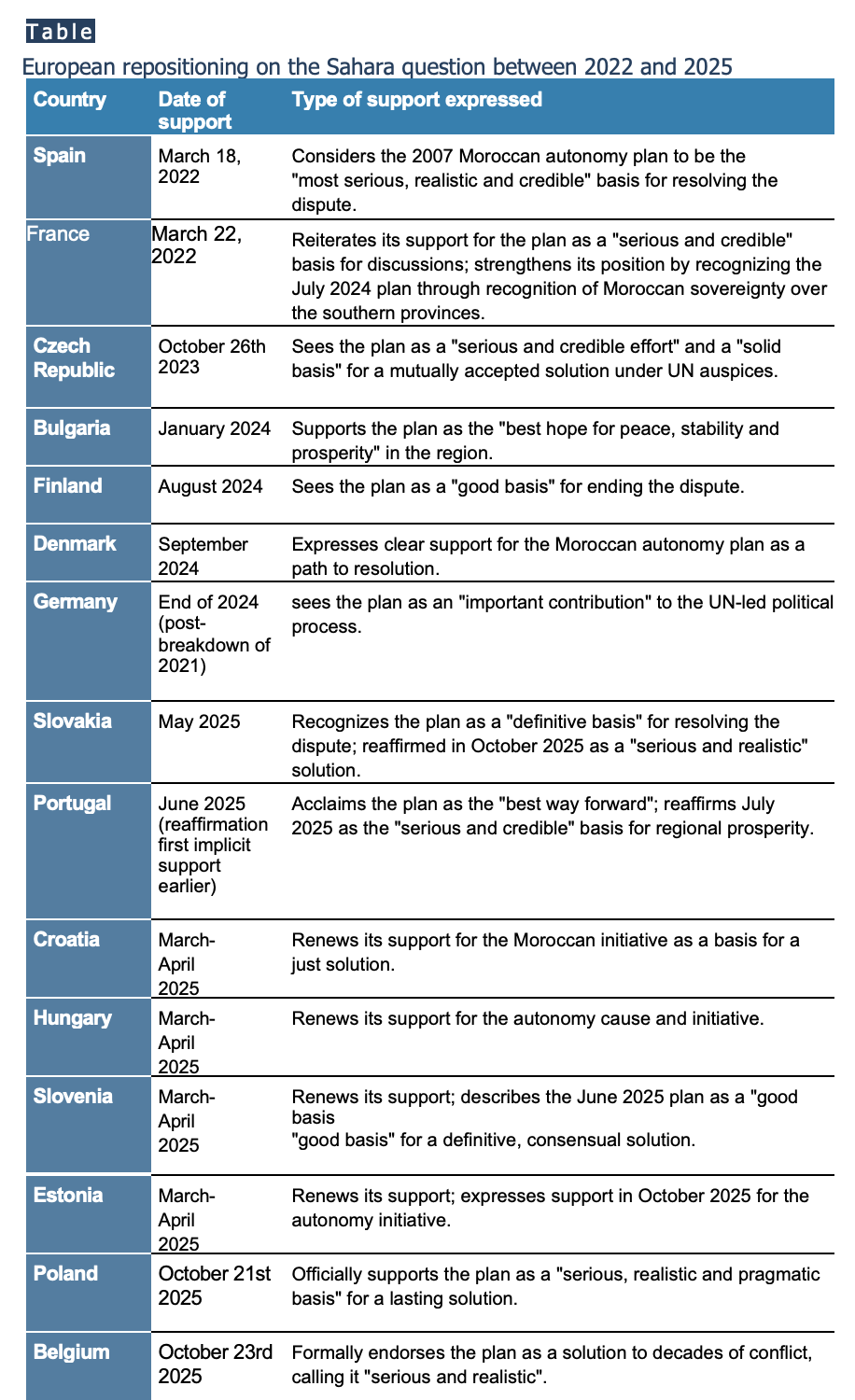
Morocco's work on this issue has consisted in capitalizing on the American position to encourage, prepare and accompany other repositionings in the world, particularly in Europe. The geopolitical opportunity presented by the American position had to be extended through diplomatic efforts, and the window of opportunity it opened had to be widened, to convince the international community not only of the justness of the Moroccan cause, but also of the strong support it enjoys from the world's leading power. If Morocco considers Chronos time to be a time of resilience and defense without plaintive expression, Kairos time is for Moroccan strategy that of the offensive without declarative euphoria. The art of diplomatic Kairos consists precisely in not rushing to victory, but in silently consolidating it.
Neutralizing the opponent's Kairos
Any Kairos strategy involves not only seizing opportunities, but also preventing the adversary from seizing his own opportunities. Morocco has systematically defused Algeria's and the Polisario's attempts to exploit what they saw as gaps in the international system to damage the national cause (see "Times of trial: resilience over time" above). Morocco countered its adversaries' attempts on all fronts:
- on the military front, by maintaining a controlled deterrent and a doctrine of restraint;
- diplomatically, by neutralizing hostile African or Latin American offensives;
- in the media, turning every controversy into an argument for stability and responsibility.
Where its adversaries sought manipulation and showmanship, Morocco offered discreet predictability, a paradoxical but formidable weapon in international relations. The adversary knows how we are going to react, but not when and to what extent; he knows the action but is unaware of its timing and scope.
The royal Kairos: the word of the right moment
The temporality of the royal speech is a central element of the Moroccan Kairos. The speeches of His Majesty King Mohammed VI - notably those of November 6 (Green March)- are calibrated to respond to the exact geopolitical moment. Never rushed, never reactive, they arrive at just the right moment to reframe, soothe or reaffirm. The quality, not the quantity, of the King's interventions is paramount. The Sovereign intervenes when and as required. The speech is justified by the moment and is, in its manner, adapted to that moment. This rhetoric of the right time is a constant in Moroccan monarchical style. It favors the "when and the how" and constitutes a mastery of silence as much as of speech, thus reinforcing Morocco's stature as a measured, responsible, serious and credible actor.
Conclusion: Reconciling the Times, a Textbook Case of Strategic Behavior
1- Resolution 2797: synthesis of Chronos and Kairos
Resolution 2797 consecrates the dialectic of time and its place in Morocco's strategy. It does not emerge from a vacuum, but is the culmination of the synergy created between fifty years of coherence (Chronos) and multiple opportunities skilfully seized (Kairos).
It is the legitimate child of resilience and strategic patience, on the one hand, and wise, intelligent awakening, on the other:
The culmination of a long process
Morocco's management of the long term has enabled it to shape the international community's perception of its national cause. It has never changed its position, despite the maneuvers of its adversaries and the vagaries of the economic climate. This resilience has reinforced the justness of the cause and pushed the world to adapt. Morocco has thus won the lexical battle; its grammar and vocabulary are no longer contested, as evidenced by the language and syntax of resolution 2797.
Exploiting the international context
Resolution 2797 is also a product of Kairos. At a time when the international community is exhausted by the crises in the Sahel, and anxious and concerned about the situation in the Maghreb and the Mediterranean, Morocco is looking for stability. It has emerged as a balanced, reliable player and partner in security and development. By presenting the Sahara as the starting point for its initiatives in the Atlantic and Sahel, Morocco has turned it into a regional platform for stability and prosperity, erasing the image of the region as a source of conflict or destabilization.
2- Towards a Moroccan doctrine of diplomatic time
At the end of this analysis, it is possible to identify a veritable doctrine of time in Moroccan diplomacy. This is based on three structuring principles.
Strategic patience
Morocco has made time a lever of power. It has been able to distinguish between slowness and immobility, making its strategy an exercise in patience based on the conviction that law, reality and diplomacy will eventually converge if we act consistently. This patience is expressed in our loyalty to the UN framework, our refusal to break with the past and the priority given to internal construction.
Controlled responsiveness
But patience does not mean passivity. Moroccan diplomacy practices a calibrated reactivity, both firm and measured. Kairos is conceived here as an art of intervention dosed: timely, proportionate, decisive action. This reactivity is based on constant monitoring of regional and international conditions, enabling us to anticipate rather than suffer, and to prepare ourselves to avoid being taken by surprise.
Reversing the relationship with time
Finally, Morocco has succeeded in reversing the relationship with time in this conflict. For a long time, its adversaries believed that time was against it, and each year without a solution was supposed to weaken its position. But the opposite has happened: time has consolidated the facts, legitimacy and recognition. Moroccan strategy has turned time not into a handicap, but into a strategic resource.
Bibliography
Official documents and resolutions
- United Nations Security Council. Resolution 2797 (2025) adopted October 30, 2025. New York: UN.
United Nations Security Council. Resolutions 1754 (2007), 2044 (2012), 2602
(2021), 2654 (2022), 2703 (2023). New York: UN.
- Kingdom of Morocco. Initiative marocaine pour la négociation d'un statut d'autonomie de la région du Sahara. Rabat: Ministry of Foreign Affairs, April 11, 2007.
- United Nations Secretary-General. Annual reports on Western Sahara, 2000- 2024. New York: UN.
- Mohammed VI. Speech to the Nation on the occasion of the 45th anniversary of the Green March. November 6, 2020, Rabat.
- Mohammed VI. Speech from the Throne: Morocco and the clarity of diplomatic positions. July 30, 2022, Rabat.
Books and articles on strategy and time
- Aron, Raymond. Peace and war between nations. Paris: Calmann-Lévy, 1962.
- Poirier, Lucien. Essais de stratégie théorique. Paris: Économica, 1982.
- Virilio, Paul. Vitesse et politique. Paris: Galilée, 1977.
Philosophical references on time
- Isocrates. Discours. Paris: Les Belles Lettres.
- Aristotle. Rhetoric. Book II. Paris: Vrin, 1980.
- Tillich, Paul. "Kairos and the fullness of time." In Theology of Culture, ed. John Cobb, 45-63. Oxford: Oxford University Press, 1959.
Studies and analyses on the Sahara issue
Rachid El Houdaïgui.Rachid El Houdaïgui. "The Sahara conflict: towards a new capital of legal legitimacy based on equity". PB. 18/16, Policy Center for the New South, 2018.
Bassou Abdelhak. "The G5 Sahel is dead, long live the G7 Sahel-Atlantic". PB. 09/25, Policy Center for the New South, 2025.
Jamal Machrouh. "Réflexions autour de l'Initiative marocaine pour la négociation d'un statut d'autonomie de la région du Sahara, à la lumière de la résolution 2797 du Conseil de sécurité". PB. 56/25, Policy Center for the New South, 2025.
Loulichki, Mohammed. "Security Council resolution 2797: the autonomy solution plebiscite". PB. 55/25. Policy Center for the New South, 2025.