Publications /
Policy Brief

Back
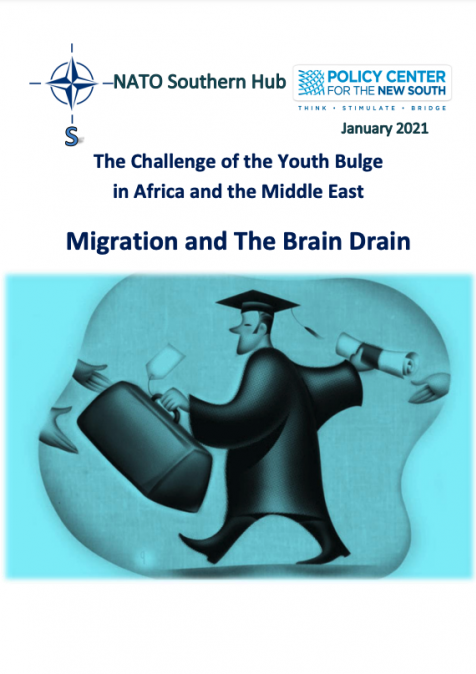
The Challenge of the Youth Bulge in Africa and the Middle East: Migration and The Brain Drain
March 11, 2021

This Policy Brief was drafted within a partnership with NATO Southern Hub (NSD-S Hub) and was originally published on NSD-S Hub website:

 The Southern Hub | The Challenge of the Youth Bulge in Africa and the Middle East - Migration and The Brain Drain

By 2050, the population of Africa is expected to double, the proportion of people in their working age is projected to increase sharply and a “youth bulge”, namely a relatively y 2050, the population of Africa is expected to double, the proportion of people in their working age is projected to increase sharply and a “youth bulge”, namely a relatively large increase in the number and proportion of the population of youthful age, is rapidly forming beneath looming economic uncertainties. This indisputable fact exacerbates the issues of migration and the brain drain, as unemployment threatens African youth and rampant poverty and inequalities still cloud the perspectives of those living where sound structural change has yet to take place.

The lack of good quality job opportunities represents a severe challenge for Africa and the Middle East and, since many states fail to absorb the increasingly large youth population, more and more young people are resorting to migrating abroad permanently, since intra-Africa migration is often hindered by regional regulations on worker mobility. As many young people migrate towards Europe and America in search of better prospects, the “brain drain”, namely the migration of engineers, physicians, scientists and other very highly skilled and educated professionals, becomes a particularly compelling issue. While on the one hand, this greatly damages origin countries by removing the very people who could most help stimulate economic growth from local productive capacities, on the other hand destination countries rarely pay for the cost of training of the workforce they recruit and also offer subpar work contracts and conditions to those joining them. This imbalance hampers structural change and stunts economic development. It is, however, mitigated by the fact that diaspora communities regularly send home parts of their remuneration and acquire new skills while abroad, both of which have the potential to enrich origin country value chains.

Against this background, this report identifies three feasible strategies to tackle this phenomenon. While mandatory service in sensitive sectors is a viable option to deter early migration, networks for knowledge transfer and investment facilitation schemes should foster diaspora contributions to origin economies. Also, investments from donors should aim at job creation and labour productivity, thus facilitating the voluntary repatriation of those who have emigrated by fostering employment and increasing wages back home. Finally, in the cases of extreme brain drain, systems of quota for selective migration could be jointly considered by origin and destination countries. 
RELATED CONTENT

  • Authors
    Karim El Mokri
    Idriss El Abbassi
    June 8, 2026
    Bientôt disponible en vente sur amazon et Livremoi. Le monde du travail est engagé dans un processus de mutation sans précédent. La quatrième révolution industrielle, portée par l’intelligence artificielle (IA) et la robotisation, a été le point de commencement d’une ère nouvelle où les repères économiques et sociaux se redéfinissent à une vitesse inédite. Ces technologies suscitent un engouement légitime et offrent des perspectives prometteuses, mais requièrent une vigilance a ...
  • June 5, 2026
    Driven by its mission to reflect on and analyze the major geopolitical, economic, and societal transformations shaping the contemporary world, and with a view to contributing to knowledge-sharing and disseminating the main outcomes of its research program, the Policy Center for the New South regularly publishes collective volumes addressing issues of particular importance to Morocco, Africa, and the broader Global/New South. In this spirit, the Center has recently released two volum ...
  • June 4, 2026
    Cet épisode revient sur les principaux enseignements du chapitre consacré au secteur extérieur marocain, en mettant en lumière le paradoxe d’un déficit commercial structurel persistant combiné à une forte résilience des équilibres externes. Badr Mandry explique comment les transferts de...
  • June 1, 2026
    Cette interview met en lumière le rôle central du secteur textile et de l’habillement dans l’économie marocaine, tant en matière d’emploi que d’exportations. Notre économiste, Mr. Fahd Azeroual revient sur son évolution historique, ses principaux défis, notamment la dépendance aux impor...
  • Authors
    May 22, 2026
    This paper, the fourth in a research series on services-led growth in the Global South, examines Egypt’s potential for growth and economic transformation through the integration of services into Global Value Chains (GVCs). It employs a new taxonomy that classifies services into Knowledge Services (KS), Enabling Services (ES), and Local Services (LS) and applies OECD 2025 Trade in Value-Added (TiVA), Trade in Employment (TiM), and input-output databases to benchmark Egypt against Mor ...
  • Authors
    May 15, 2026
    This paper is the third in a series of country and comparative studies that together comprise a research program on services as drivers of economic growth and structural transformation in the Global South. The paper analyzes the pattern of Tunisia's services-led economic growth from 2012- 2022 using a specialized three-category framework: knowledge services (KS), enabling services (ES), and local services (LS). Using data from the OECD Trade in Value Added (TiVA), Trade in Employmen ...
  • April 29, 2026
    Cet oped a été publié initialement dans la revue afkar/ideas 77 (IEMed).  La politique étrangère du Maroc traverse une transition structurelle, sous l’effet de la polycrise mondiale, de la diversification de ses partenariats et de l’affirmation de nouveaux choix stratégiques. La centralité accordée aux notions de « hub », de « plateforme »ou de « corridor » traduit un glissement sémantique et fonctionnel dans le narratif national, accordant une priorité majeure aux considé ...
  • Authors
    April 20, 2026
    This paper was published as a book chapter in “The Economic Potential of Islamic Countries, Part B: Sustainability, Governance, Energy and Digital Transformation,” released by Emerald Publishing. The COVID-19 pandemic exposed significant deficiencies within social protection systems worldwide, especially in Middle Eastern and North African (MENA) countries. This underscores the urgent need to fortify these social protection schemes to ensure resilience in the face of crises (Sa ...
  • April 16, 2026
    Gulf countries are increasingly shaping Africa’s political and economic landscape through investments in infrastructure, energy, and strategic sectors. Their flexible, capital-driven approach and strong political ties distinguish them from traditional partners. While creating opportunit...
  • Authors
    March 12, 2026
    Historically, manufacturing has served as the primary pathway to economic development, offering strong scale economies, learning-by-doing effects, and the capacity to generate the foreign exchange necessary to import capital goods and technology. However, advances in robotization and artificial intelligence (AI) are fundamentally undermining manufacturing’s traditional role, making it increasingly skill- and capital-intensive while limiting its ability to absorb labor. Thi ...