Publications /
Opinion
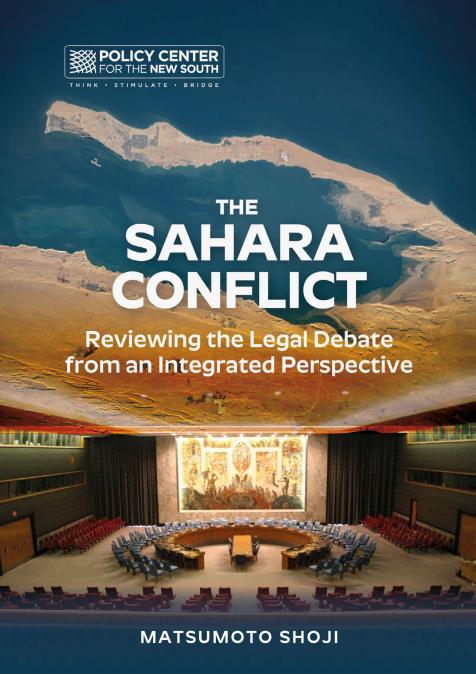
In his thought-provoking book, The Sahara Conflict and International Law: Reviewing the Legal Debate from an Integrated Perspective, Pr. Matsumoto Shoji embarks on an ambitious project to dissect the Sahara conflict through the lens of international law, regional politics, and global diplomacy. As a seasoned expert in comparative African law and international legal systems, Matsumoto brings a wealth of expertise to an issue that has long been a flashpoint in North African geopolitics. His book is notable for its rigorous legal analysis and multidimensional methodology that integrates human, historical, and geopolitical considerations.
The book is structured into twelve chapters, each exploring critical aspects of the Sahara conflict, including the interpretation of international law principles such as jus cogens, the advisory opinions of the International Court of Justice (ICJ), and the recognition of secessionist entities like the Sahrawi Arab Democratic Republic (RASD). The author provides a fresh perspective on the interplay between legal norms and the region's political realities, offering what he terms an "integrated perspective" to an issue that has divided scholars, policymakers, and international organizations for decades.
This review critically evaluates the key themes of Matsumoto’s work, focusing on his legal arguments, historical contextualization, and proposed solutions, particularly the Moroccan autonomy initiative. While the book’s comprehensive approach is commendable, this review also identifies areas where the author could have expanded his analysis to address unresolved tensions in the debate.
The Strength of Jus Cogens and the Limits of Self-Determination
One of the book’s foundational arguments is the nuanced application of jus cogens norms—imperative principles of international law that cannot be overridden, such as the prohibition of racial discrimination. Matsumoto situates the Sahara conflict within the broader framework of these norms, arguing that any resolution must adhere to such fundamental principles. His analysis challenges the oversimplified invocation of self-determination as an absolute right, contending that this principle is neither universally binding nor inviolable under international law.
Matsumoto’s discussion is particularly incisive when he critiques the discriminatory applications of self-determination. He notes that referenda proposed by the Polisario Front, aimed at determining the status of the Sahara, often exclude significant demographic groups, violating jus cogens norms of equality and non-discrimination. This tension between self-determination and non-discrimination forms a recurring theme in the book, as Matsumoto skillfully navigates the legal and moral contradictions inherent in such conflicts.
However, while Matsumoto’s legal critique is robust, the book could benefit from a deeper exploration of the philosophical underpinnings of self-determination. For instance, the author might have examined how the principle has evolved from a political aspiration in the early 20th century to a legal right enshrined in UN resolutions. This historical evolution would have added further depth to his argument, highlighting the contested nature of self-determination in postcolonial contexts.
The Role of the ICJ and Legal Ambiguities
A significant portion of Matsumoto’s analysis focuses on the 1975 advisory opinion of the ICJ, which addressed Morocco’s claim to the Sahara and the applicability of self-determination. The ICJ’s opinion, which concluded that the Sahara was not terra nullius prior to Spanish colonization and recognized legal ties between the region and Morocco, has been a cornerstone of Morocco’s legal case. Matsumoto critiques the ICJ for expanding its mandate by addressing sovereignty and self-determination—issues that were not explicitly within the scope of its inquiry.
Matsumoto’s argument is compelling in its focus on the limitations of advisory opinions, which, while influential, lack binding force. He draws comparisons to other ICJ cases, such as the Namibia opinion 1971, to illustrate how legal interpretations often become tools for political maneuvering. His critique underscores the need for more explicit boundaries between legal and political mandates, particularly in contentious cases like the Sahara conflict.
Nevertheless, Matsumoto’s analysis could have delved further into the broader implications of ICJ opinions for international law. The book could have provided a more comprehensive view of the ICJ’s role in global governance by examining how advisory opinions shape state behavior and influence multilateral negotiations.
Recognition and the Question of Secession
One of Matsumoto’s most compelling contributions is his critique of the recognition of secessionist entities, particularly the RASD. He argues that premature recognition by some states and organizations, such as the African Union, undermines established territorial integrity and non-intervention principles. Drawing on historical analogies, such as the recognition of Manchukuo in the 1930s, Matsumoto illustrates how recognition can destabilize regions and erode the legitimacy of international law.
This section of the book is particularly strong in its use of comparative examples to highlight the dangers of selective recognition. Matsumoto’s argument is grounded in legal doctrine, particularly the Vienna Convention on the Law of Treaties, which emphasizes the inviolability of sovereign borders. He further critiques the role of the African Union, noting the contradictions between its recognition of the RASD and its member states’ commitments to UN principles.
While Matsumoto’s critique is incisive, the book could have explored the motivations behind such recognitions in greater depth. For instance, analyzing the geopolitical and economic interests driving certain states to support the Polisario Front would have added nuance to his argument.
The Madrid Accord and the Legacy of Decolonization
The Madrid Accord of 1975, which transferred administrative authority over the Sahara from Spain to Morocco and Mauritania, is another focal point of Matsumoto’s analysis. The author defends the accord's legality, arguing that it represents a valid step in the decolonization process. He contrasts this with critics who claim the agreement failed to fulfill a referendum requirement.
Matsumoto’s discussion of the Madrid Accord is enriched by his comparison to similar agreements, such as the transfer of Hong Kong from Britain to China. These examples underscore the complexities of administrative transitions in postcolonial contexts, particularly when conflicting interpretations of international law are involved.
However, Matsumoto’s reliance on historical analogies raises questions about their applicability to the Sahara conflict. While the Hong Kong example is instructive, the Sahara's unique cultural, political, and geographic dynamics warrant a more context-specific analysis.
The Moroccan Autonomy Initiative: A Pragmatic Solution?
Matsumoto devotes considerable attention to Morocco’s 2007 autonomy initiative, which he presents as a pragmatic and legally sound alternative to the stalemated referendum proposal. The initiative offers significant autonomy to the Sahara under Moroccan sovereignty, balancing local governance with national integration.
The author praises the initiative for its potential to break the diplomatic deadlock, citing support from several European and African countries as evidence of its viability. He also highlights the initiative’s emphasis on economic and social development, arguing that it aligns with the region's broader goals of stability and human rights.
While Matsumoto’s endorsement of the autonomy initiative is well-argued, the book could have addressed its limitations more critically. For instance, the author might have explored the practical challenges of implementing such a proposal, including the logistics of governance, resource allocation, and integrating diverse political actors.
The Limitations of Referenda
One of the book’s most incisive critiques is its analysis of referenda as a tool for conflict resolution. Matsumoto identifies several flaws in the proposed referendum for the Sahara, including its zero-sum nature, its susceptibility to manipulation, and its failure to address underlying issues of governance and identity.
This critique is particularly relevant given the global trend of using referenda in conflict resolution, from Brexit to South Sudan. Matsumoto’s argument underscores the need for alternative mechanisms that prioritize compromise and inclusivity over binary choices.
However, the book could have expanded on these alternatives. For instance, Matsumoto might have explored models of power-sharing or federalism as potential solutions, drawing on examples from other conflict zones.
A Multidimensional Methodology
One of the book’s strengths is its multidimensional approach, which integrates legal, historical, and human perspectives. Matsumoto emphasizes the importance of grounding legal analysis in historical context, recognizing the colonial legacies and geopolitical dynamics that shape the Sahara conflict. He also prioritizes the human dimension, advocating for policies that promote the well-being and aspirations of Saharan populations.
This holistic approach sets Matsumoto’s work apart from more narrowly focused studies. By weaving together diverse strands of analysis, the book provides a comprehensive framework for understanding the Sahara conflict and its broader implications for international law and regional stability.
Conclusion
In The Sahara Conflict and International Law, Pr. Matsumoto Shoji offers a masterful analysis of one of North Africa’s most enduring disputes. His integration of legal, historical, and geopolitical perspectives provides a nuanced and balanced view of the Sahara conflict, highlighting both the challenges and opportunities for resolution. While the book’s comprehensive approach is commendable, certain areas, such as the philosophical underpinnings of self-determination and the practical challenges of implementing autonomy, could have been explored in greater depth.
Overall, Matsumoto’s work is a significant contribution to the study of international law and conflict resolution. By addressing the Sahara conflict within a broader framework of legal and political principles, the book offers valuable insights not only for scholars and policymakers but also for anyone interested in the complexities of territorial disputes and international governance.
This critical review underscores the relevance and importance of Matsumoto’s integrated approach, making The Sahara Conflict and International Law an essential read for understanding the interplay between law, politics, and diplomacy in resolving complex conflicts.