Publications /
Policy Brief
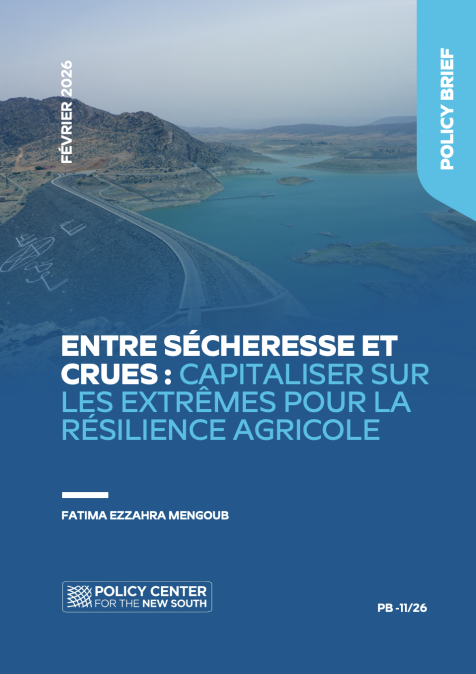
After more than seven years of drought, Morocco experienced exceptionally abundant rainfall during the winter of 2025-2026, reflecting increasingly marked water variability. This rapid alternation between chronic deficits and occasional excesses reveals the country's water paradox: a system historically centered on scarcity must now manage concentrated and intense extreme episodes.
Hydraulic infrastructures helped limit human and economic impacts and ensured significant replenishment of water reserves. Nevertheless, some agricultural areas suffered localized losses affecting crops, forage stocks, livestock and value-chain logistics, exposing structural vulnerabilities.
At the same time, groundwater recharge and improved dam filling rates create favorable prospects for upcoming agricultural seasons. These events underline the need to progressively adjust the hydraulic model to integrate excess water management and strengthen agricultural resilience and food security in the face of increasing climatic variability.
INTRODUCTION
Water management is faced with a dual dynamic: the increasing scarcity of resources and the intensification of extreme climatic events, which have a direct impact on food security, ecosystems and economies. Today, more than two billion people live in areas facing severe water stress. These extreme conditions are tending to intensify, as evidenced by the increasing frequency and intensity of climatic hazards. Since 2000, flood-related disasters have risen by 134%, while the number and duration of drought episodes have increased by 29%, accentuating economic vulnerabilities and weakening the resilience of affected populations (WMO, 2021).
Reflecting similar global trends, Morocco, a country with an arid to semi-arid climate marked by high spatio-temporal variability in rainfall, is facing a growing water paradox. After more than seven years of prolonged drought, the country experienced exceptionally abundant rainfall in the space of a few months, from December 2025 to the end of January 2026, signaling a rapid shift from scarcity to excess. This transition comes in a context where Morocco, over the decades, has built up a hydraulic system centered on the mobilization and storage of water resources, primarily designed to cope with periods of shortage while also providing flow regulation and flood mitigation. However, the concentrated rainfall and intensification of extreme events during the winter of 2025–2026 have exposed the limits of this model in the face of increasingly unstable climatic patterns, resulting simultaneously in rapid replenishment of water reserves and a surge in flooding incidents.
This context highlights the urgent need for structural adaptation of water management policies, based on an integrated approach that reconciles risk prevention, sustainable resource development and the strengthening of territorial resilience. This Policy Brief aims to demystify the water paradox facing Morocco, analyze the potential main repercussions of flooding on the agricultural sector, and identify how to take advantage of this exceptional situation to boost agricultural production, improve soil fertility and strengthen the country's food security.
FROM CHRONIC SCARCITY TO EPISODIC EXCESS: A REVEALING WATER PARADOX
Morocco is a paradigmatic example of the contemporary water paradox: its hydraulic infrastructures were designed both to secure water supplies during periods of drought and to mitigate the impact of floods. The intensification of extreme events, linked to climate change, exposes the country to punctual excesses of water, putting to the test a model historically centered on scarcity. Although there have been flooding episodes since the 1950s, many of them fatal, the collective memory remains far more strongly shaped by the long periods of drought that have permanently influenced perceptions and water management practices.
This historical experience of scarcity has continued even in recent years. Between 2019 and 2025, Morocco experienced a period of prolonged water stress.Across several strategic basins, annual rainfall fell 20–30% short of normal climatic averages, leading to a significant contraction in mobilizable resources. Dam levels fell on average below 30%, occasionally dropping to 22–24%, while the piezometric levels of certain groundwater aquifers experienced significant declines (Mengoub, 2024 In this context, the hydraulic infrastructures developed over several decades—including nearly 152 large dams with a total capacity of around 20 billion cubic meters—serve a dual purpose. Originally designed to secure water during periods of deficit, they also contribute to flood regulation, mitigating the impacts of episodic water surpluses. These infrastructures thus embody the complexity of Morocco’s water paradox: a country historically organized to manage scarcity now faces occasional excesses that rely on the same structures, highlighting both their utility and the limitations imposed by the intensification of climatic events.
The flood-mitigation function of dams becomes particularly evident during slow-onset floods, typical of large basins such as the Sebou, Oum Er-Rbia and Tensift rivers. By regulating flow, dams shift the frequency of damaging floods - an event that would naturally occur every two or five years can thus be postponed to a ten- or multi-decade occurrence. This mechanism provides substantial protection for populations and the economy, but it can also create a false sense of security, giving the impression that major floods will no longer occur. This perception has encouraged urban expansion and the occupation of floodplains, thereby increasing vulnerability to exceptional flood events (Department of the Environment, 2008).
In parallel, Morocco is also exposed to rapid flooding, concentrated on mountain slopes and coastal wadis, characterized by very short concentration times, high flow velocities and significant solid transport. These torrential floods, triggered by intense rainfall on steep slopes and poorly permeable soils, drastically reduce warning times and amplify material and human damage. The hydrological duality - slow and extensive in the lowlands, brutal and concentrated in mountainous and coastal areas - requires a fine-tuned understanding of risks for any management and innovation strategy (Department of the Environment, 2008).
Land use accentuates this complexity and increases the risk of flooding. Rapid urbanization and increasing soil sealing increase surface runoff and reduce natural water infiltration, modifying the hydrological responses of watersheds and increasing the risk of local flooding. Scientific research has shown that the increase in impervious surfaces reduces catchment response times and raises peak flows, which can transform moderate rainfall events into significant flooding events, depending on the spatial distribution and extent of urbanization (Duan & al., 2020). This dynamic is exacerbated by the effect of hydric and social memory: prolonged years of drought have led to a relative oblivion of flood risk, reducing vigilance and encouraging the gradual occupation of major riverbeds and historically flood-prone areas. Thus, where caution would have been justified, urbanization and agricultural development have advanced into at-risk areas, increasing the vulnerability of populations and infrastructures during intense rainfall episodes.
Analysis of recent episodes, particularly those of winter 2025-2026, shows that the severity of flooding depends as much on hydrological intensity as on the national system's ability to anticipate, coordinate and disseminate information. Against this backdrop, Morocco demonstrated an effective and structured post-flood response, rapidly mobilizing crisis management systems, institutional players and local communities, thereby limiting the human and economic impact. This positive experience underlines the country's ability to manage extreme hazards, while highlighting the importance of further anticipating future events, notably by strengthening early-warning systems, territorial planning and raising public awareness.
Thus, the Moroccan water paradox remains clear: hydraulic infrastructures, designed to secure resources in times of deficit, regulate floods and, when accompanied by effective post-crisis management, offer an opportunity to strengthen territorial resilience. The consolidation of this resilience now depends on a greater capacity to predict and prepare for future extreme events, transforming climate variability into a lever for sustainable development and food security.
WATER SURPLUS EPISODES AND AGRICULTURE: INITIAL FINDINGS AND INSIGHTS
It is still too early to draw definitive conclusions, but recent flooding episodes have highlighted the vulnerability of certain agricultural areas to excess water concentrated over time. Intense flows may have simultaneously affected crops, feed stocks and value-chain logistics, revealing structural fragilities that may manifest themselves differently depending on regional contexts and crop types.
From an agronomic point of view, losses are potentially multiple and closely interconnected, and their extent is likely to vary according to region, agricultural vocation and crop type. Autumn cereals, essential to national food security, could be partially or totally destroyed in some basins, while forage crops and perennial plantations, including citrus, may suffer prolonged root asphyxia, compromising future yields and jeopardizing the survival of some farms.
Flooding can also lead to massive loss of feed stocks and livestock. Hay and straw intended for cattle and sheep, as well as stored corn silage, can become unfit for animal feed. At the same time, direct mortality of livestock by drowning can occur in heavily submerged areas, exacerbating the economic and food vulnerability of farms already weakened by consecutive years of drought. In addition, flooding forces many livestock farmers to move their herds to areas designated by the authorities, often with limited resources, increasing the pressure on host sites.
Beyond individual farms, floods can significantly disrupt agricultural value-chains and logistics on several levels. On the one hand, access to the inputs and resources needed for farming may be limited. Submerged or impassable roads complicate the transport of seeds, fertilizers, fodder and other essential supplies for crops and livestock, slowing down normal farm operations.
At the same time, floods make work more arduous, and the lack of available manpower for essential agricultural activities further complicates the management of plots, crops and herds. The distribution of agricultural and food products could also be severely affected. Milk collection by factories could be partially interrupted, the circulation of dairy and meat products is encountering difficulties, and rural souks may experience partial paralysis. These disruptions show that the impacts of flooding go beyond the mere loss of production: they compromise food availability, farmers' incomes and the resilience of local markets.
CAPITALIZING ON FLOODING: RESILIENCE LEVERS AND AGRICULTURAL PROSPECTS
Recent episodes of water abundance are not just negative hazards: they also offer a rare but structuring window of opportunity to strengthen water and agricultural resilience. In arid and semi-arid contexts, intense rainfall and flooding can help to replenish and recharge aquifers, provided that landscapes and management systems allow for greater water infiltration. In addition, infiltration and sediment deposition associated with flooding can improve soil structure and fertility, encouraging the regeneration of degraded land. These mechanisms have been observed in several regions where integrated stormwater management mobilizes not only physical infrastructures, but also agricultural and territorial practices that maximize the hydric and ecological benefits of these excesses.
The leaching of minerals and salts and temporary submergence of land can help reduce salinity and stimulate biological activity in soils, promoting medium- and long-term fertility and the partial reconstitution of natural and agricultural ecosystems. At the same time, the significant recharge of water tables and the filling rate of agricultural dams, which exceeded sixty-nine percent compared with twenty-five percent the previous year, offer unprecedented scope for securing irrigation and regulating flows during future rainy episodes.
These conditions make it possible to envisage a strategic revival of irrigated crops, integrating alternative crops adapted to post-flood conditions and fodder to secure livestock feed. They help reduce the economic vulnerability of farms and stabilize the agricultural value-chain, while promoting the development of the functional biodiversity necessary for the resilience of farming systems.
To transform these excesses into opportunities, it is essential to combine a rapid, systemic reading of post-flood conditions with technical interventions on soil and water, a reorganization of agricultural cycles adapted to water flows, and effective coordination between the State and agricultural stakeholders. By capitalizing on ecological and water-related gains, it is possible to sustainably boost productivity and food security, while preparing the sector to better absorb future shocks. In this context, flooding is not only a risk factor, but also a lever for rethinking and modernizing Moroccan agriculture, by transforming one-off excesses into medium- and long-term strategic resources.
CONCLUSION
Morocco now operates in a context of increased water variability, marked by alternating episodes of prolonged drought and punctual excesses concentrated over time. This dynamic does not reflect a reversal of the climatic regime, but rather an intensification of extremes that complicate the management of water resources and agricultural systems.
Recent floods have highlighted the different vulnerabilities of different regions, sectors and production systems. They have revealed logistical, forage and land fragilities, while simultaneously generating potentially favorable effects in terms of recharging water tables, filling dams and, in some cases, improving edaphic conditions.
These episodes do not in themselves constitute a structural break with the hydraulic model historically centered on scarcity management, but they do highlight the adjustments required in the face of increased water variability. The challenge, then, is not to substitute one paradigm for another, but to integrate the management of one-off excesses more fully into a strategic framework initially structured around scarcity.
With this in mind, the consolidation of water and agricultural resilience will be based on progressive, territorialized and coordinated adaptation, capable of anticipating shocks, reducing identified structural vulnerabilities and making the best use of water surpluses when they occur. Climate variability cannot be eliminated, but it can be better integrated into planning and governance, in order to sustainably strengthen national water and food security.
REFERENCES
- Department of the Environment, 2008. Étude pour la réalisation d'une cartographie et d'un système d'information géographique sur les risques majeurs au Maroc mission 1 identification des risques d'inondation. Secrétariat d'État auprès du Ministère de l'Energie, des Mines, de l'Eau et de l'Environnement chargé de l'Eau et de l'Environnement Département de l'Environnement. Direction de la Surveillance et de la Prévention des Risques. September 2008.
- Duan, H., Zhou, Q., & Zhou, H. (2020). Impacts of urbanization on runoff and flood hazards: A review of hydrological modeling approaches. Natural Hazards, 102(3), 945-966. https://doi.org/10.1007/s11069-020-04480-0
- Mengoub F., 2024. Au fil de l'eau: water innovation in Morocco. Publication/ Opinion. Policy Center for the New South. March 2024.
- Ministère de l'Équipement et de l'Eau, 2026. Présentation du Programme National pour l'Approvisionnement en Eau Potable et l'Irrigation (PNAEPI) 2020-2027. https:// www.equipement.gov.ma/eau. Accessed on 12/02/2026.https://www.equipement.gov.ma/eau
- WMO, 2021. 2021 State of Climate Services. Water. World Meteorological Organization (WMO). https://library.wmo.int/idurl/4/57630https://library.wmo.int/idurl/4/57630