Publications /
Opinion

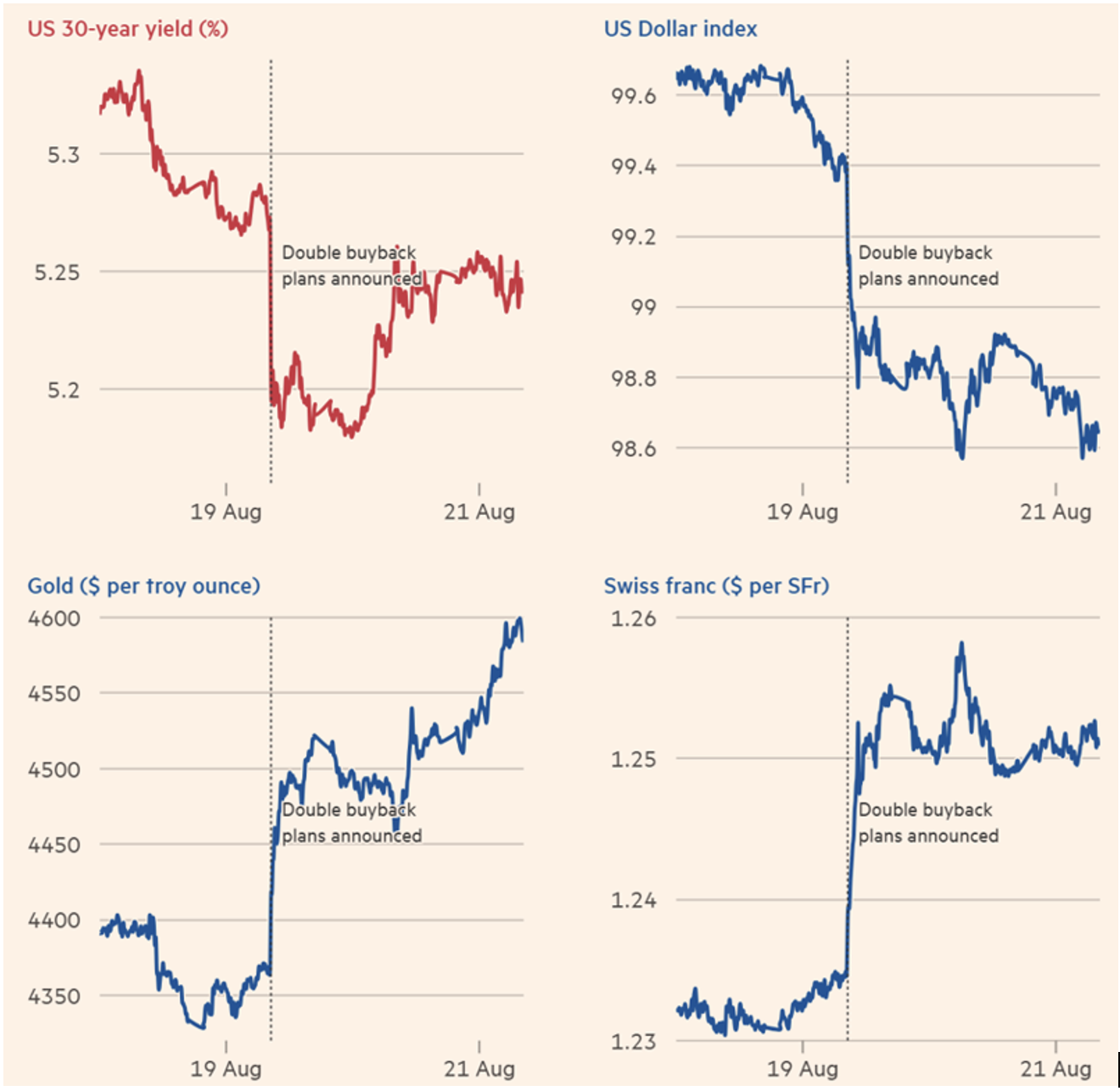
“A band-aid on a bullet hole!” That’s how Charlie McElligott, a cross-asset strategist at Nomura, described the maneuver carried out by United States Treasury Secretary Scott Bessent on August 19. The U.S. Treasury Department announced that from September 9 to November 4, it would double the volume of long-term bond buybacks, going from $2 billion to at least $4 billion per operation, with a focus on maturities of between 10 and 30 years.
The announcement came right after the yield on 30-year U.S. Treasury bonds hit its highest level in 19 years. In the wake of the announcement, yields fell within minutes. However, by the afternoon of the following day, they returned to levels not far from those before the intervention. Gold and the Swiss franc climbed as investors sought shelter elsewhere, while the U.S. dollar depreciated (Figure 1).
Figure 1: Bessent’s Bond Intervention Sent Investors Towards Other Havens
Source: Katie Martin (2026). Bossing the bond market around never works, Financial Times, August 22.
Scott Bessent described his action as “liquidity management”. But the market reaction, however, was evident after just one day, suggesting that the rise in long-term rates is driven by more fundamental factors.
Public sector deficits and debt in the U.S. are on an upward trajectory. Federal government debt held by the public jumped from $3.4 trillion in 2000 to $32.3 trillion today, a rise from 33.7% of GDP to over 100% in a little over 25 years. The cost of servicing that debt has doubled, going from 11% of tax revenues in 2000 to 21.5% in the first ten months of the current fiscal year.
Unlike what happened in the years after the 2008 global financial crisis, higher long-term borrowing costs in the 2020s are one of the dimensions of the macroeconomic policy regime change in advanced economies. The U.S. budget deficit (heading toward levels close to 6% per year), and the continuous volume of issuance to refinance debt, could be responsible for the rise in long-term rates.
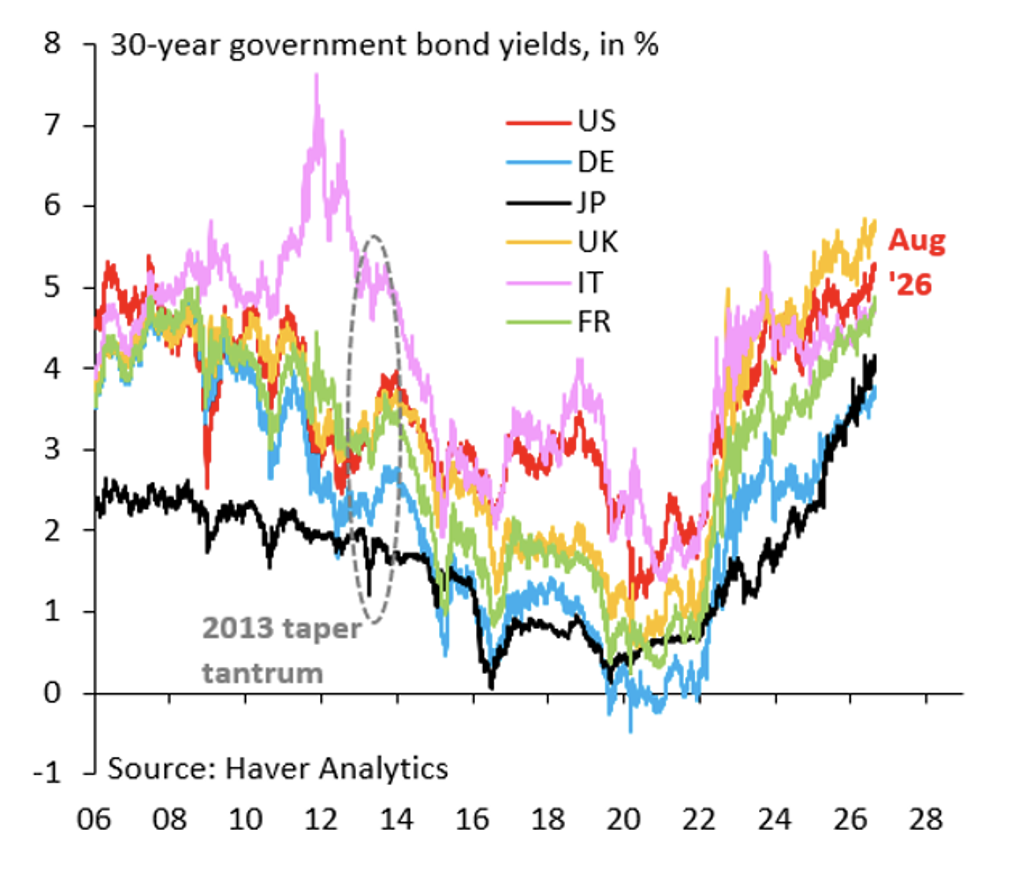
The U.S. is not the only advanced economy currently facing such challenges of growing deficits and public debt, while debt service keeps rising. Thirty-year government bond yields have risen broadly among advanced economies (Figure 2). But the central position of U.S. Treasury bonds as a global reserve asset evidently gives them a unique importance.
Figure 2: 30-year Government Bond Yields, %, Selected Economies
Source: Robin Brooks (2026). Q&A on the Global Bond Market Sell-Off, August 19. Note: US=United States; DE=Germany; JP=Japan; UK=United Kingdom; IT=Italy; FR=France.
Two other factors also potential influence rising U.S. Treasury long-term interest rates. First, there is competition between Treasury bond purchases and strong corporate debt issuance, especially from the technology sector for artificial intelligence investment. Second, expectations for monetary policy in the face of inflation may have played a role. Market doubts about the path of inflation and whether it is converging toward the Federal Reserve’s (Fed) target could be leading investors to demand higher returns for holding long-term bonds.
The small magnitude of Bessent’s intervention should be noted. For a U.S. Treasury tradable debt market totaling more than $32 trillion, buybacks of $4 billion function more as a signal, and are far from constituting a structural adjustment of supply and demand. The fading of the immediate effect—accompanied by Bessent’s promises that the public deficit will eventually shrink to 3% of GDP—suggests the signal was unconvincing.
In this context, there is a curious contrast between U.S. Treasury Secretary Scott Bessent and the Bessent who participated, as a member of George Soros’s team, in the most successful speculative attack in history—against the British pound sterling in 1992.
It is worth remembering that, to maintain sterling’s peg to the Deutsche Mark after joining the European exchange rate mechanism, which preceded the introduction of the euro, the Bank of England had to set high interest rates, while the British economy desperately needed the opposite: lower rates to stimulate credit and employment. There was a mismatch between the fixed exchange rate and macroeconomic fundamentals. The bet made by Soros and his team—that the British exchange rate would not be sustainable—ultimately paid off. The rise in long-term U.S. rates, however, does not seem to correspond to deviations from fundamentals.
Bessent succeeded in supporting the Argentine peso in 2025, not least because doubts about the political sustainability of the reform project attempted by Argentina’s President Javier Milei were dispelled by the results of the country’s congressional elections in October 2025 (Milei’s party won the largest share of votes). Bessent also managed to prevent Japan from dumping Treasury bonds to defend the yen, instructing the Fed to sell euros rather than dollars in order to buy Japanese securities, without notifying European Union authorities beforehand—although the effect of that intervention dissipated quickly. But U.S. long-term yields are a different story.
Bessent argues that long-term rates are currently higher than fundamentals would suggest, and advocates short-term borrowing to weather the rate surge, which, in his assessment, will soon give way to declining rates. He has promised that, helped by AI-driven growth, the U.S. public deficit should decrease as a share of GDP.
An extension of his August 19 move would mean swapping long-term debt for short-term debt. This is similar to the measures adopted by the Fed during the ‘quantitative easing’ era. Such an approach can make sense in moments of panic, as after the global financial crisis, when the probability was high that long-term rates would fall. At this point, however, market signals point in the opposite direction.
This puts Bessent in obvious contrast with Federal Reserve Chair Kevin Warsh, who is opposed not only to quantitative easing but also to forward guidance from officials on interest-rate policy. The market’s own reactions—such as the recent rise in long-term rates—would already provide to some extent an answer to doubts about the resilience of inflation.
In an August 28 speech at the Jackson Hole meeting of central bankers, Warsh said the Fed would be ready to raise rates under his leadership if inflation does not fall soon. Japan’s currency and bonds came under pressure on Monday August 31 as investors increased bets that the U.S. and Japan would raise interest rates.
On the other hand, there is also a more benign narrative about what is happening with U.S. long-term yields. In a Financial Times article (August 27), Stephen Miran, former head of the White House Council of Economic Advisers and former temporary member of the Fed’s Open Market Committee, acknowledged the recent rise in the real component of interest rates. But he highlighted that this happened without a pronounced rise in the term premium, or in inflation expectations. Paul Krugman has also argued against the idea that the U.S. public debt market might be undergoing some sort of “looming Greek-type debt crisis”.
According to Miran, the recent rise in bond yields is due almost entirely to expectations of higher overnight rates in the long run, on account of an increase in investors’ economic growth projections; not by concerns regarding central bank credibility or the fiscal situation. One percentage point of additional GDP growth would reduce deficits by about one percentage point of GDP... Interest rates would be rising for benign reasons...
A word of caution is needed on the argument that rising Treasury yields reflect a stronger economy that will in due course pay for the public deficit. Deficits are aggravated by higher interest rates. And it remains a strong presumption that AI’s effects on productivity and growth will outweigh the revenue shortfall from tariffs and the tax exemptions in the One Big Beautiful Bill Act passed by the Trump administration in 2025.