Publications /
Opinion

Back
A Bad Year? Climate Variability and the Wine Industry in Chile
Authors
Patricio Aroca
Pilar Jano
Ademir Rocha
Bruno Pimenta
November 23, 2020

Short-term climate conditions may affect crop yields and vintage quality and, as a consequence, wine prices and vineyards’ earnings. In this paper, we use a Computable General Equilibrium (CGE) model for Chile, which incorporates very detailed information about the value chain of the wine sector in the country. Using information for the 2015-2016 harvest, we calibrate climate variability shocks associated with a “bad year” for the wine industry in Chile, when premature rains occurred in important wine regions, reducing the area harvested and leading to wines with less concentrated flavors, particularly for reds. We model the climate shocks as a productivity change in the grape-producing sector (quantity effect). Moreover, we model quality effects as a shift in the foreign demand curve for Chilean wine. Given the specific economic environment in the model and the proposed simulation, it is possible to note the reduction of Chilean real GDP by about 0.067%. By decomposing this result, we verify that the quality effect has a slightly greater weight compared to the quantity effect.
RELATED CONTENT

  • Authors
    Russel Dinh
    January 27, 2016
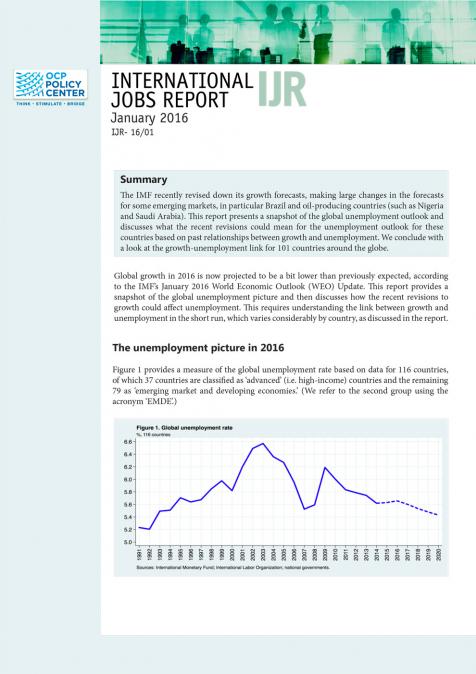
    The IMF recently revised down its growth forecasts, making large changes in the forecasts for some emerging markets, in particular Brazil and oil-producing countries (such as Nigeria and Saudi Arabia). This report presents a snapshot of the global unemployment outlook and discusses what the recent revisions could mean for the unemployment outlook for these countries based on past relationships between growth and unemployment. We conclude with a look at the growth-unemployment link f ...
  • Authors
    December 14, 2015
    The end of supply chain is the natural corollary of the sustained price fall of virtually all commodities observed over the past many months. If it appears premature to state exactly what is the impact of this deconsolidation in the commodities value chain, it is believed that the strategic role of physical trading is strengthening. Under such circumstances, the industrial strategies of developing countries and commodity exporters may have to evolve and, in priority, foster optimizi ...
  • November 5, 2015
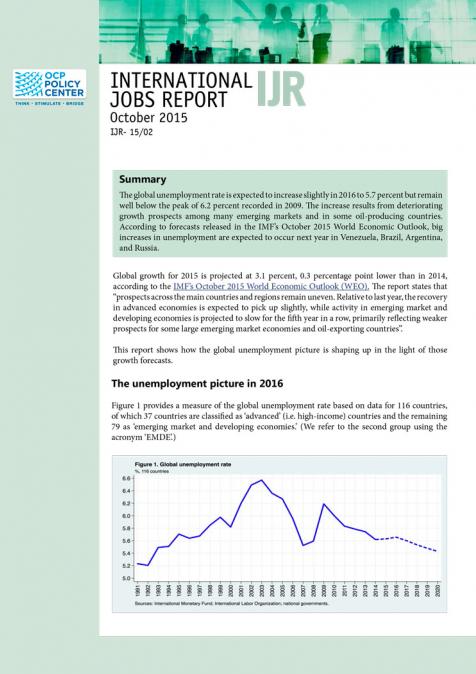
    The global unemployment rate is expected to increase slightly in 2016 to 5.7 percent but remain well below the peak of 6.2 percent recorded in 2009. The increase results from deteriorating growth prospects among many emerging markets and in some oil-producing countries. According to forecasts released in the IMF’s October 2015 World Economic Outlook, big increases in unemployment are expected to occur next year in Venezuela, Brazil, Argentina, and Russia. ...