Publications /
Annual Report
Book / Report
Back
Atlantic Vision 2025
Authors
Policy Center for the New South
July 23, 2026

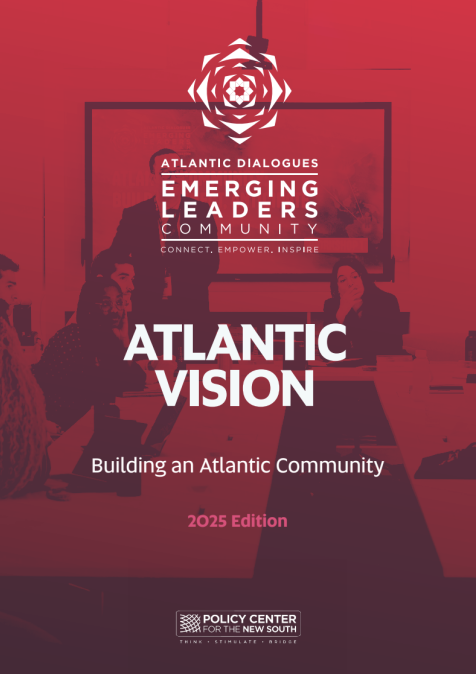
Since 2018, the Atlantic Vision exercise has provided a structured space within the Atlantic Dialogues Emerging Leaders program for successive cohorts to reflect collectively on the future of the Atlantic Basin. Each year, participants are divided into economic, political, and social working groups and tasked with identifying the region’s most pressing challenges and proposing forward-looking solutions. Over time, these reports have formed a coherent intellectual trajectory. 

The first edition established a baseline diagnosis. It identified structural obstacles to the emergence of a genuine Atlantic Community, including economic asymmetries, fragmented governance, weak coordination mechanisms, and persistent social inequalities. Subsequent cohorts expanded this agenda, responding to evolving geopolitical tensions, climate pressures, democratic stress, technological disruption, and widening inequality. The economic strand evolved from outlining a foundational roadmap to calling for structural reforms in financing, connectivity, and regulatory alignment. The political strand moved from diagnosing fragmented initiatives and misleading narratives to envisioning governance architectures capable of aligning regional strategies and elevating local voices. The social strand progressed from mapping structural injustices rooted in colonial legacies to designing participatory and narrative tools aimed at strengthening cohesion in diverse and unequal societies. 

Across editions, several cross-cutting messages have become increasingly clear. The Atlantic Community remains under-constructed and insufficiently tangible in citizens’ daily lives. Youth leadership is central, but it must be embedded within broader, intergenerational coalitions capable of scaling impact. Building, connecting, and anticipating are inseparable processes. Most importantly, the unfinished agenda is implementation. Cohorts have consistently converged on ambitious ideas; the challenge now lies in testing them, scaling what works, and embedding accountability mechanisms that endure beyond individual workshops. 

In 2025, the original foresight horizon has been reached. This milestone marks not the end of the exercise, but its transformation. Rather than asking what should be achieved by 2025, this year’s cohort was invited to engage with a retrospective of previous reports and to confront a new and more demanding question: 

What would a credible, shared Atlantic Community look like by 2035 and beyond, and what concrete steps must be taken now to make it operational? 

The shift is deliberate. The Atlantic Basin is one of the world’s busiest oceanic corridors—a vital artery for global trade, energy flows, and commercial exchange—and an increasingly strategic geopolitical space. Yet, despite growing economic interdependence and the emergence of multiple cooperation initiatives across security, trade, climate, and blue economy governance, fragmentation persists. The region’s institutional landscape remains dense but insufficiently aligned. Trust gaps endure between North and South. Social protection systems struggle to keep pace with climate disruption and technological change. Economic value chains remain vulnerable to external shocks. Against this backdrop, the 2025 cohort focused less on broad crisis mapping and more on the structural bottlenecks that prevent the Atlantic from functioning as a coherent and resilient community

RELATED CONTENT

  • December 12, 2017
    Countries in the Sahel are facing political changes that affect the rest of the continent and the world. The Sahel region has had a long history of vulnerability owing to dry land conditions, climate change as well as movements of people. These factors have resulted in porous frontiers ...
  • July 5, 2017
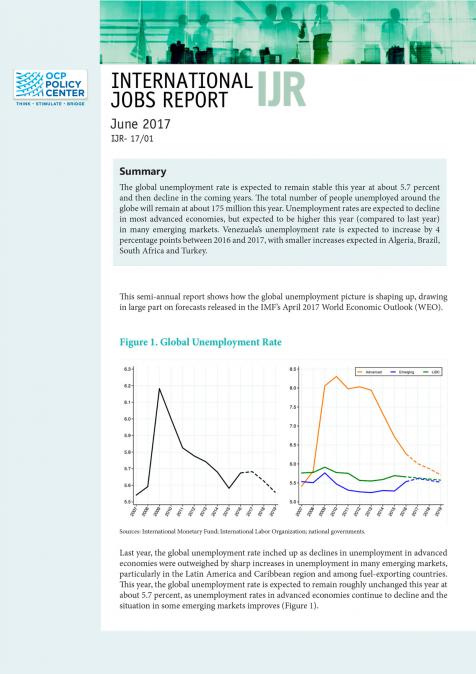
    The global unemployment rate is expected to remain stable this year at about 5.7 percent and then decline in the coming years. The total number of people unemployed around the globe will remain at about 175 million this year. Unemployment rates are expected to decline in most advanced economies, but expected to be higher this year (compared to last year) in many emerging markets. Venezuela’s unemployment rate is expected to increase by 4 percentage points between 2016 and 2017, with ...
  • Authors
    December 13, 2016
    The authors of the Atlantic Currents report cross-examine the trends and challenges of the Atlantic space under different perspectives, driven by the desire to move away from the North-South divisions and influences. Among the factors that motivate the communities in the Atlantic basin to co-operate with each other, we find the succession of financial and banking crises (now economic), which have destabilized nearly if not all the countries of the globe since 2008, more specifically ...
  • October 7, 2016
    La réunion des chefs d’État et de gouvernement des pays de l’OTAN à Varsovie constitue une étape importante de la transformation structurelle et fonctionnelle de l’Alliance atlantique et de l’OTAN. Le Communiqué final et les trois déclarations confirment le retour progressif à l’endiguement, à travers le renforcement de la dissuasion et la défense de l’Alliance, et la mise à distance de la menace asymétrique et hybride. Cette dynamique contribue à la centralité de la défense collect ...
  • Authors
    Karim EL Mokri
    June 21, 2016
    The Atlantic basin holds a strategic place in the global economy given the systemic importance that the northern part of the region represents. However, this area remains very heterogeneous with significant differences between the economies within it. The analysis conducted in this policy brief also shows the lack of synchronization of the economic cycle among the countries in the region, and especially the low level of trade and financial integration of the African part of the basi ...
  • Authors
    Karim EL Mokri
    June 21, 2016
    Le bassin Atlantique occupe une place stratégique dans l’économie mondiale vu le poids systémique que représente la partie Nord de la région. Néanmoins, cet espace demeure très hétérogène avec des écarts importants entre les économies qu’il englobe. Les analyses menées dans ce Brief montrent également le manque de synchronisation du cycle économique entre les pays de la région mais surtout le faible degré d’intégration commerciale et financière de la partie africaine du bassin. En o ...
  • Authors
    Michel Petit
    January 12, 2016
    The expression “green revolution” is controversial today; yet my own assessment is that, in spite of many valid criticisms, the Green Revolution was a major achievement for humankind: it made erroneous the Malthusian predictions of the 1960s and 70s that it would be impossible to provide enough food for a rapidly growing world population and that major humanitarian crises, including famines, would occur in several countries within a few years, particularly in South Asia. In a wider ...