Publications /
Annual Report
Book / Report
Back
Atlantic Vision 2025
Authors
Policy Center for the New South
July 23, 2026

Since 2018, the Atlantic Vision exercise has provided a structured space within the Atlantic Dialogues Emerging Leaders program for successive cohorts to reflect collectively on the future of the Atlantic Basin. Each year, participants are divided into economic, political, and social working groups and tasked with identifying the region’s most pressing challenges and proposing forward-looking solutions. Over time, these reports have formed a coherent intellectual trajectory. 

The first edition established a baseline diagnosis. It identified structural obstacles to the emergence of a genuine Atlantic Community, including economic asymmetries, fragmented governance, weak coordination mechanisms, and persistent social inequalities. Subsequent cohorts expanded this agenda, responding to evolving geopolitical tensions, climate pressures, democratic stress, technological disruption, and widening inequality. The economic strand evolved from outlining a foundational roadmap to calling for structural reforms in financing, connectivity, and regulatory alignment. The political strand moved from diagnosing fragmented initiatives and misleading narratives to envisioning governance architectures capable of aligning regional strategies and elevating local voices. The social strand progressed from mapping structural injustices rooted in colonial legacies to designing participatory and narrative tools aimed at strengthening cohesion in diverse and unequal societies. 

Across editions, several cross-cutting messages have become increasingly clear. The Atlantic Community remains under-constructed and insufficiently tangible in citizens’ daily lives. Youth leadership is central, but it must be embedded within broader, intergenerational coalitions capable of scaling impact. Building, connecting, and anticipating are inseparable processes. Most importantly, the unfinished agenda is implementation. Cohorts have consistently converged on ambitious ideas; the challenge now lies in testing them, scaling what works, and embedding accountability mechanisms that endure beyond individual workshops. 

In 2025, the original foresight horizon has been reached. This milestone marks not the end of the exercise, but its transformation. Rather than asking what should be achieved by 2025, this year’s cohort was invited to engage with a retrospective of previous reports and to confront a new and more demanding question: 

What would a credible, shared Atlantic Community look like by 2035 and beyond, and what concrete steps must be taken now to make it operational? 

The shift is deliberate. The Atlantic Basin is one of the world’s busiest oceanic corridors—a vital artery for global trade, energy flows, and commercial exchange—and an increasingly strategic geopolitical space. Yet, despite growing economic interdependence and the emergence of multiple cooperation initiatives across security, trade, climate, and blue economy governance, fragmentation persists. The region’s institutional landscape remains dense but insufficiently aligned. Trust gaps endure between North and South. Social protection systems struggle to keep pace with climate disruption and technological change. Economic value chains remain vulnerable to external shocks. Against this backdrop, the 2025 cohort focused less on broad crisis mapping and more on the structural bottlenecks that prevent the Atlantic from functioning as a coherent and resilient community
RELATED CONTENT

  • Authors
    Alessandro Minuto-Rizzo
    Bernardo Sorj
    Frannie Léautier
    Iskander Erzini Vernoit
    Kassie Freeman
    Nathalie Delapalme
    J. Peter Pham
    March 7, 2022
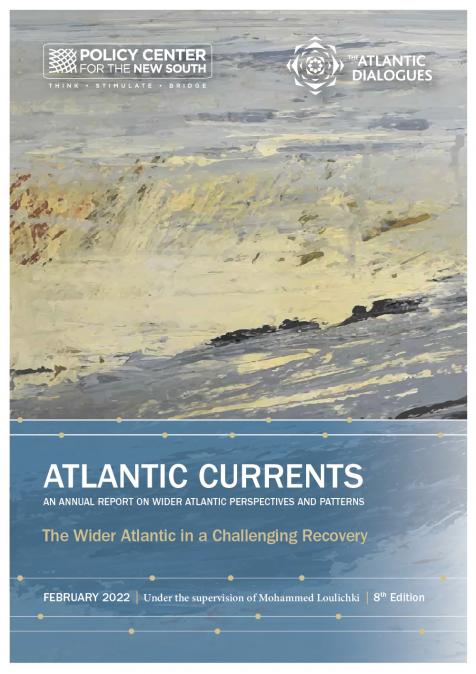
    The COVID-19 pandemic has had a huge impact on the global economy and has challenged the best minds to rethink how to design and implement an effective recovery. Countries in the wider Atlantic region have exhibited differential trajectories in traversing the pandemic. A number of countries in Europe succeeded in vaccinating most of their eligible populations, enabling life to return somewhat to normal. A smaller group of countries in Europe could manage infection rates even more ti ...
  • Authors
    Sabine Cessou
    February 16, 2022
    Based in Washington DC, where he launched the Accountability Lab in 2012, this British citizen describes himself as « inquisitive, energetic and values-driven ». He heads a global « translocal network » which is expanding rapidly and about to open new local labs in Uganda and Somalia. The Lab, a non profit organization, currently employs 104 people in 14 countries in Asia, Africa and Latin America. The aim is to make governments more transparent and accountable ...
  • Authors
    Sabine Cessou
    January 14, 2022
    “Entrepreneurial, curious, energetic”. This is how Youssef Kobo, a Belgian citizen coming from a Moroccan family, would describe himself in three words. Always on the road, this busy traveler is taking part in conferences and workshops all over the world. His line of work? He is an individual consultant on strategic innovation. Despite the COVID-19 pandemic, he has launched his own enterprise, called New Blueprints, end of 2020. The demand is high for his talents of keynote speaker ...
  • December 22, 2021
    The new challenge for Latin America with the new pandemic variants: Regional unity in a context of political polarization At the beginning of the global health crisis, Latin America was immersed in multiple changes in ideological and political trends in different countries. In a world t...
  • December 13, 2021
    The African Continental free Trade Area (AfCfTA) finally entered into force on the first month of 2021, after the 22nd country ratified the agreement. It is a one of the flagship projects of the African Union 2063 agenda, but It is a first step on a long journey to African Economic inte...
  • Authors
    Sabine Cessou
    December 13, 2021
    This political analyst, expert in security issues and international development, describes her personality as « down to earth, curious », and not taking herself « very seriously ». Born in Seattle, half German and half Korean-American, she was raised « between three cultures ». After a decade living and working abroad in Rwanda, China, Afghanistan, the UK, and Myanmar, she is now based in Berlin. She’s fond of cooking and is a « beer nerd » – ...
  • Authors
    Sabine Cessou
    December 7, 2021
    This impact-driven young Peruvian legal scholar studies and advocates for the redesign of Corporate Law internationally through innovation for sustainable development. What does that mean exactly? After graduating from Harvard Law School (LL.M.’19), Juan Diego Mujica Filippi has been working as academic coordinator of an international research project on purpose-driven companies and the regulation of the fourth sector sponsored by the Ibero-American General Secretariat (SEGIB, base ...