Publications /
Annual Report
Book / Report
Back
Atlantic vision 2025: building an Atlantic community - 2024 edition
Authors
Policy Center for the New South
April 24, 2025

The countries of the Atlantic region continue to navigate a complex series of challenges that demand urgent and innovative responses. Economic and financial instability, social unrest, and shifting political landscapes are reshaping the region’s geopolitical dynamics. Pressing issues including unemployment, poverty, violence, extremism, climate change, and migration are intensifying, underscoring the need for sustainable and inclusive solutions. Addressing these multifaceted challenges requires intergenerational and cross-regional dialogue to foster collaboration and drive meaningful change.

In this context, the 2024 Atlantic Dialogues Emerging Leaders (ADEL) program brought together a diverse group of high-impact young leaders from across the Atlantic space. These participants engaged in dynamic discussions to identify the main challenges confronting the region, and to develop innovative, actionable solutions.

This report presents the outcomes of the Build, Connect, Anticipate workshop, during which ADEL participants critically examined the pressing issues shaping the Atlantic’s future, and explored strategies to address them. The discussions centered on fostering a more integrated and inclusive Atlantic community—one that amplifies the voices of the Global South.

Divided into three working groups, the Emerging Leaders analyzed the economic, political, and social aspects of the region’s challenges.

At the heart of their discussions were two key guiding questions:

1- What are the most pressing challenges facing the Atlantic Basin?
2- What concrete solutions can the Atlantic community implement to address these challenges?

This report synthesizes their findings, offering valuable insights into the region’s evolving challenges and presenting strategic recommendations for a more prosperous and interconnected Atlantic future.

RELATED CONTENT

  • Authors
    Policy Center for the New South
    July 16, 2026
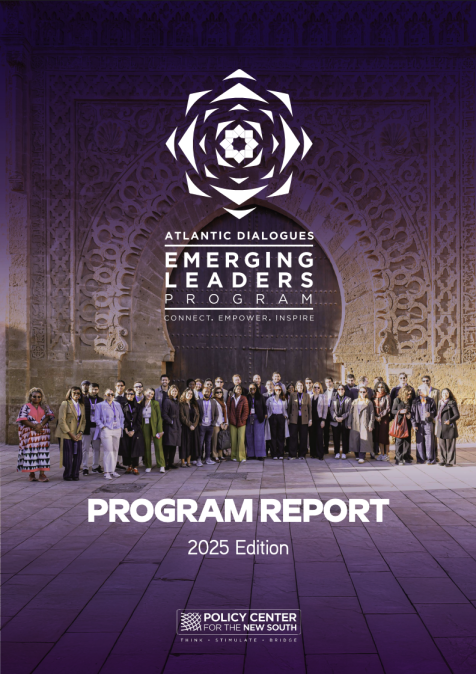
    The 12th Atlantic Dialogues Emerging Leaders program took place from December 7 to 11, 2025, in Rabat, Morocco. From a highly competitive pool of more than 1,900 applicants representing 125 countries, 42 exceptional young professionals, aged 25 to 35, were selected. The cohort included participants from 27 countries across the Atlantic Basin, spanning Africa, Europe, and the Americas, with additional representation from Asia and Oceania, reflecting the program’s growing global reach ...
  • Authors
    Policy Center for the New South
    July 1, 2026
    At a time when unpredictability has become a defining characteristic of international affairs, meaningful dialogue is both increasingly difficult to sustain and more essential than ever. Geopolitical rivalries, technological transformations, and mounting global fragmentation have challenged many of the assumptions that once underpinned international cooperation. In numerous instances, these developments have eroded confidence in institutions, strained partnerships, and weakened comm ...
  • Authors
    Sous la direction de
    June 23, 2026
    L’Afrique atlantique émerge aujourd’hui comme un espace de réflexion stratégique majeur. Longtemps envisagée sous l’angle de sa fragmentation ou de sa marginalité relative dans les grands récits géopolitiques, cette façade maritime tend désormais à être appréhendée comme un ensemble en devenir, structuré par des dynamiques géopolitiques, économiques et sécuritaires de plus en plus intenses. C’est dans cette perspective qu’a été initié le Africa Maritime Symposium (AMS), dont la ...
  • Authors
    Paul Isbell
    April 2, 2026
    PrefaceThis series of policy briefs, Pan-Atlanticism: The Atlantic Basin in a Multipolar-Transnational World, assesses the strategic significance—and potential—of the Atlantic Basin, when viewed and engaged with as a distinct and coherent region for international cooperation or governance, and as a potential arena of strategic competition, within a shifting structure of international power that is now moving from unipolarity to a new multipolar reality.The series began by tracing th ...
  • Authors
    Jonathan Berkshire Miller
    March 10, 2026
    At the Atlantic Dialogues in December 2025, I argued that a period was underway in which trade and security could no longer be analytically or practically separated. Assessments have solidified in recent months regarding the emergence of a geoeconomic world order. Geoeconomics was a gradual transition from a purely geopolitical focus on military force, to an emphasis on economics to gain competitive advantage. It is no longer a transitional phase, but an emerging structural componen ...
  • Authors
    Sofia Formigli
    February 13, 2026
    There is a story told by Václav Havel, the Czech dissident writer who later became president after the fall of communism. In his essay The Power of the Powerless, Havel describes a shopkeeper who, every morning, places a sign in his window reading: “Workers of the world, unite!” He does not believe in it. Nor do the people around him. Yet the sign remains. ...
  • Authors
    Amine Ghoulidi
    February 5, 2026
    This Paper was originally published on orient-online.com  The Western Mediterranean’s exposure to the Sahel is usually framed in terms of security spillovers and crisis management. This paper argues that this framing misreads how Sahelian access conditions now shape Mediterranean integration. Morocco’s Atlantic Initiative is a state-led corridor strategy combining Atlantic port infrastructure, inland transit routes, and energy systems to connect landlocked Sahelian economi ...
  • January 30, 2026
    En 2019, Donald Trump a proposé d’acheter le Groenland, déclenchant un refus catégorique du Danemark et une tension diplomatique transatlantique. Cette initiative reflétait l’intérêt stratégique et économique des États-Unis pour l’Arctique et ses ressources. L’épisode a mis en lumière l...
  • Authors
    January 27, 2026
    This paper revisits Big Push industrialization theory in the context of open economies deeply integrated into global value chains (GVCs). While classical Big Push models emphasize demand complementarities and coordination failures in largely closed economies, many middle-income countries now industrialize through foreign-owned, import-intensive production networks. We develop an extended Big Push framework that incorporates GVC integration and import leakage, and show how these feat ...