Publications /
Annual Report
Book / Report
Back
Atlantic Vision 2025
Authors
Policy Center for the New South
July 23, 2026

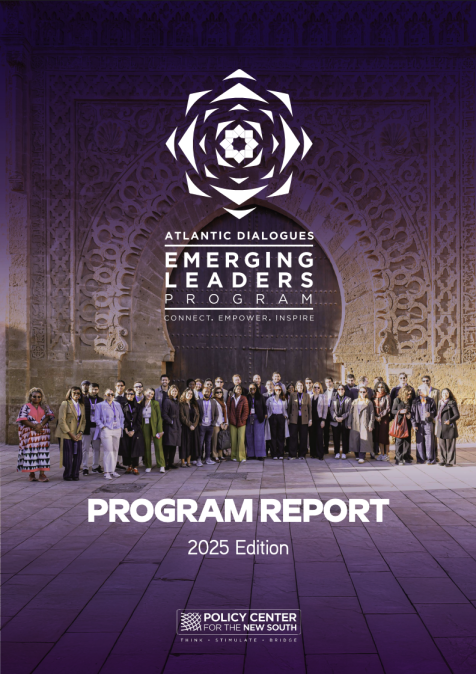
Since 2018, the Atlantic Vision exercise has provided a structured space within the Atlantic Dialogues Emerging Leaders program for successive cohorts to reflect collectively on the future of the Atlantic Basin. Each year, participants are divided into economic, political, and social working groups and tasked with identifying the region’s most pressing challenges and proposing forward-looking solutions. Over time, these reports have formed a coherent intellectual trajectory. 

The first edition established a baseline diagnosis. It identified structural obstacles to the emergence of a genuine Atlantic Community, including economic asymmetries, fragmented governance, weak coordination mechanisms, and persistent social inequalities. Subsequent cohorts expanded this agenda, responding to evolving geopolitical tensions, climate pressures, democratic stress, technological disruption, and widening inequality. The economic strand evolved from outlining a foundational roadmap to calling for structural reforms in financing, connectivity, and regulatory alignment. The political strand moved from diagnosing fragmented initiatives and misleading narratives to envisioning governance architectures capable of aligning regional strategies and elevating local voices. The social strand progressed from mapping structural injustices rooted in colonial legacies to designing participatory and narrative tools aimed at strengthening cohesion in diverse and unequal societies. 

Across editions, several cross-cutting messages have become increasingly clear. The Atlantic Community remains under-constructed and insufficiently tangible in citizens’ daily lives. Youth leadership is central, but it must be embedded within broader, intergenerational coalitions capable of scaling impact. Building, connecting, and anticipating are inseparable processes. Most importantly, the unfinished agenda is implementation. Cohorts have consistently converged on ambitious ideas; the challenge now lies in testing them, scaling what works, and embedding accountability mechanisms that endure beyond individual workshops. 

In 2025, the original foresight horizon has been reached. This milestone marks not the end of the exercise, but its transformation. Rather than asking what should be achieved by 2025, this year’s cohort was invited to engage with a retrospective of previous reports and to confront a new and more demanding question: 

What would a credible, shared Atlantic Community look like by 2035 and beyond, and what concrete steps must be taken now to make it operational? 

The shift is deliberate. The Atlantic Basin is one of the world’s busiest oceanic corridors—a vital artery for global trade, energy flows, and commercial exchange—and an increasingly strategic geopolitical space. Yet, despite growing economic interdependence and the emergence of multiple cooperation initiatives across security, trade, climate, and blue economy governance, fragmentation persists. The region’s institutional landscape remains dense but insufficiently aligned. Trust gaps endure between North and South. Social protection systems struggle to keep pace with climate disruption and technological change. Economic value chains remain vulnerable to external shocks. Against this backdrop, the 2025 cohort focused less on broad crisis mapping and more on the structural bottlenecks that prevent the Atlantic from functioning as a coherent and resilient community
RELATED CONTENT

  • Authors
    Policy Center for the New South
    July 23, 2026
    Since 2018, the Atlantic Vision exercise has provided a structured space within the Atlantic Dialogues Emerging Leaders program for successive cohorts to reflect collectively on the future of the Atlantic Basin. Each year, participants are divided into economic, political, and social working groups and tasked with identifying the region’s most pressing challenges and proposing forward-looking solutions. Over time, these reports have formed a coherent intellectual trajectory. Th ...
  • Authors
    Policy Center for the New South
    July 16, 2026
    The 12th Atlantic Dialogues Emerging Leaders program took place from December 7 to 11, 2025, in Rabat, Morocco. From a highly competitive pool of more than 1,900 applicants representing 125 countries, 42 exceptional young professionals, aged 25 to 35, were selected. The cohort included participants from 27 countries across the Atlantic Basin, spanning Africa, Europe, and the Americas, with additional representation from Asia and Oceania, reflecting the program’s growing global reach ...
  • Authors
    Policy Center for the New South
    July 1, 2026
    At a time when unpredictability has become a defining characteristic of international affairs, meaningful dialogue is both increasingly difficult to sustain and more essential than ever. Geopolitical rivalries, technological transformations, and mounting global fragmentation have challenged many of the assumptions that once underpinned international cooperation. In numerous instances, these developments have eroded confidence in institutions, strained partnerships, and weakened comm ...
  • Authors
    Sous la direction de
    June 23, 2026
    L’Afrique atlantique émerge aujourd’hui comme un espace de réflexion stratégique majeur. Longtemps envisagée sous l’angle de sa fragmentation ou de sa marginalité relative dans les grands récits géopolitiques, cette façade maritime tend désormais à être appréhendée comme un ensemble en devenir, structuré par des dynamiques géopolitiques, économiques et sécuritaires de plus en plus intenses. C’est dans cette perspective qu’a été initié le Africa Maritime Symposium (AMS), dont la ...
  • Authors
    Paul Isbell
    April 2, 2026
    PrefaceThis series of policy briefs, Pan-Atlanticism: The Atlantic Basin in a Multipolar-Transnational World, assesses the strategic significance—and potential—of the Atlantic Basin, when viewed and engaged with as a distinct and coherent region for international cooperation or governance, and as a potential arena of strategic competition, within a shifting structure of international power that is now moving from unipolarity to a new multipolar reality.The series began by tracing th ...
  • Authors
    Jonathan Berkshire Miller
    March 10, 2026
    At the Atlantic Dialogues in December 2025, I argued that a period was underway in which trade and security could no longer be analytically or practically separated. Assessments have solidified in recent months regarding the emergence of a geoeconomic world order. Geoeconomics was a gradual transition from a purely geopolitical focus on military force, to an emphasis on economics to gain competitive advantage. It is no longer a transitional phase, but an emerging structural componen ...
  • Authors
    Sofia Formigli
    February 13, 2026
    There is a story told by Václav Havel, the Czech dissident writer who later became president after the fall of communism. In his essay The Power of the Powerless, Havel describes a shopkeeper who, every morning, places a sign in his window reading: “Workers of the world, unite!” He does not believe in it. Nor do the people around him. Yet the sign remains. ...
  • Authors
    Amine Ghoulidi
    February 5, 2026
    This Paper was originally published on orient-online.com  The Western Mediterranean’s exposure to the Sahel is usually framed in terms of security spillovers and crisis management. This paper argues that this framing misreads how Sahelian access conditions now shape Mediterranean integration. Morocco’s Atlantic Initiative is a state-led corridor strategy combining Atlantic port infrastructure, inland transit routes, and energy systems to connect landlocked Sahelian economi ...
  • January 30, 2026
    En 2019, Donald Trump a proposé d’acheter le Groenland, déclenchant un refus catégorique du Danemark et une tension diplomatique transatlantique. Cette initiative reflétait l’intérêt stratégique et économique des États-Unis pour l’Arctique et ses ressources. L’épisode a mis en lumière l...