Publications /
Book / Report

Back
Africa Economic Symposium (AES) 3nd edition - SUMMARY REPORT
Authors
General rapporteur Mahmoud Arbouch
September 2, 2025

The Africa Economic Symposium (AES) has firmly established itself as one of the flagship annual events of the Policy Center for the New South, alongside the Atlantic Dialogues and the African Peace and Security Annual Conference (APSACO). Now in its third edition, AES continues to provide a unique platform for economists, policymakers, and academics from across the continent and beyond to exchange perspectives on the pressing macroeconomic and structural challenges facing Africa. Its mission remains to foster rigorous, evidence-based debates that inform policymaking and support long-term strategies for Africa’s development in an era of uncertainty. 

The 2025 edition, convened under the theme “Bold Moves amid Global Shifts,” explored the difficult policy trade-offs confronting African governments as they navigate a volatile global environment. The continent’s recovery from COVID-19 has been uneven, while debt pressures, supply chain disruptions, and geopolitical tensions weigh heavily on fiscal and economic resilience. Structural challenges such as persistent unemployment, low productivity, and the exclusion of Africa’s youth continue to hinder inclusive growth, even as policymakers are called upon to adapt to deep systemic uncertainty. 

The symposium underscored that many African states are increasingly resorting to short-term stabilization measures—such as accumulating reserves and postponing reforms—that may provide immediate security but risk delaying the structural transformation urgently needed. Against this backdrop, AES 2025 called for a careful balance between fiscal prudence, social investment, and the pursuit of sustainable growth, placing emphasis on reforming governance, improving macroeconomic management, and accelerating structural change. 

The discussions highlighted the urgent need to rethink Africa’s economic strategies in a shifting global order. From debt sustainability and the role of central banks to the promise of financial innovation, digital inclusion, and new instruments such as central bank digital currencies, the symposium emphasized that policy choices must align with long-term transformation goals. The debates also explored the opportunities and challenges of regional integration, trade connectivity, and development finance, all of which are essential levers for Africa’s resilience and prosperity. 

As in previous editions, the Annual Report on African Economies was launched alongside the symposium, offering an in-depth analysis of the continent’s macroeconomic dynamics and structural transformation pathways. More than just a publication, the report reflects the collective intellectual effort of leading scholars and practitioners, providing evidence-based insights to guide decision- makers. Together, the symposium and the report reinforced the Policy Center for the New South’s commitment to fostering forward-looking economic thinking that moves beyond short-term headlines to tackle Africa’s enduring challenges.
RELATED CONTENT

  • May 24, 2024
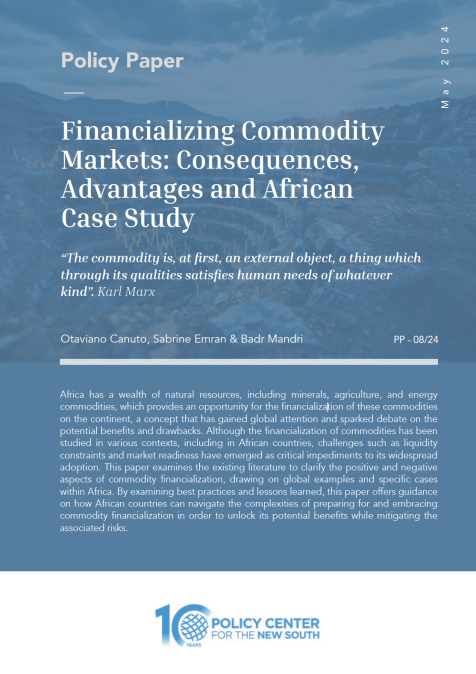
    Africa has a wealth of natural resources, including minerals, agriculture, and energy commodities, which provides an opportunity for the financialization of these commodities on the continent, a concept that has gained global attention and sparked debate on the potential benefits and drawbacks. Although the financialization of commodities has been studied in various contexts, including in African countries, challenges such as liquidity constraints and market readiness have emerged a ...
  • May 22, 2024
    This Paper was originally published on sciencedirect.com The gender gap in education has been a significant concern for Moroccan policymakers and researchers, but the quantitative measurement of this gap has often been overlooked. This study specifically examines the gender gap in academic achievement in reading and mathematics at both the national and residential levels. The objective is to identify the factors that influence gender performance differences and their magnitude ...
  • Authors
    May 20, 2024
    Carbon pricing mechanisms are central to mitigating climate change. These mechanisms work by internalizing the costs associated with greenhouse gas emissions, thus encouraging emissions reductions and promoting technological progress in favor of sustainable alternatives. However, the implementation of carbon pricing mechanisms faces numerous complexities and challenges, especially in developing countries, given the potentially regressive impact of carbon pricing on low-income groups ...
  • Authors
    Mabingue Ngom
    May 17, 2024
    In today’s world, African governments face the challenge of not only providing basic services for their populations but also improving the quality of those services. However, resource constraints often make it difficult to provide high-quality services, creating a delicate balance between population growth, fiscal limitations and the pursuit of quality. This mission requires careful consideration and innovative solutions, especially in countries like Senegal. The Dilemma of Unmet S ...
  • Authors
    May 16, 2024
    The integration of Artificial Intelligence (AI) in Africa presents promising prospects and substantial challenges. While some countries on the continent stand out for their commitment and progress in preparing for AI adoption, others face significant obstacles such as structural inequalities and digital divides. This disparity highlights the need for an inclusive and holistic approach to ensure that all African countries can benefit from AI while closing the gap with other regions o ...
  • Authors
    May 16, 2024
    L'intégration de l'Intelligence Artificielle (IA) en Afrique laisse entrevoir des perspectives prometteuses et pose des défis substantiels. Si certains pays du continent se distinguent par leur engagement et leurs avancées dans la préparation à l'adoption de l'IA, d'autres font face à des obstacles majeurs, tels que les inégalités structurelles et les fractures numériques. Cette disparité souligne la nécessité d'une approche inclusive et holistique pour garantir que tous ...
  • May 15, 2024
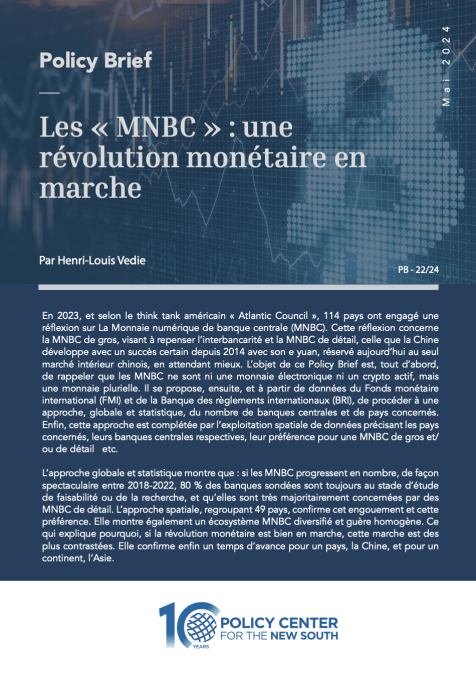
    En 2023, et selon le think tank américain « Atlantic Council », 114 pays ont engagé une réflexion sur La Monnaie numérique de banque centrale (MNBC). Cette réflexion concerne la MNBC de gros, visant à repenser l’interbancarité et la MNBC de détail, celle que la Chine développe avec un succès certain depuis 2014 avec son e yuan, réservé aujourd’hui au seul marché intérieur chinois, en attendant mieux. L’objet de ce Policy Brief est, tout d’abord, de rappeler que les MNB ...
  • Authors
    Bruce Byiers
    Saloi El Yamani
    May 14, 2024
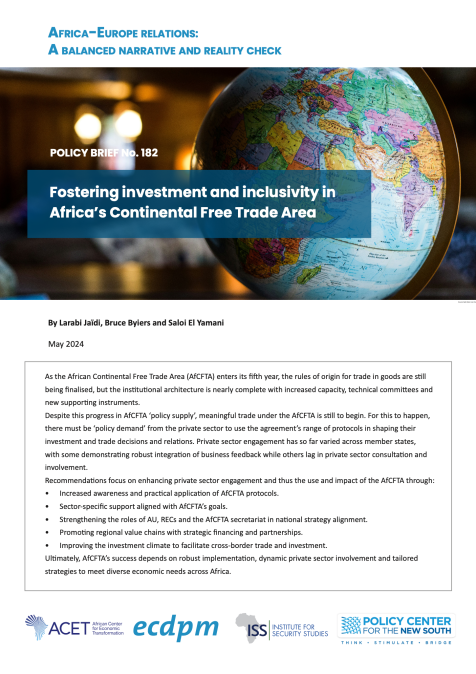
    As the African Continental Free Trade Area (AfCFTA) enters its fifth year, the rules of origin for trade in goods are still being finalised, but the institutional architecture is nearly complete with increased capacity, technical committees and new supporting instruments. Despite this progress in AfCFTA ‘policy supply’, meaningful trade under the AfCFTA is still to begin. For this to happen, there must be ‘policy demand’ from the private sector to use the agreement’s range of protoc ...
  • Authors
    Abdelkhalek Touhami
    Dorothee Boccanfuso
    May 9, 2024
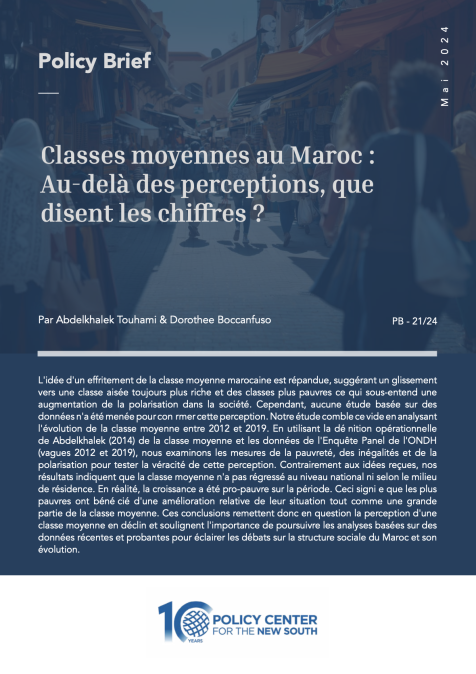
    L'idée d'un effritement de la classe moyenne marocaine est répandue, suggérant un glissement vers une classe aisée toujours plus riche et des classes plus pauvres ce qui sous-entend une augmentation de la polarisation dans la société. Cependant, aucune étude basée sur des données n'a été menée pour confirmer cette perception. Notre étude comble ce vide en analysant l'évolution de la classe moyenne entre 2012 et 2019. En utilisant la définition opérationnelle de Abdelkhalek (2014) de ...
  • Authors
    May 6, 2024
    The issue of environmental degradation represents a significant global challenge. It manifests in various forms, including physical alterations such as air pollution, ozone depletion, climate change, marine pollution and biodiversity loss. These changes are proven to be linked to human activities, such as energy production and consumption, tourism and agriculture. Additionally, factors like population growth and health and safety concerns contribute to environmental decline. Is Gro ...