Publications /
Book / Report

Back
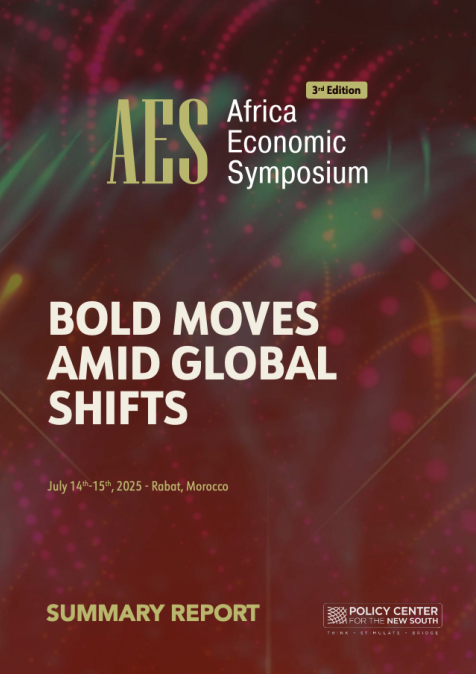
Africa Economic Symposium (AES) 3nd edition - SUMMARY REPORT
Authors
General rapporteur Mahmoud Arbouch
September 2, 2025

The Africa Economic Symposium (AES) has firmly established itself as one of the flagship annual events of the Policy Center for the New South, alongside the Atlantic Dialogues and the African Peace and Security Annual Conference (APSACO). Now in its third edition, AES continues to provide a unique platform for economists, policymakers, and academics from across the continent and beyond to exchange perspectives on the pressing macroeconomic and structural challenges facing Africa. Its mission remains to foster rigorous, evidence-based debates that inform policymaking and support long-term strategies for Africa’s development in an era of uncertainty. 

The 2025 edition, convened under the theme “Bold Moves amid Global Shifts,” explored the difficult policy trade-offs confronting African governments as they navigate a volatile global environment. The continent’s recovery from COVID-19 has been uneven, while debt pressures, supply chain disruptions, and geopolitical tensions weigh heavily on fiscal and economic resilience. Structural challenges such as persistent unemployment, low productivity, and the exclusion of Africa’s youth continue to hinder inclusive growth, even as policymakers are called upon to adapt to deep systemic uncertainty. 

The symposium underscored that many African states are increasingly resorting to short-term stabilization measures—such as accumulating reserves and postponing reforms—that may provide immediate security but risk delaying the structural transformation urgently needed. Against this backdrop, AES 2025 called for a careful balance between fiscal prudence, social investment, and the pursuit of sustainable growth, placing emphasis on reforming governance, improving macroeconomic management, and accelerating structural change. 

The discussions highlighted the urgent need to rethink Africa’s economic strategies in a shifting global order. From debt sustainability and the role of central banks to the promise of financial innovation, digital inclusion, and new instruments such as central bank digital currencies, the symposium emphasized that policy choices must align with long-term transformation goals. The debates also explored the opportunities and challenges of regional integration, trade connectivity, and development finance, all of which are essential levers for Africa’s resilience and prosperity. 

As in previous editions, the Annual Report on African Economies was launched alongside the symposium, offering an in-depth analysis of the continent’s macroeconomic dynamics and structural transformation pathways. More than just a publication, the report reflects the collective intellectual effort of leading scholars and practitioners, providing evidence-based insights to guide decision- makers. Together, the symposium and the report reinforced the Policy Center for the New South’s commitment to fostering forward-looking economic thinking that moves beyond short-term headlines to tackle Africa’s enduring challenges.


RELATED CONTENT

  • Authors
    Eckart Woertz
    April 10, 2015
    1970s : Oil and wheat are strategic commodities, their prices are skyrocketing, Arab countries declare an oil boycott against the US and the US contemplates to retaliate with a grain embargo. Gulf countries are alarmed and look into a plan to develop Sudan as an Arab breadbasket.  This plan, however, unravels by the 1980s amidst political instability, misguided project designs and alleged corruption amongst the Sudanese (Nimeiri) regime. Instead, Saudi Arabia embarks on a ...
  • Authors
    March 25, 2015
    The strategy to vertically integrate mining producers requires the identification of the right conditions for its financing. Many approaches are possible and the technique of securitization, although widely stigmatized since the financial crisis of 2008, must be considered. Several conditions are however necessary. It is unlikely that the off-balance sheet securitization is currently positioned as an important means to finance this sector’s production capacity. Whatever the scope of ...
  • Authors
    Ezana Bocresion
    March 16, 2015
    Over the next couple of months, we want to explore the investing climate in Sub Saharan Africa (“SSA”) and try to understand where it is and what elements/variables are required to increase the continent’s attractiveness to institutional investors and thereby speed up the continent’s development. We will discuss the Private Equity industry in Africa and delve into the challenges faces. We will then work through how best to address them, and in particular, in the Agribusiness sector. ...
  • Authors
    Sergio Fausto
    February 27, 2015
    Brazil’s future prospects, and ability to harness its advantages, will hinge on its own policy choices over the next few years. Yet the outlook for meaningful change is unclear. At present, Brazil is in a weaker position than four years ago, from both an economic and a foreign policy standpoint. Even in a scenario where Brazil’s economy gradually returns to the course it was on until 2008, no major strategic changes are likely to happen in Rousseff’s four-year term. ...
  • Authors
    Pierre-Richard Agénor
    February 18, 2015
    Cet article propose, dans un premier temps, une revue de la littérature analytique et empirique récente sur les gains et coûts potentiels associés à l’intégration financière internationale, ainsi que les enjeux de politique économique créés ou exacerbés par cette intégration. En particulier, l’analyse fait ressortir le fait que, pour un pays en développement, les gains associés à cette intégration se matérialisent surtout sur le long terme, tandis que les coûts (liés notamment aux r ...
  • Authors
    February 10, 2015
    Manufacturing is declining as a share of GDP not only in advanced countries, but in developing countries as well. This new trend, a result of complex forces, should be seen on balance as a reason for development-optimism, not pessimism. In the 21st century economy, manufacturing remains important, but poor countries can attract investment, grow rapidly and diversify away from agriculture on the basis of many possible sources of comparative advantage, without artificially promoting m ...
  • Authors
    January 30, 2015
    “In my view, China’s very high rates of saving and of investment in infrastructure, plant and equipment, Rand D, and human capital should be seen more as a source of strength, than of weakness. There has, of course, been overinvestment in some sectors, such as heavy industry and housing in some regions, but China’s GDP and infrastructure stock per capita is still just a fraction of that of the most advanced countries, and the country’s potential to catch-up remains largely unexploit ...
  • January 26, 2015
    OCP Policy Center vient de rendre public le 10 janvier son premier Policy Brief de l’année 2015, qui traite de la question de la baisse significative des prix des produits pétroliers, ses causes, et ses conséquences macroéconomiques pour les producteurs et les consommateurs de ce produit.  Yves Jégourel, Senior Fellow à OCP Policy Center et auteur du Policy Brief en question, a accumulé une expertise dans le domaine de l’analyse des marchés des matières premières. Il ...