Podcasts

Back

What Role and Strategies for NATO in the New Arch of Crisis?

12
November 2015
Alessandro Marrone

This podcast is performed by Alessandro Marrone. The aim of the briefing is to analyze the debate within NATO on which role the Alliance may play with regard to the arch of crisis stretching from the Mediterranean Sea to the Black Sea across the Middle East and Ukraine. Particular attention will be paid to the different threat perceptions of NATO Member States with respect to the Eastern and Southern flanks of the Alliance, the strategies agreed so far to deal such security threats and challenges, and the future perspectives.
RELATED CONTENT

  • Authors
    Sofia Formigli
    February 13, 2026
    There is a story told by Václav Havel, the Czech dissident writer who later became president after the fall of communism. In his essay The Power of the Powerless, Havel describes a shopkeeper who, every morning, places a sign in his window reading: “Workers of the world, unite!” He does not believe in it. Nor do the people around him. Yet the sign remains. ...
  • Authors
    February 11, 2026
    The U.S.–China technological rivalry has become a central axis of global economic and geopolitical competition. While the United States continues to lead in frontier innovation—most notably in advanced semiconductors and artificial intelligence (AI)—China has consolidated strengths in large-scale implementation, manufacturing capacity, and control over critical segments of global supply chains. These advantages are especially visible in clean energy technologies and in the processin ...
  • February 4, 2026
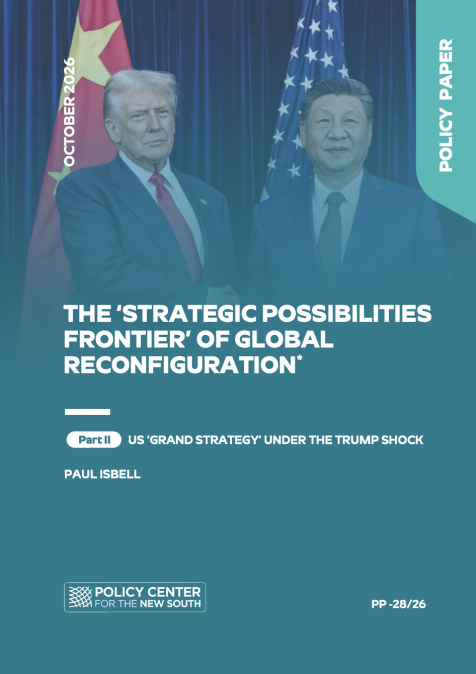
    This article examines the quiet but profound implications of the erosion of U.S.-led hegemony for small and vulnerable states of the New South. While the post-1945 international order was never egalitarian, it offered predictability: power was organized through law, and sovereignty for weaker states rested less on justice than on procedural stability. Davos 2026 marked a turning point in the public acknowledgment of that system’s unraveling. Statements by leading Western figures rev ...
  • Authors
    February 3, 2026
    From the use of tariffs as a foreign policy instrument, to the weaponization of critical resources, and from targeted sanctions to attacks on critical infrastructure, economic security is at the forefront of international debates. The aggressive use of economic instruments for strategic purposes has become an explicit feature of international affairs, in a way not seen since the interwar period[1]. Beyond the weaponization of resources of all kinds, an increasing ‘monetization’ is u ...
  • Authors
    September 24, 2024
      This paper was originally published on t20brasil.org The resurgence of Neo protectionism as a reality is creating a pressing need to establish New Industrial Policies (NIPs) capable of striking a balance between Global Value Chains (GVC) managers' quest for efficiency and policy makers' need for more increasing resilience or national security in a turmoiled geopolitical landscape. Furthermore, although NIPs might pursue legitimate non-economic objectives, they are often cap ...
  • June 26, 2023
    The COVID-19 pandemic and the war in Ukraine have reignited the debate on efficiency versus resilience in international trade and global value chains (GVCs). This policy brief[a] (i) explains the contrasting perspectives of the private sector (primarily seeking efficiency) and the public sector (aiming for resilience); (ii) demonstrates that GVCs are still flourishing, despite some mounting signals of a geo-fragmentation leading to greater reallocation of the GVCs; and (iii) provide ...
  • April 10, 2023
    This policy paper examines India’s growing engagement in North Africa, focusing on five countries: Morocco, Algeria, Tunisia, Libya, and Egypt. Despite lacking a distinct regional policy for North Africa, India has amplified its bilateral engagement with these countries, underpinned by a steadfast commitment to the principle of South-South cooperation. Through its strategic moves in North Africa, India has established a powerful southern-west axis for its foreign policy that stretch ...
  • September 23, 2022
    Relations between Rabat and Seoul have been in a state of considerable flux in every aspect since the establishment of diplomatic relations between the two countries in July 1962. The Korean embassy in Rabat is Seoul's first permanent diplomatic representation on the African continent. ...
  • September 23, 2022
    A l’occasion de l’anniversaire des 60 ans des relations diplomatiques et économiques entre la République de Corée et le Royaume du Maroc, une rencontre est organisée par le Policy Center for the New South en collaboration avec le Korean Institute for International Economic Policy (KIEP)...