Podcasts

Back

Trapped in the middle: A talk on MENA’s economic challenges

20
October 2023
Akram Zaoui & Mustapha Kamel Nabli
Related topics: 

High unemployment rates, particularly among the urban and educated youth, low accumulation of human capital, and a weak private sector leading to low growth levels have been the key features of the MENA region's economy. Dr. Mustapha Kamel Nabli, former governor of the Tunisian Central Bank and current president of the North Africa Bureau of Economic Studies, unpacks these factors that have been affecting the MENA region in the last decades.
RELATED CONTENT

  • Authors
    Prakash Loungani
    November 9, 2016
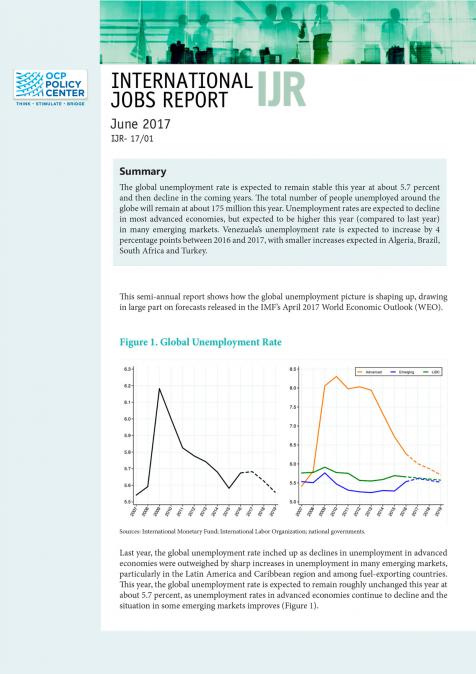
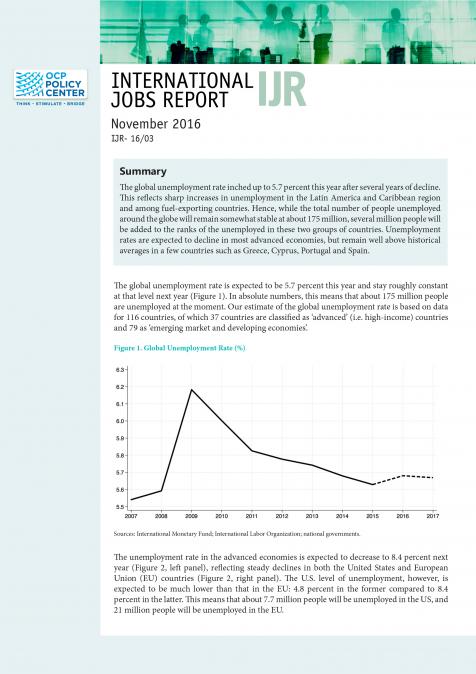
    The global unemployment rate inched up to 5.7 percent this year after several years of decline. This reflects sharp increases in unemployment in the Latin America and Caribbean region and among fuel-exporting countries. Hence, while the total number of people unemployed around the globe will remain somewhat stable at about 175 million, several million people will be added to the ranks of the unemployed in these two groups of countries. Unemployment rates are expected to decline in m ...
  • Authors
    November 7, 2016
    Despite the gloomy tone of much discussion at the just-concluded IMF and World Bank annual meetings, the global economy is not in as bad shape as many think. The concerns about “secular stagnation” in advanced countries are also overplayed, and nor are developing countries directly exposed to such risks. By contrast, the pessimism about the prospects for MENA are unfortunately largely justified. Most importantly, at the global and at the MENA level the biggest concerns are not econo ...
  • Authors
    Karim EL Mokri
    October 13, 2016
    Le Maroc est actuellement plus que jamais menacé par le piège des économies à revenu intermédiaire. Il se retrouve pris entre, d'une part, la concurrence accrue exercée par des pays à faible revenu sur les secteurs à faible productivité et intensifs en main d'œuvre et, d'autre part, la difficulté d'accélérer son rythme de transformation structurelle vers des activités à plus forte valeur ajoutée et à contenu technologique plus élevé. L'expérience internationale nous montre que rares ...
  • Authors
    Nuria Boot
    Karim El Mokri
    Simone Tagliapietra
    Karen E. Wilson
    Guntram B. Wolff
    Georg Zachmann
    August 22, 2016
    This joint Bruegel-OCP Policy Center publication comprised of four policy contributions from researchers of both institutions is the result of the establishment of “Platform for Advanced & Emerging Economies Policy Dialogue.” The first edition of this continuous dialogue took place in Rabat on April 1st 2016 under the theme of “Seven Years after the Crisis: Intersecting Perspectives.” In the first paper, “Youth Unemployment in the Mediterranean Region and its Long term Implicat ...
  • Authors
    May 25, 2016
    This paper will take stock of the economic performance of Europe and the Arab world, examining how they can do better by working together. The paper pays special attention to the trade, investment, migration and energy linkages between the two regions, as well as those among the Arab countries, as well as how they can be improved to achieve better development. Whereas we present a southern perspective, with Arab countries as main focus, the purpose is to understand the constraints f ...
  • Authors
    Russel Dinh
    January 27, 2016
    The IMF recently revised down its growth forecasts, making large changes in the forecasts for some emerging markets, in particular Brazil and oil-producing countries (such as Nigeria and Saudi Arabia). This report presents a snapshot of the global unemployment outlook and discusses what the recent revisions could mean for the unemployment outlook for these countries based on past relationships between growth and unemployment. We conclude with a look at the growth-unemployment link f ...
  • Authors
    December 7, 2015
    The Euro-Mediterranean Partnership was initiated with the aim to build a space of shared prosperity and security among all the countries in the region. The achievement of this objective, however, continues to be challenged by several geopolitical, economic and social factors. In such a context, there is now a greater urgency to adapt the approach and the instruments, thus allowing Euro-Mediterranean partners to seize opportunities towards an effective area of shared stability and pr ...
  • Authors
    November 25, 2015
    The contribution that the diaspora makes to development in the country of origin is examined. Drawing on a recent World Bank survey of migrants from the MENA countries, the needs of the diaspora and the development role it can play through its organizations are reviewed. A constructive interaction with the diaspora can be greatly enhanced by supportive policies in the country of origin. The main focus of the paper is on the Middle East and North African region, and more specifically ...
  • Authors
    May 18, 2015
    Economic integration is crucial in order to achieve rapid and sustainable growth. However, instabilities in the MENA region and the recent plunge in oil prices may stifle the economic progress in some of these countries, and threaten their attempts at integration. Within this context, this note seeks to analyze the efforts of integration that MENA countries have undertaken, particularly through trade agreements; and to articulate some principles that can help guide the ongoing searc ...