Podcasts

Back

Crises interconnectées : lectures géopolitiques entre l’Iran, l’Afghanistan, le Pakistan et l’Inde

07
November 2025
Christophe Chabert & Helmut Sorge

Dans cet épisode du Policy Center for the New South, Christophe Chabert analyse les crises interconnectées entre l’Iran, l’Afghanistan, le Pakistan et l’Inde, en retraçant leurs racines historiques et coloniales. Il met en avant l’impact des rivalités géopolitiques et estime que la paix viendra des nouvelles générations, prêtes à dépasser les clivages religieux et politiques hérités du passé.

RELATED CONTENT

  • Authors
    July 14, 2026
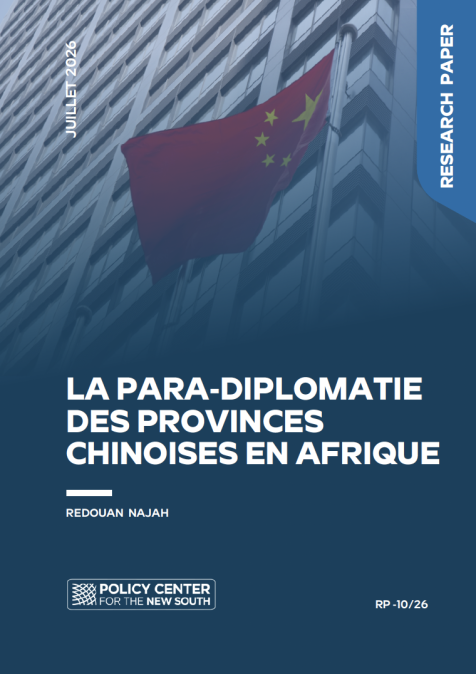
    Avec la capitale Pékin comme acteur principal de la politique étrangère chinoise, l’engagement de la Chine en Afrique ne peut plus être appréhendé à travers le seul prisme de l’État central. Suite aux réformes de décentralisation engagées en 1978, les gouvernements provinciaux de l’Empire du Milieu jouent un rôle de plus en plus visible et structurant, en s’affirmant en tant qu’acteurs à part entière de la coopération internationale. Ils interviennent, entre autres domaines, dans le ...
  • July 10, 2026
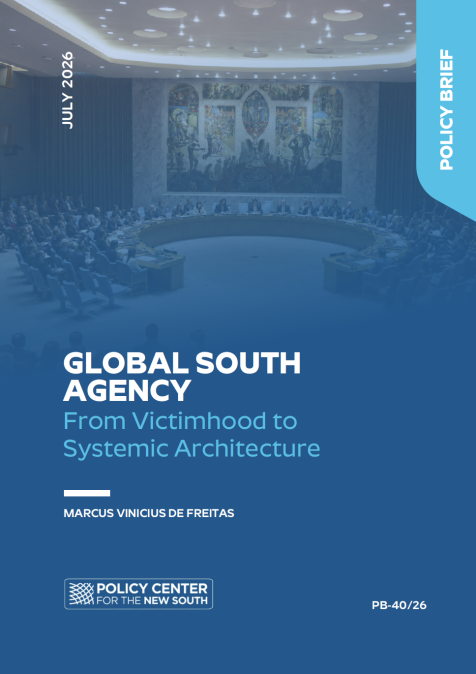
    For much of the post-war period, the Global South was framed as an object of history, defined by dependency, constrained by structural asymmetries, and confined to the margins of global decision-making. That narrative, once empirically grounded, is now no longer adequate. A profound yet uneven transformation is underway. The Global South is no longer only reacting; it is increasingly shaping rules, institutions, and narratives.This Policy Brief argues that the Global South is thus t ...
  • Authors
    Diogo Ramos Coelho
    Bruno Saraiva
    June 22, 2026
    Global imbalances are back—and this time the risks look different. The 2008 financial crisis showed how persistent current-account deficits and surpluses between major economies can fuel financial instability and trigger sudden, severe reversals of capital flows. After almost two decades, many thought that episode had been resolved. It had not. New imbalances have built up, with a familiar cast: China, Germany, Japan, and oil exporters running large surpluses, and the United States ...
  • June 22, 2026
    History devotes considerable attention to the rise and fall of great powers. Scholars have spent centuries analyzing why empires collapse, why nations decline, and why dominant states eventually lose their position. By comparison, relatively little attention has been devoted to a different question: what happens when a country succeeds beyond its own expectations? ...
  • May 13, 2026
    The meeting between Donald Trump and Xi Jinping in Beijing this week goes far beyond the traditional framework of a bilateral encounter between the world’s two largest economies. In many respects, it is a symbolic moment in the transition toward a new international order—one increasingly shaped not only by great-power competition but also by the Global South’s growing political consciousness and strategic relevance. ...
  • Authors
    May 6, 2026
    Trump’s Strategy of Overriding Constitutional SafeguardsPerhaps bearing in mind that only a minority of voters in the United States support U.S. military action against Iran, President Donald Trump has called the war a “short term excursion” and a “little journey” that may be over “pretty quickly”. The war is thus not a war, although Trump has said the U.S. will take Iran “back to the stone ages, where they belong”, and the U.S. military has admitted to attacks on 14,000 Irania ...
  • Authors
    Stephan Klingebiel
    Andy Sumner
    May 4, 2026
    This Opinion was originally published on policyedge.in The weakening of global institutions creates both risk and opportunity, placing India at the center of debates on reform and renewal.The global order is not collapsing outright but is gradually hollowing out, as institutions lose normative coherence and great power contestation reshapes rules from within. This moment of transition creates both risks of fragmentation and opportunities for redesign. For India, rising economic ...
  • Authors
    February 12, 2026
    Divergent regulatory regimes for data, driven by different motivations, ranging from privacy protection in the European Union to information control in China, could eventually produce distinctively different, and possibly contradictory, bodies of data. Artificial-intelligence models trained on those datasets could produce differing and possibly even conflicting outputs. To the extent that AI outputs start to shape human perception and to influence decisions, in governments and ...