Podcasts

Back

Biden’s action: a political economy perspective

01
March 2024
By Otaviano Canuto, Dominique Bocquet, Paul Isbell
Related topics: 

This podcast tackles the intricacies of Biden’s presidency from a political economy standpoint. Our guests initially discuss the degree to which it can be argued that US democracy has recently been under threat. Following this, the conversation shifts to the consequences of US domestic political polarization on its global leadership role. Subsequently, the dialogue explores the surprising political accomplishments of Biden’s presidency thus far, alongside their failure to enhance Biden’s reelection prospects. This podcast is the precursor to additional episodes centered around the US political economy.
RELATED CONTENT

  • Authors
    July 16, 2026
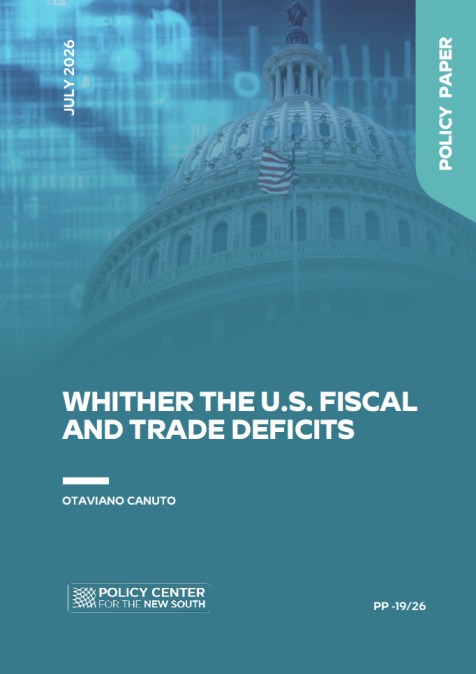
    Thanks to the AI investment boom, the U.S. economy has performed well at the macroeconomic level. However, it is on an unsustainable fiscal and debt path. Mr. Trump’s fiscal policy in his second term has aggravated this trajectory. In turn, Mr. Trump’s tariff-based trade policy has failed to address what he sees as U.S. economic problems associated with the trade balance. Besides explaining why this has been the case, and what its implications are for the U.S. economy and the r ...
  • Authors
    June 30, 2026
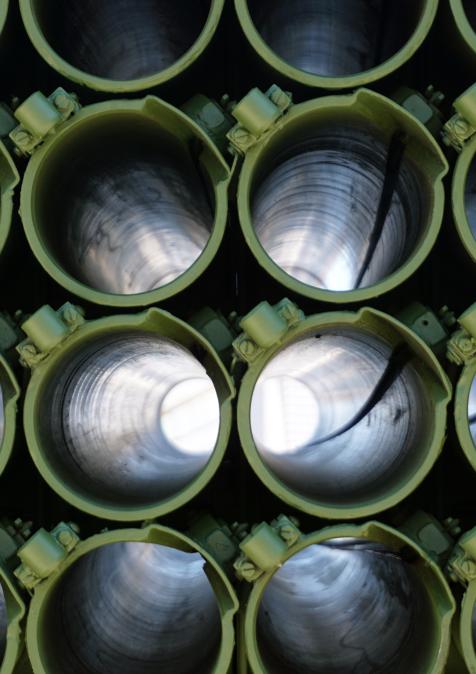
    The inventory is worrisomely low The US military has fired off more than 1000 Tomahawk cruise missiles, roughly ten times the number it currently buys each year. The Pentagon used more than 1200 Patriot interceptor missiles, "more than three million dollars a pop", and more than 1000 precision strike, ground based missiles, "leaving the inventories worrisomely low." US commanders were forced to ration interceptors by letting unguided or less destructive missiles hit empty or no ...
  • Authors
    Diogo Ramos Coelho
    Bruno Saraiva
    June 22, 2026
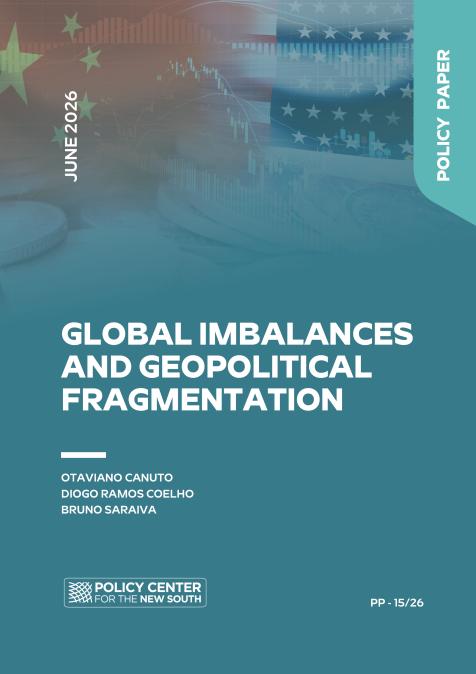
    Global imbalances are back—and this time the risks look different. The 2008 financial crisis showed how persistent current-account deficits and surpluses between major economies can fuel financial instability and trigger sudden, severe reversals of capital flows. After almost two decades, many thought that episode had been resolved. It had not. New imbalances have built up, with a familiar cast: China, Germany, Japan, and oil exporters running large surpluses, and the United States ...
  • Authors
    June 19, 2026
    The early March 2026 Pentagon briefings were tuned towards triumph and surrender - unconditional. The white flag of defeat was visible on the Iran horizon, and America's commander in chief needed only a few more weeks to declare "their military is gone. Wiped out". His secretary of war, Pete Hegseth, added to Trump's assessment his own, the Iranian navy was "decimated, destroyed and defeated", the naval fleet of the enemy rested on the bottom of the Persian Gulf. Iran's defense indu ...
  • Authors
    March 3, 2026
    The February 20 United States Supreme Court decision against President Donald Trump’s use of the U.S. International Emergency Economic Powers Act (IEEPA) to establish tariffs has led him to resort to other legal instruments. So-called U.S. reciprocal tariffs on countries set out in April 2025 were based on IEEPA, as were tariffs that allegedly punished countries for allowing fentanyl into the U.S. Trump tried to evade the constraints presented by other legal instruments that could f ...
  • Authors
    February 12, 2026
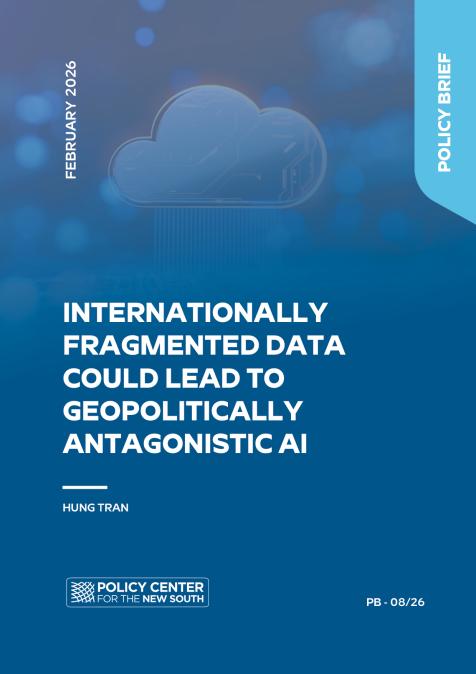
    Divergent regulatory regimes for data, driven by different motivations, ranging from privacy protection in the European Union to information control in China, could eventually produce distinctively different, and possibly contradictory, bodies of data. Artificial-intelligence models trained on those datasets could produce differing and possibly even conflicting outputs. To the extent that AI outputs start to shape human perception and to influence decisions, in governments and ...
  • Authors
    February 11, 2026
    The U.S.–China technological rivalry has become a central axis of global economic and geopolitical competition. While the United States continues to lead in frontier innovation—most notably in advanced semiconductors and artificial intelligence (AI)—China has consolidated strengths in large-scale implementation, manufacturing capacity, and control over critical segments of global supply chains. These advantages are especially visible in clean energy technologies and in the processin ...
  • Authors
    Nizar Messari
    December 19, 2025
    The U.S. military buildup in the Caribbean—the most significant since the Cuban Missile Crisis—comes at a moment when a new world order is taking shape, its contours still unclear, and in which the U.S. seeks to be more assertive in the Western Hemisphere. This disposition toward South America and the Caribbean was underscored by the recent publication of the new U.S. National Security Strategy, in which the Monroe Doctrine is explicitly invoked. This Policy Brief situates the devel ...