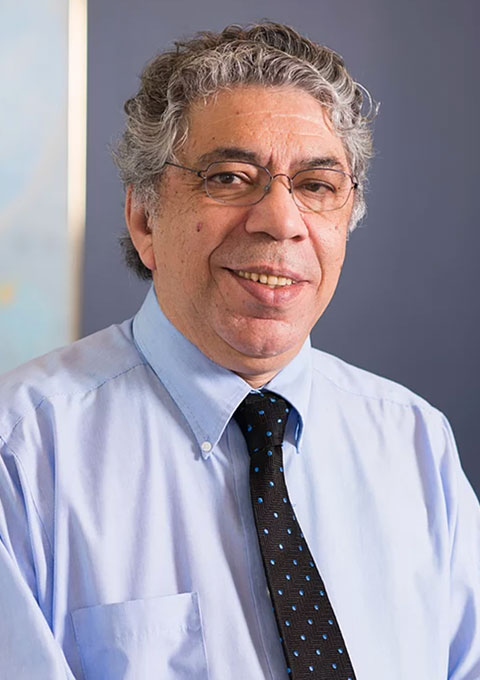
Otaviano Canuto on Global Current Account Imbalances

April 20, 2021

Otaviano Canuto, Policy Center for the New South After peaking in 2007 at around 6% of world GDP, global current-account imbalances declined to 3% of world GDP in the last few years. But they have never left entirely the spotlight, albeit acquiring a different configuration from that which marked the trajectory prior to the global financial crisis (GFC). This is not because they threaten global financial stability, but mainly because they reveal asymmetries in adjustment and post-GFC recovery between surplus and deficit economies, and because of the risk of sparking waves of trade protectionism. They also reveal the sub-par performance of the global economy in terms of foregone product and employment, i.e. a post-crisis global economic recovery below its potential.
Speakers
Otaviano Canuto
Senior Fellow
Senior Fellow at the Policy Center for the New South, Affiliate Professor at Mohammed VI Polytechnic University and Non-Resident Senior Fellow at Brookings Institute. Former Vice President and Executive Director at the World Bank, Executive Director at the International Monetary Fund (IMF) and Vice President at the Inter-American Development Bank. ...

RELATED CONTENT

  • Authors
    Georges Ali Benyahia
    November 20, 2026
    This paper was originaly published on sciencedirect.com Ammonia and methanol feature in a growing share of announced low-emissions hydrogen projects; evidence on their progression to a final investment decision (FID) remains aggregate. We follow 2098 pre-FID projects, classified by output product, across six releases (2021–2026) of the International Energy Agency hydrogen projects database and estimate discrete-time cause-specific hazard models of progression to FID and ex ...
  • November 17, 2026
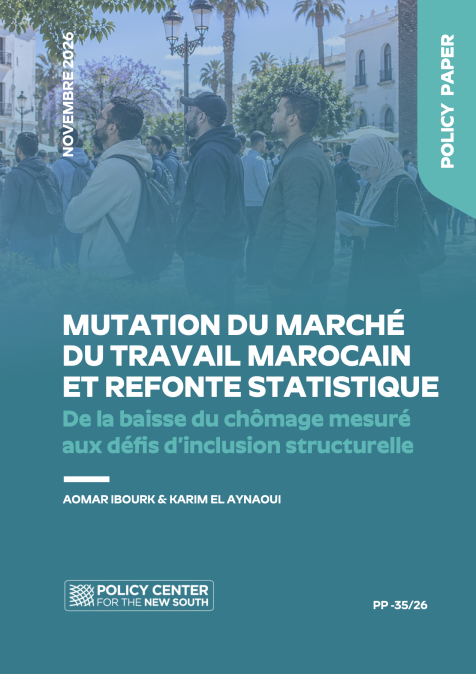
    Au deuxième trimestre 2026, le taux de chômage au Maroc s’établit à 9,5 %, sous la barre symbolique des 10 %. Ce chiffre est issu de la nouvelle Enquête sur la main-d’œuvre (EMO2026) du Haut-Commissariat au Plan (HCP), qui remplace l’Enquête nationale sur l’emploi et s’aligne sur les normes de l’Organisation internationale du travail (OIT). Cette refonte est un progrès pour la transparence. Mais elle change aussi la définition du chômage, si bien que la baisse affichée tient en part ...
  • Authors
    November 16, 2026
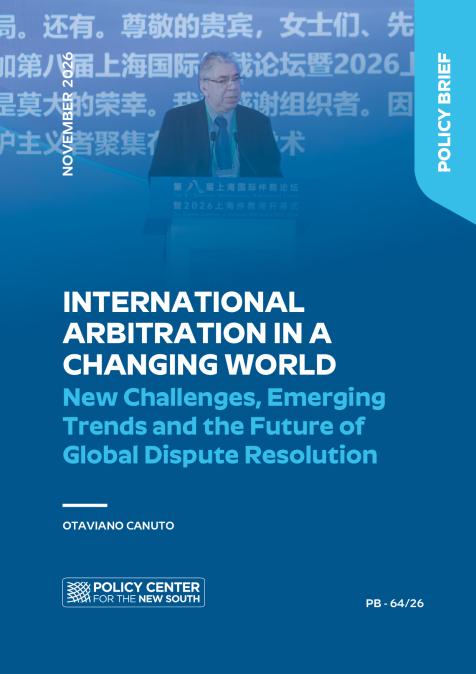
    How can international arbitration preserve its core principles of neutrality, party autonomy and enforceability while adapting to a world increasingly characterized by geopolitical fragmentation, technological disruption and competing regulatory interests? Meeting this challenge demands a collective effort, bringing together arbitral institutions, national courts, governments, international organizations, academics and practitioners. It requires openness to institutional innovation, ...
  • November 10, 2026
    يناقش هذا الحوار أبرز التوجهات الاقتصادية والاجتماعية لمشروع قانون المالية لسنة 2027 في المغرب، في ظل الحاجة إلى التوفيق بين دعم النمو والاستثمار وخلق فرص الشغل، وتعزيز الحماية الاجتماعية، والحفاظ على التوازنات المالية. كما يتناول شروط فعالية المجهود الاستثماري، وسبل تمويل الأولويات الا...
  • Authors
    Patrick Kabanda
    November 10, 2026
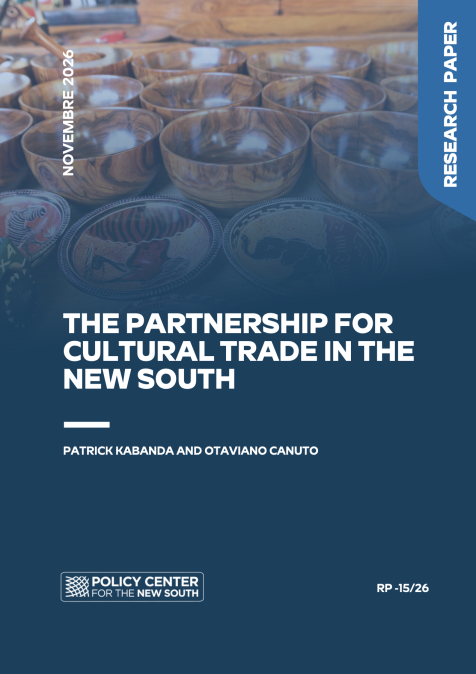
    Cultural trade is a dynamic engine for economic diversification in the New South. Despite decades of diversification rhetoric, however, this sector remains underrealized. Thus, many countries across Africa, Latin America and the Caribbean, Asia, and the Middle East are still commodity-dependent, even though the global creative economy has grown roughly eightfold since 2002, to surpass $2 trillion—that figure, moreover, does not even account for the nonmonetary benefits that merit co ...
  • November 9, 2026
    Cette interview examine les perspectives d’une éventuelle adhésion du Maroc à l’OCDE à l’horizon 2040, en revenant sur les conditions économiques, institutionnelles et réglementaires qu’un tel processus pourrait impliquer. Elle met en perspective les réformes engagées par le Royaume, le...
  • Authors
    Bambang Brodjonegoro
    November 2, 2026
    This policy note was published as part of the T20 U.S. 2026 Workstreams, under the workstream “Fostering Trade and People-Centered Economic Growth,” which brings together policy experts to develop recommendations for G20 policymakers. The Group of Twenty (G20) accounts for most of the world’s output, yet its decisions shape the prospects of 174 United Nations Member States without G20 membership, among them the great majority of least developed countries and small states. Many ...