حديث الثلاثاء: المعادن الاستراتيجية والتحول العالمي: رهانات التصنيع وسلاسل القيمة الجديدة

April 21, 2026

في هذه الحلقة، نناقش الأهمية الجيو-اقتصادية للمعادن الاستراتيجية كركيزة أساسية للتحولات الطاقية والرقمية العالمية وتأثيرها المباشر على سلاسل القيمة الدولية. ونسلط الضوء على قدرة القارة الإفريقية والمغرب على تجاوز تصدير المواد الخام نحو بناء منظومة صناعية محلية متكاملة تضمن السيادة الاقتصادية والاجتماعية. كما نستعرض آفاق التحول نحو التصنيع وتحديات الاستثمار والحكامة اللازمة لتحويل هذه الموارد الطبيعية إلى قاطرة للتنمية المستدامة وخلق فرص شغل للشباب


Speakers
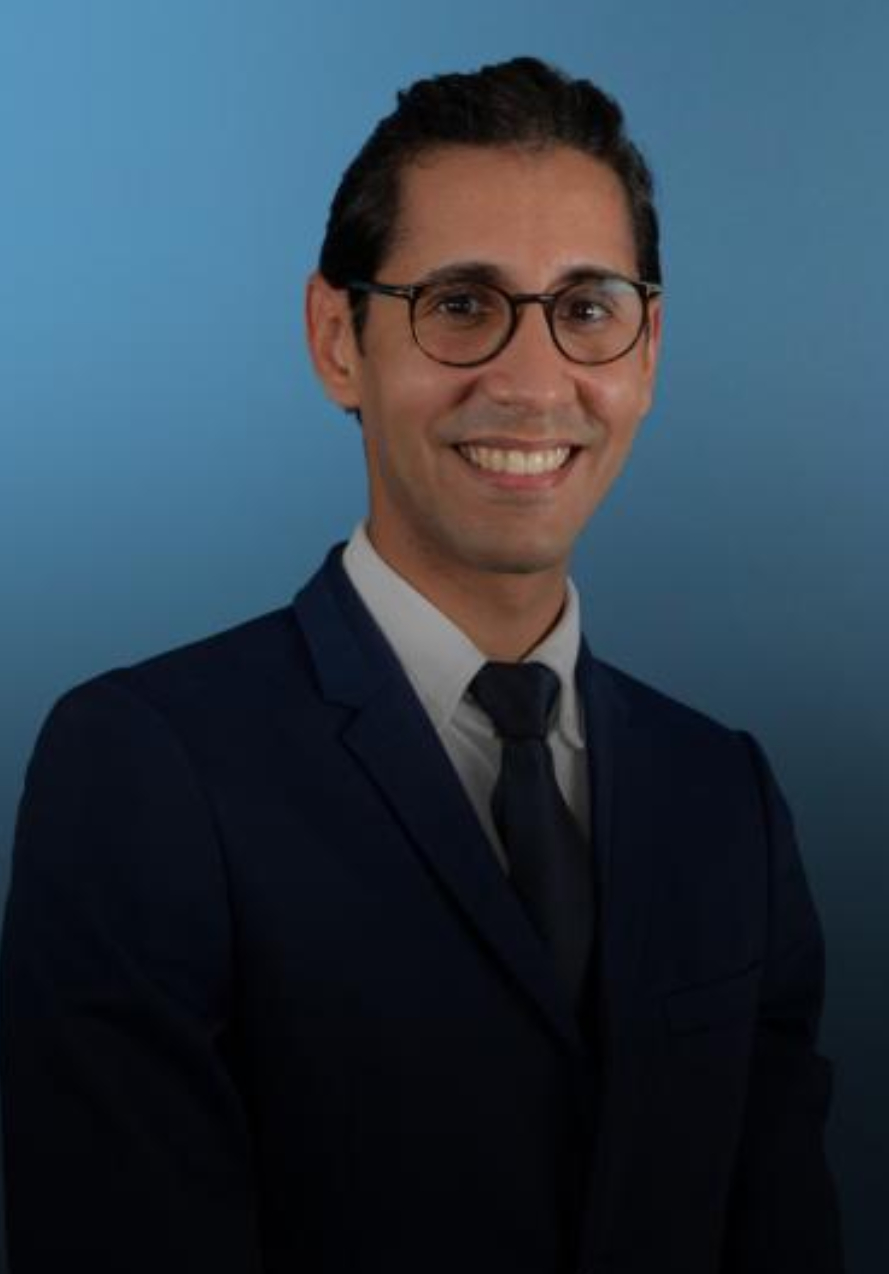
Ahmed Ouhnini
Economist, Policy Center for the New South
Ahmed Ouhnini is an Economist at the Policy Center for the New South. His research area covers agricultural economics, human and social development. Previously, he has worked as a researcher at the Paris School of Economics (PSE) and has also a record of working in consulting services in Morocco. Ahmed holds an engineering Diploma in Agriculture and Rural Development from the National School of Agriculture of Meknes and a Master’s Degree in Law, Economics and Management from the Paris 1 Pantheon Sorbonne Institute of Development. ...

Oussama Tayebi
International Relations Specialist, Policy Center for the New South
Oussama Tayebi is a Senior International Relations Specialist at the Policy Center for the New South (PCNS).At the PCNS, Oussama Tayebi primarily conducts research on governance, peace, and security issues in Central Africa. Before joining the PCNS in 2019, Oussama Tayebi contributed to the activities of the UN Women’s multi-country office for the Maghreb and the Paris office of the ONE Campaign (NGO), providing support for advocacy initiatives on the Africa-EU partnership and official development cooperation issues.Oussama Tayebi holds a bachelor’s degree in political science from the School of Governance and Economics in Rabat, Morocco, and a master’s degree in international relations from Sciences Po Aix, France.Oussama Tayebi is fluent in Arabic, English, and French. ...
RELATED CONTENT

  • Authors
    Chami Abdelilah
    Derj Atar
    Hammi Ibtissem
    Morazzo Mariano
    Naciri Yassine
    with the technical support of AFRY
    July 9, 2021
    The consequences of climate change are becoming progressively more visible in Morocco. Changes in rainfall patterns and drought, increases in average temperatures and heatwaves, flooding, and rising sea levels are increasingly affecting several regions. Yet, Morocco has a relatively low greenhouse gas (GHG) emission rate, compared to other countries. In 20162, Morocco’s total GHG emissions reached 86127.7 gigagram of carbon dioxide equivalent (Gg CO2-eq), totaling around 0.2% of glo ...
  • Authors
    Chami Abdelilah
    Derj Atar
    Hammi Ibtissem
    Morazzo Mariano
    Naciri Yassine
    with the technical support of AFRY
    July 9, 2021
    Les importantes ressources en énergies renouvelables du Maroc offrent une opportunité sans précédent d’ancrer les choix économiques et politiques du pays dans la transition énergétique, et de faire de cette transition un levier essentiel du développement économique. Ceci est d’autant plus important que le coût des énergies renouvelables a baissé au cours des 10 dernières années2 et présente désormais un fort potentiel, non seulement de création d’emplois verts mais aussi de croissan ...
  • Authors
    Chami Abdelilah
    Derj Atar
    Hammi Ibtissem
    Morazzo Mariano
    Naciri Yassine
    with the technical support of AFRY
    June 28, 2021
    Lors de la Conférence des Parties à la Convention-cadre des Nations unies sur les changements climatiques (CCNUCC) qui s'est tenue à Paris en 2015, les gouvernements se sont engagés à limiter l'augmentation de la température mondiale à un niveau bien inférieur à 2°C par rapport aux niveaux préindustriels. Ils se sont également engagés à atteindre, dès que possible, un pic de leurs émissions et à parvenir à la neutralité carbone au cours de la seconde moitié du siècle. Pour autant, m ...
  • Authors
    Chami Abdelilah
    Derj Atar
    Hammi Ibtissem
    Morazzo Mariano
    Naciri Yassine
    with the technical support of AFRY
    June 28, 2021
    During the 2015 Paris Conference of the Parties to the United Nations Framework Convention on Climate Change (UNFCCC), governments pledged to limit the global temperature increase to well below 2°C above pre- industrial levels, to peak emissions as soon as possible, and to achieve carbon neutrality in the second half of the century. Yet, even assuming full implementation of the commitments made by governments in Paris, the global concentration of greenhouse-gas (GHG) emissions will ...
  • Authors
    Sang-Hyun Lee
    Amjad T. Assi
    Bassel Daher
    October 5, 2020
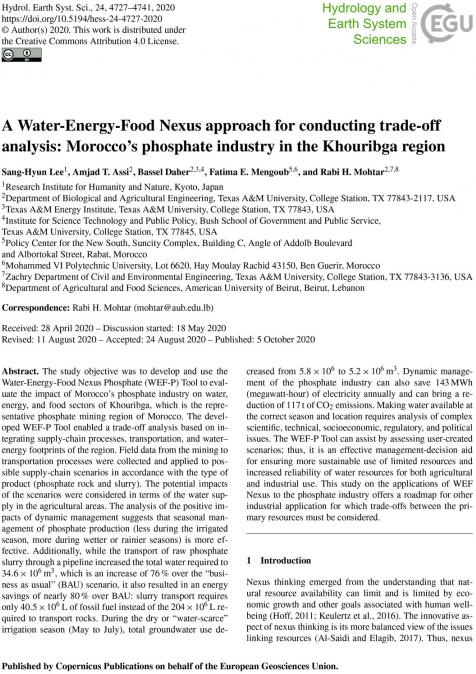
    Our Senior Fellow Rabi Mohtar has co-authored with our economist, Fatima Ezzahra Mengoub along other researchers a research paper entitled « A Water-Energy-Food Nexus approach for conducting trade-off analysis: Morocco’s phosphate industry in the Khouribga region » in Hydrology and Earth System Sciences Journal (Volume 24, Issue 10). The study objective was to develop and use the Water-Energy-Food Nexus Phosphate (WEF-P) Tool to evaluate the impact of Morocco’s phos ...
  • Authors
    Vinicius A. Vale
    April 24, 2020
    This paper aims at evaluating the virtual water content in trade in an intra-country perspective and discussing potential tradeoffs between the use of natural resources and value added creation. We develop a trade-based index that reveals the relative water use intensities associated with specific interregional and international trade flows. The index is calculated considering the measures of water and value added embedded in trade flows associated with each regional origin-destinat ...
  • Authors
    Holger Hoff
    Sajed Aqel Alrahaife
    Rana El Hajj
    Kerstin Lohr
    Nadim Farajalla
    Kerstin Fritzsche
    Guy Jobbins
    Gül Özerol
    Robert Schultz
    Anne Ulrich
    May 13, 2019
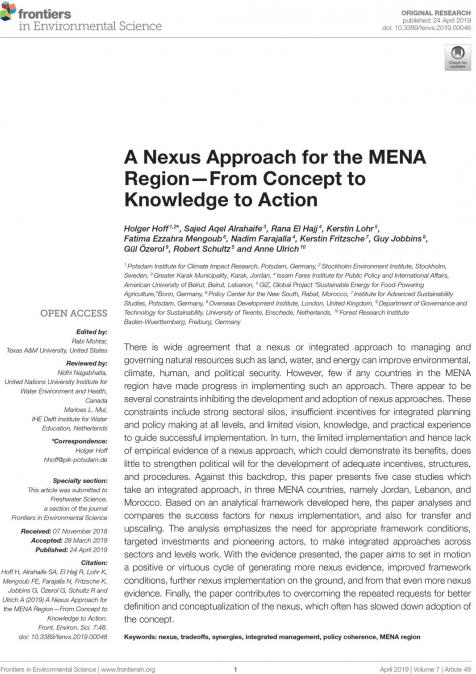
    Adopting an integrated approach to the management and governance of natural resources including land, water and energy is seen as an effective way to improve the sphere of production while respecting the environment. Fatima Ezzahra Mengoub, economist at the Policy Center for the New South, was invited by Stockholm Environment Institute, alongside other prestigious research centers with expertise in environmental studies, to co-author this research paper and share her analysis of th ...
  • Authors
    Vinicius A. Vale
    April 26, 2018
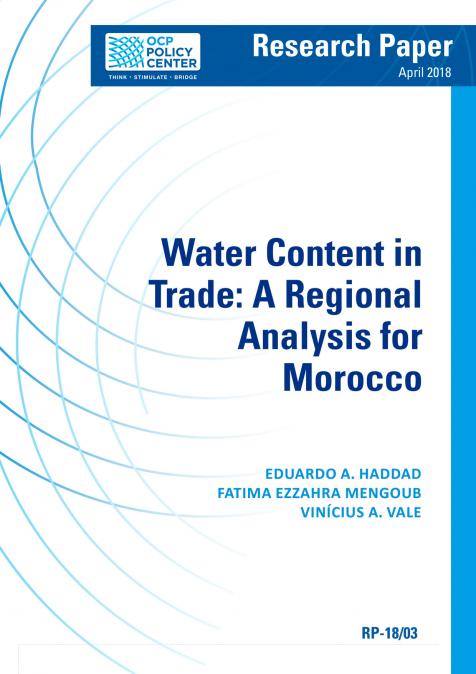
    This paper reports the results of an application using an interregional input-output matrix for Morocco together with regional information on water consumption by sectors. We develop a trade-based index that reveals the relative water use intensities associated with specific interregional and international trade flows. We estimate, for each flow associated with each origin-destination pair, measures of trade in value added and trade in water that are further used to calculate our in ...
  • Authors
    Prepared by Global Nexus
    October 13, 2017
    Since inception nearly a century ago, corporations and industries have coevolved with Morocco’s legacy of peace and prosperity. With a growing pressure on agricultural production and natural resources, exacerbated with climate change, there is urgency to define sustainable strategies that would reassure corporations and industries for longterm prosperity and for a healthy economy. Studies have highlighted the perilous state of our natural environment, the exhaustion of our aquifers, ...
  • Authors
    July 28, 2017
    Renewable energy technologies are projected to have substantial growth in the coming decades, especially given the environmental, social and economic drivers observed globally. The Middle East and North Africa (MENA) region encloses abundant alternative energy sources such as solar, wind and hydropower. The concern is more whether the Arab region will be able to respond to and manage the growth opportunities in this emerging sector. This Policy Brief explores opportunities and chall ...