The Future of European Investment in Africa

September 4, 2026

Why is Africa becoming a strategic destination for European investment? What opportunities are emerging, and what will determine their success? In this conversation, Ahmed Ouhnini from the Policy Center for the New South speaks with Christoph Weiss, Economist and Principal Advisor at the European Investment Bank (EIB), about the future of Europe-Africa investment relations. They discuss how shifting global supply chains, the green and digital transitions, and Africa's growing consumer market are creating new opportunities for investment in renewable energy, infrastructure, manufacturing, agribusiness, healthcare and digital innovation. The conversation also explores what is needed to attract more long-term, high-quality investment: a stronger business environment, reduced investment risks, effective institutions and a focus on sustainable and inclusive growth. What will it take to unlock the next generation of European investment in Africa, and what could both continents gain from it?


Speakers
Ahmed Ouhnini
Senior Program Officer, Policy Center for the New South
Ahmed Ouhnini is an Economist at the Policy Center for the New South. His research area covers agricultural economics, human and social development. Previously, he has worked as a researcher at the Paris School of Economics (PSE) and has also a record of working in consulting services in Morocco. Ahmed holds an engineering Diploma in Agriculture and Rural Development from the National School of Agriculture of Meknes and a Master’s Degree in Law, Economics and Management from the Paris 1 Pantheon Sorbonne Institute of Development. ...
Christoph Weiss
Economist and Principal Advisor at the European Investment Bank (EIB)
...

RELATED CONTENT

  • October 14, 2026
    في ظل التوترات الجيوسياسية المتصاعدة، تتغير طرق التجارة العالمية وتتبدل معها موازين الممرات الاستراتيجية. تفتح هذه الحلقة من «حديث الثلاثاء» النقاش حول التقاء المسارات البحرية والبرية داخل هذه الممرات، والعوامل التي تتحكم في طبيعة السلع التي تعبرها. وتبحث كذلك في ما يمكن للمغرب أن يجنيه...
  • Authors
    Paul Isbell
    October 9, 2026
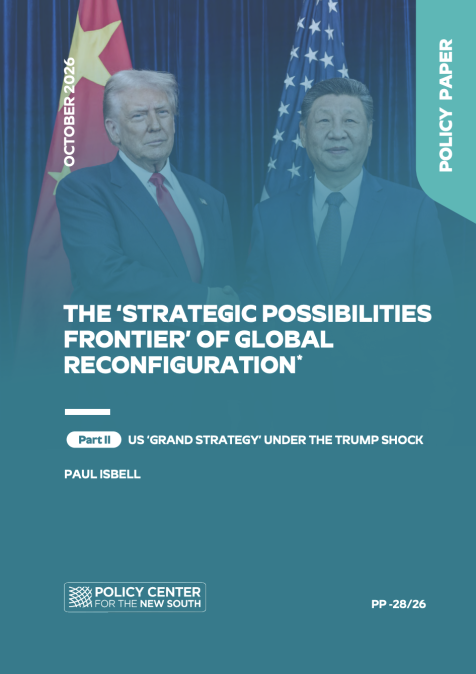
    In the first seven Policy Briefs of this ongoing series of analysis on Pan-Atlanticism: The Atlantic Basin in a Multipolar-Transnational World, we developed the argument that the strategic significance of the Atlantic Basin is on the rise for a range of international actors (states, regions and non-state agents) and from distinct political or ideological perspectives. In addition, in the most recently published Policy Brief -- “The U.S. and the Current International Reconfiguration: ...
  • September 4, 2026
    Why is Africa becoming a strategic destination for European investment? What opportunities are emerging, and what will determine their success? In this conversation, Ahmed Ouhnini from the Policy Center for the New South speaks with Christoph Weiss, Economist and Principal Advisor at t...
  • Authors
    August 29, 2023
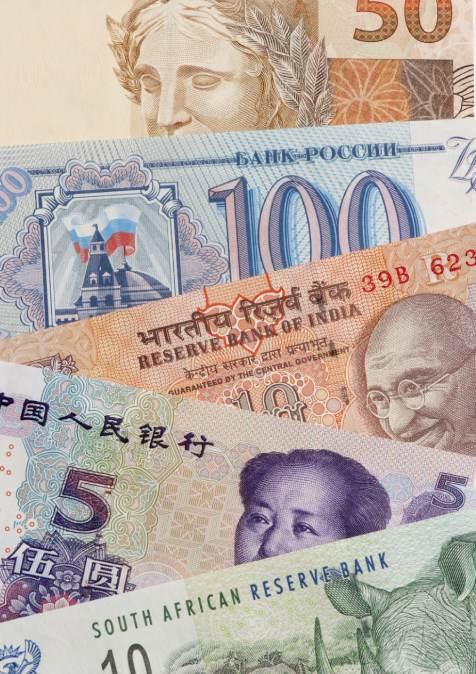
    At the August 22-24 BRICS summit in Johannesburg, the leaders of Brazil, Russia, India, China and South Africa said they wanted to use more of their national currencies for cross-border payments, which are currently dominated by the U.S. dollar and other global convertible currencies. Like China and the other BRICS, several other countries have also sought to develop alternative external payment mechanisms. Pairs of countries have agreed to settle commercial and financial transactio ...
  • April 4, 2023
    Face à l’essor des cryptomonnaies, les banques centrales sont en train de réagir en lançant leurs propres monnaies numériques. L’objet de ce Policy Brief est de faire le point sur la préparation des monnaies numériques de banques centrales (MNBC) par les autorités monétaires, un processus qui concerne tous les pays, émergents, en développement, et plus avancés. Il s’agit aussi d’analyser les conditions et certaines des conséquences (pour les banques, pour l’inclusion fin ...
  • April 4, 2023
    Faced with the rise of cryptocurrencies, central banks are responding by launching their digital currencies. The purpose of this Policy Brief is to provide an update on the preparation of central bank digital currencies (CBDs) by monetary authorities, a process that concerns all emerging, developing, and more advanced countries. It is also about analyzing the conditions and some of the consequences (for banks, for financial inclusion, for the conduct of monetary policy...) of such a ...
  • Authors
    Selassie Tay
    February 15, 2023
    Background The African Union in 2018 agreed to implement the world’s second-largest free-trade area measured by number of countries, people, and geographical size, with the signing of the African Continental Free Trade Agreement (AfCFTA). This agreement will ultimately lead to a continent-wide free trade area consisting of 54 countries with 1.3 billion people and a combined GDP of $3.4 trillion[1]. This equates to about 19%-20% of the GDP of the European Union and China, which ...
  • Authors
    Moubarack Lo
    Amaye SY
    August 1, 2022
    Avant la pandémie Covid-19, le continent abritait les économies à la croissance la plus rapide du monde et plusieurs pays africains montraient les premiers signes de transformation structurelle et de progrès vers l’émergence économique. Plus de deux ans après la pandémie et les ondes de choc qui en ont résulté, deux questions cruciales se posent : dans quelle mesure le choc sanitaire Covid-19, exacerbé par la crise ukrainienne, a-t-il constitué un tournant dans le processus général ...
  • May 20, 2022
    Traders have worried that the war involving Russia and Ukraine could stoke inflation, further disrupt supply chains and derail the global economic recovery. Scarcity of food has led ...