(FR) Composition and Performance of the Moroccan Manufacturing Sector

April 29, 2026

Cet épisode explore le parcours industriel du Maroc depuis l’indépendance, en retraçant le passage des industries textiles traditionnelles vers des secteurs à forte valeur ajoutée tels que l’automobile, l’aéronautique et l’électronique. Il examine comment ces transformations redéfinissent le paysage industriel, en mettant en lumière les acquis, les contraintes persistantes et le potentiel encore inexploité. Des orientations stratégiques sont proposées afin de renforcer la compétitivité, la diversification et l’intégration du Maroc dans l’économie mondiale.

Speakers

Karim El MOKRI
Senior Expert Economist, The Economic, Social and Environmental Council
Karim El Mokri is an economist-researcher with a PhD in economics from Mohammed V University in Rabat. Over the course of his career, he has held various positions at the central bank of Morocco and the Policy Center for the New South. He currently serves as a Senior Expert at Morocco’s Economic, Social, and Environmental Council. His research focuses on industrial policy, structural transformation, and economic complexity, as well as labour market dynamics, the economic impact of automation and artificial intelligence, and both monetary and fiscal policies. He has contributed to numerous publications in these fields. ...
Abdelaaziz Ait Ali
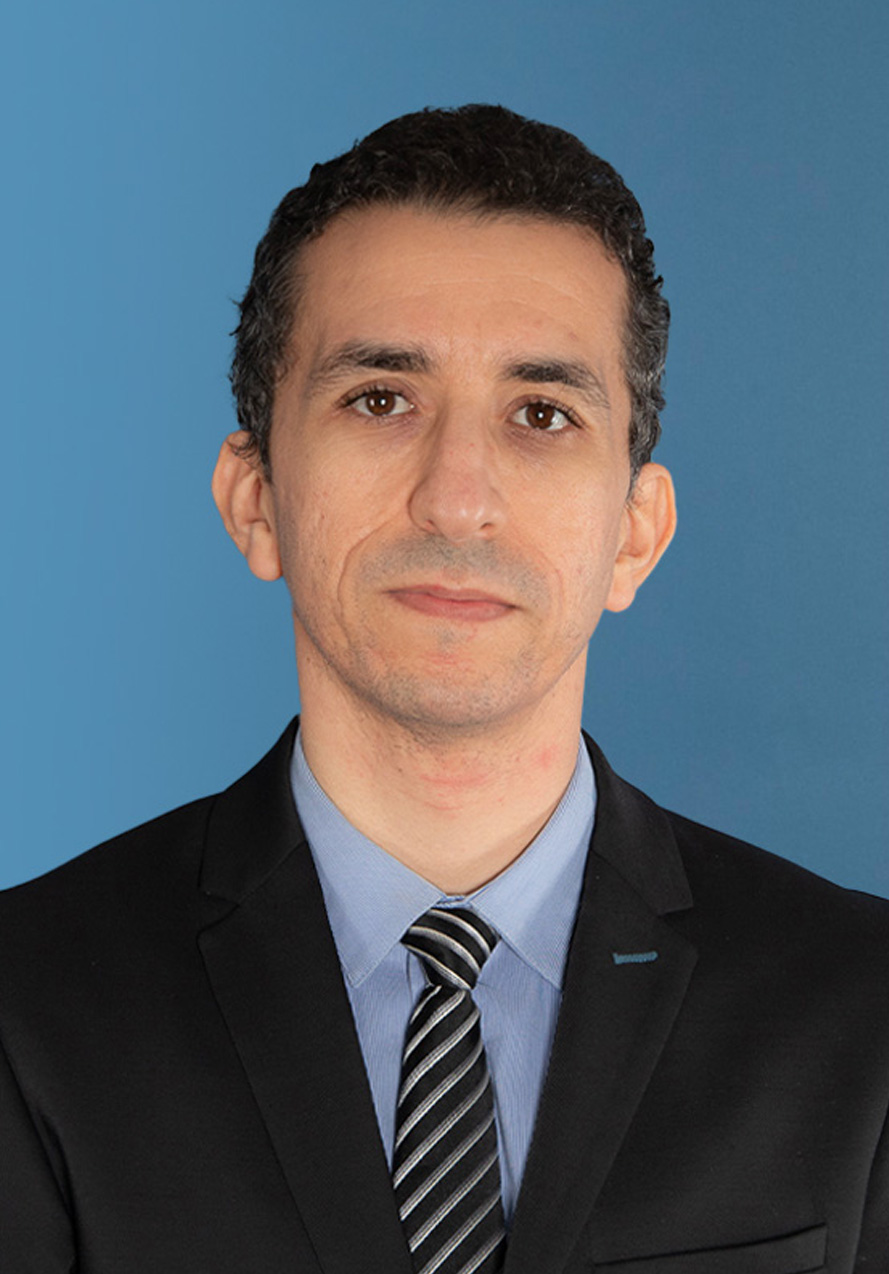
Head - Research in Economics
Abdelaaziz Ait Ali is a principal Economist and head of the Research Department at the Policy Center for the New South. He joined the Center in 2014 after five years of experience at the Central Bank of Morocco. He worked as an economist in the International Studies and Relations Department and was analyzing the real estate price index and financial asset prices for monetary policy and financial stability purposes. Since then, Abdelaaziz has focused on cyclical and structural issues of the Moroccan economy, including macroeconomic management and industrial policy design. He has published articles on the reform of the exchange rate regime in the Moroccan economy and its implications for macroeconomic regulation, as well as on the evolution of the macroeconomic framework over th ...
RELATED CONTENT

  • Authors
    Under the Supervision of
    October 2, 2019
    Africa is an economic region which holds great potential despite the risks associated with its development. Indeed, many experts agree that Africa is emerging as the new frontier for global growth. Boosted by its abundant natural resources, a young and vibrant population, strong urbanization, more stable macroeconomic conditions, more stringent economic policies, a constantly improving business climate and improving governance, Africa is on track for a structural transformation that ...
  • September 24, 2019
    En pleine transition ordonnée de son régime de change, sous l'autorité bienveillante du Fonds monétaire international (FMI), le Royaume du Maroc est un exemple très concret des avantages et des inconvénients des deux régimes de change dominants ces dernières décennies/change fixe et change flottant /. L’objet de cette note est de rappeler, tout d'abord, les fondamentaux économiques des deux systèmes et leur environnement historique (I). Ensuite, à la lumière de ces fondamentaux, pré ...
  • Authors
    Elhadj EZZAHID
    July 19, 2019
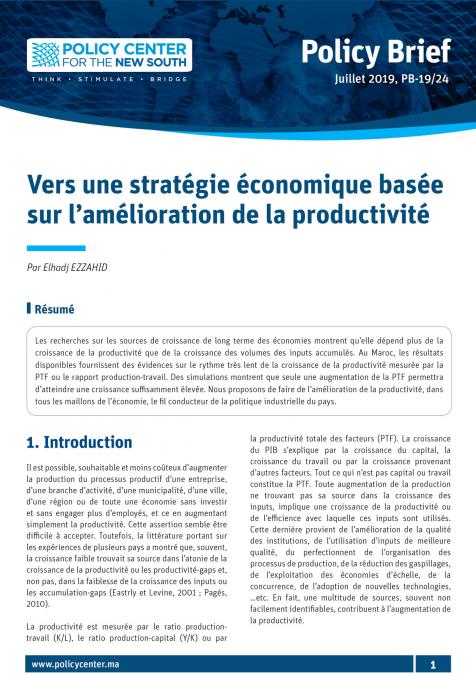
    Les recherches sur les sources de croissance de long terme des économies montrent qu’elle dépend plus de la croissance de la productivité que de la croissance des volumes des inputs accumulés. Au Maroc, les résultats disponibles fournissent des évidences sur le rythme très lent de la croissance de la productivité mesurée par la PTF ou le rapport production-travail. Des simulations montrent que seule une augmentation de la PTF permettra d’atteindre une croissance suffisamment élevée. ...
  • Authors
    Sandiso Sibisi
    July 17, 2019
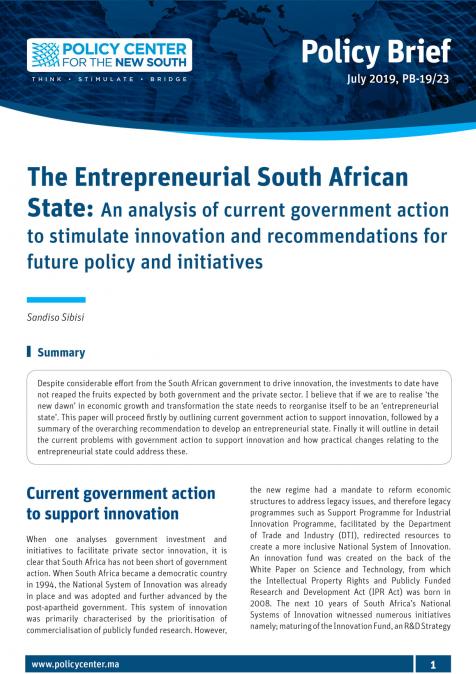
    Despite considerable effort from the South African government to drive innovation, the investments to date have not reaped the fruits expected by both government and the private sector. I believe that if we are to realise ‘the new dawn’ in economic growth and transformation the state needs to reorganise itself to be an ‘entrepreneurial state’. This paper will proceed firstly by outlining current government action to support innovation, followed by a summary of the overarching recomm ...
  • Authors
    Taoufik Abbad
    July 5, 2017
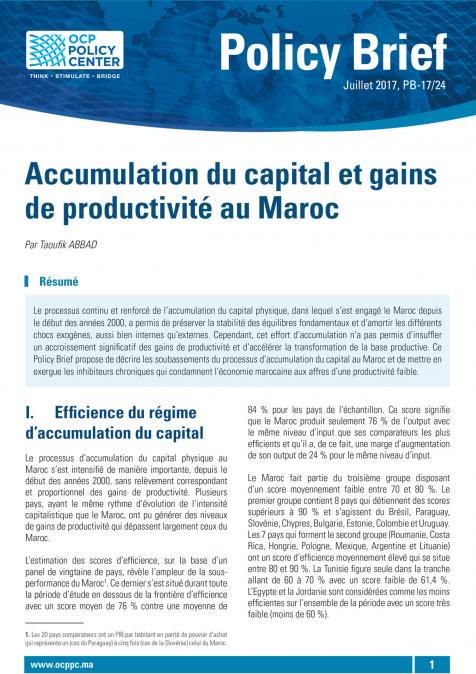
    Le processus continu et renforcé de l’accumulation du capital physique, dans lequel s’est engagé le Maroc depuis le début des années 2000, a permis de préserver la stabilité des équilibres fondamentaux et d’amortir les différents chocs exogènes, aussi bien internes qu’externes. Cependant, cet effort d’accumulation n’a pas permis d’insuffler un accroissement significatif des gains de productivité et d’accélérer la transformation de la base productive. Ce Policy Brief propose de décri ...
  • Authors
    Taoufik Abbad
    July 5, 2017
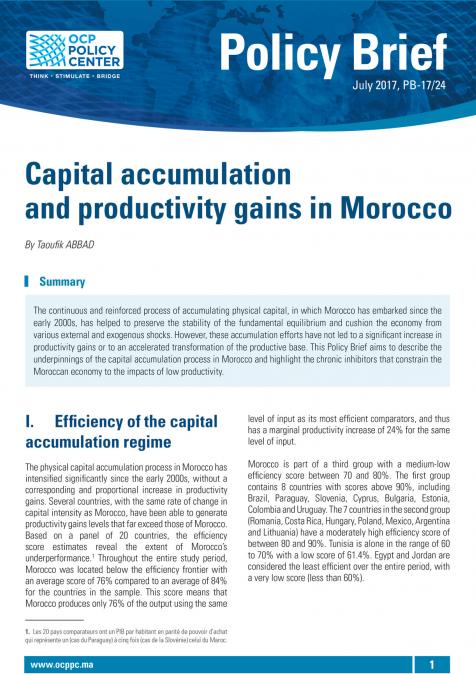
    The continuous and reinforced process of accumulating physical capital, in which Morocco has embarked since the early 2000s, has helped to preserve the stability of the fundamental equilibrium and cushion the economy from various external and exogenous shocks. However, these accumulation efforts have not led to a significant increase in productivity gains or to an accelerated transformation of the productive base. This Policy Brief aims to describe the underpinnings of the capital a ...
  • June 21, 2017
    Ce podcast est présenté par Moubarack Lo. Il y analyse l’apport de l’adhésion marocaine à la CEDEAO suite à l’accord de principe donné par ses membres au 51e sommet de Monrovia le 4 juin ...
  • Authors
    Edité par
    Idriss El Abbassi
    Lahcen Oulhaj
    Aziz Ragbi
    November 28, 2016
    Le présent ouvrage se propose d’apporter quelques éléments d’appui supplémentaires aux policy-makers pour une meilleure identification des défaillances des marchés au Maroc et une mise en place d’une stratégie de diversification et une politique industrielle efficientes, sans toutefois tomber dans la situation inverse où une stratégie mal définie et des outils mal choisis peuvent se traduire par une défaillance des politiques publiques. L’appréhension des difficultés qu’éprouve l’é ...
  • Authors
    Under the Supervision of
    Philippe Chalmin
    July 4, 2016
    Guinea’s bauxite, Moroccan phosphates, Nigerian Bonny Light, Zambian copper, Côte d'Ivoire’s cocoa, Ethiopian coffee or Madagascar’s vanilla: all are examples demonstrating that raw materials have a dimension that is as global as it is local. Global by the markets on which they are traded, local by their quality, a key element of their price, and their macroeconomic impact, particularly for Africa. In line with the 2016 CyclOpe report, which celebrates three decades of existence thi ...
  • Authors
    Russel Dinh
    January 27, 2016
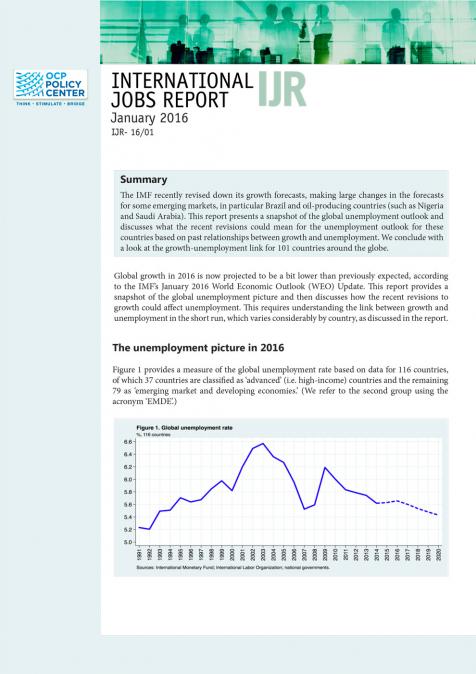
    The IMF recently revised down its growth forecasts, making large changes in the forecasts for some emerging markets, in particular Brazil and oil-producing countries (such as Nigeria and Saudi Arabia). This report presents a snapshot of the global unemployment outlook and discusses what the recent revisions could mean for the unemployment outlook for these countries based on past relationships between growth and unemployment. We conclude with a look at the growth-unemployment link f ...