
This episode examines firms’ access to finance in Morocco, highlighting its critical role in business creation and growth, especially for SMEs. It challenges common assumptions by showing that medium-sized firms, rather than small ones, face the most binding financial constraints. The discussion emphasizes the importance of bank-firm relationships, as well as structural issues such as information gaps and managerial capacity. It also points to digitalization and supply chain finance as key avenues to improve access to funding
RELATED CONTENT
-
 February 15, 2022Using education and elite configurations as the main variables of analysis, this Policy Paper aims to show how higher levels of popular sector incorporation during elite conflicts, namely in the process of formulating and implementing policies related to education reforms, can negatively affect the economic complexity of developing countries. To do so, it analyzes the experiences of Mauritius and Singapore and links foundational political economy theories, particularly developmental ...
 -
 December 16, 2021We provide evidence on the direct and indirect effects of trade and infrastructure on women’s participation in the labor force. We use panel data from 91 developing and emerging economies, and examine the impacts of openness to international trade and three indicators of infrastructure (access to electricity, mobile phone subscriptions and internet use) on female labor force participation. Fixed-effects and instrumental variable fixed-effects estimates suggest that both trade and ac ...
 -
 September 8, 2021We explore whether improved export sophistication increases women’s participation in wage employment. Using panel data from a large group of developing and emerging economies, and Fixed-effects and Generalized Method of Moments (GMM) estimators, we find that export sophistication has significant and mostly positive effects on women’s participation in paid employment in all regions, but these effects are nonlinear, since they become positive only after a threshold level of sophistica ...
 -
 December 29, 2020Dès les premiers cas du Coronavirus relevés en Afrique, les prédictions les plus sombres ont été faites sur la catastrophe sanitaire à venir sur le continent, en raison d’un certain nombre de caractéristiques supposées favoriser la propagation de l’épidémie. Ces prévisions ont été démenties par la rapidité des ripostes des Etats et par divers autres facteurs. La progression de la Covid-19 en Afrique n’est pas le fait d’une dynamique unique mais plutôt de multiples profils de risques ...
 -
 December 14, 2020This article has originally been published on OECD Development matter platform Many donor countries seem eager to see middle-income countries (MICs) “master out” and graduate to a non-client status in multilateral development institutions before fully achieving their development potential. We argue that such institutions can still significantly contribute to the sustainable development of MICs, while also seizing many benefits from this relationship (Middle income countries and mul ...
 -
 January 9, 2020The main goal of this paper is to address an important question that arises from the interaction between increased participation in international trade, labor markets, and gender inequality; namely, the impact of trade liberalization on women’s access to wage employment in the non-agricultural sector. We empirically address this question by performing fixedeffects and GMM estimations on panel data from a large group of developing economies, and tracing the impact of trade on women’s ...
 -
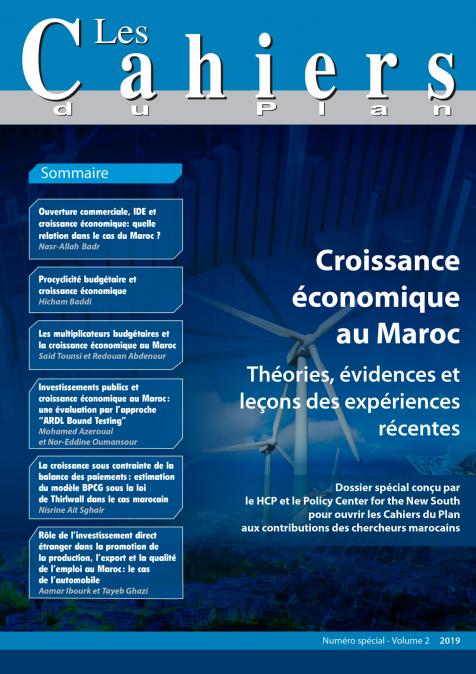 December 18, 2019Lors du colloque autour du thème « Croissance économique au Maroc : théories, évidences et leçons des expériences récentes », organisé conjointement par le Haut-Commissariat au Plan (HCP) et le Policy Center for the New South et accueilli par le HCP en mai 2017 dans ses locaux à Rabat, des experts et praticiens de près de 30 institutions académiques et non académiques ont échangé et débattu de la croissance économique au Maroc dans un framework transverse alliant le théorique au pra ...
 -
 October 14, 2019The objective of this paper is to better understand the evolution of manufacturing employment across the world. Manufacturing value added has grown rapidly since 2000, at least matching world GDP growth, even after the global financial crisis, reflecting mainly rising demand for manufactures especially in developing countries. However, manufacturing employment increased at only a slow pace, both before and after the global financial crisis. Manufacturing employment growth provided o ...
 -
 October 2, 2019Africa is an economic region which holds great potential despite the risks associated with its development. Indeed, many experts agree that Africa is emerging as the new frontier for global growth. Boosted by its abundant natural resources, a young and vibrant population, strong urbanization, more stable macroeconomic conditions, more stringent economic policies, a constantly improving business climate and improving governance, Africa is on track for a structural transformation that ...
 -
May 17, 2019Sur quelles contraintes faut-il anticiper lorsqu’on évoque la croissance de l’Afrique? Comment guider les décideurs politiques dans les priorités à définir pour piloter l’économie et arriver à bon port dans le monde qui vient? Le séminaire organisé le 11 avril à Paris par le PCNS et le Centre de développement de l’OCDE a apporté des éléments de réponse. La discussion s’est ouverte en prenant appui sur le rapport de référence publié en 2018 par l’Union africaine et l’OCDE ...

