The Consequences of Inflation in the Wider Atlantic

December 14, 2022

Inflation is back on the agenda. The rise of inflation occurred in the aftermath of the global activity rebound out of the COVID-19 when global value chains were severely disrupted and have been contending to recover since then. The Russia-Ukraine conflict added new strains over the global economy, raising energy and food prices. Inflation brings more uncertainty in the operation of an economy and introduces new transaction costs for economic agents, constrained to hedge against it. A more granular assessment indicates that vulnerable households were severely affected on two fronts. Their real disposable income shrunk while at the same time their savings slushed considerably, as their holdings are not generally inflation-immune. Besides, the aggressive reaction it generated from macroeconomic policy makers and its implications worldwide, this inflation trend could be the catalyst of ongoing transformations. It could strengthen even further the hand of those preaching globalization and advocating for self-reliance behaviors. In addition, inflation can also lead to questioning the balance of power between workers and capital holders, heralding a new era in labor markets negotiations.

- Are we heading toward a new inflation age?

- What are the drivers of today’s inflation and how similar/different is it from the 1970s?

- How can domestic policies cope with this issue? Can a collective international response prove to be effective?

- Beyond classic implications, can this inflation trend trigger more profound transformation of the worldwide economic system?

RELATED CONTENT

  • Authors
    January 27, 2026
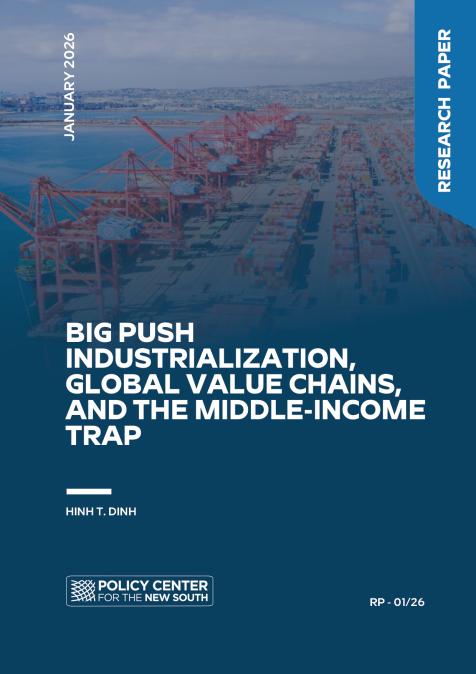
    This paper revisits Big Push industrialization theory in the context of open economies deeply integrated into global value chains (GVCs). While classical Big Push models emphasize demand complementarities and coordination failures in largely closed economies, many middle-income countries now industrialize through foreign-owned, import-intensive production networks. We develop an extended Big Push framework that incorporates GVC integration and import leakage, and show how these feat ...
  • January 23, 2026
    The post-1945 international order, an architecture born of war-weariness and colonial twilight, is now a majestic but empty shell. Its foundational promise—a universal system of rules administered impartially—has been hollowed out by decades of selective enforcement, instrumentalized law, and a chasm between the rhetorical ideals of its custodians and their geopolitical practice. This is not a temporary dysfunction, but a systemic failure of legitimacy. From the invasion of Iraq und ...
  • Authors
    January 21, 2026
    In response to developing countries’ dissatisfaction with the New Collective Quantified Goal (NCQG) of $300 billion, which was decided at the Twenty-Ninth Conference Of the Parties (COP29) to the United Nations Framework Convention on Climate Change, in 2024 in Baku, Azerbaijan, the COP29 and COP30 presidencies promised to develop a roadmap to achieve $1.3 trillion in external climate finance that developing countries need, and to present it at COP30 in Belém, Brazil[1]. The two pre ...
  • Authors
    January 20, 2026
    This policy brief examines what the 2025–2026 period reveals about the future of global energy risk and the energy transition. After the shocks of 2021–2023, 2025 brought broad price easing: oil and coal prices declined as supply growth outpaced demand, and the World Bank projects further declines in the global energy price index in 2026, offering short-term relief for energy-importing economies. The brief argues, however, that the macroeconomic relevance of energy entering 202 ...
  • Authors
    Fadoua Ammari
    September 12, 2025
    The Atlantic Initiative, announced by King Mohammed VI in November 2023 to provide landlocked Sahelian countries with access to the Atlantic Ocean via Moroccan territory, promises to profoundly reshape the bilateral relationship between Rabat and Nouakchott. This research paper examines how this unprecedented project creates new strategic opportunities while raising shared challenges for Morocco and Mauritania. Diplomatically, the rapprochement around the Atlantic Initiative unfolds ...
  • Authors
    Fadoua Ammari
    August 28, 2025
    L’Initiative Atlantique, annoncée par le Roi Mohammed VI en novembre 2023, visant à offrir aux pays sahéliens enclavés un accès à l’océan Atlantique via le territoire marocain, promet de redessiner en profondeur la relation bilatérale entre Rabat et Nouakchott. Cet article examine comment ce projet inédit crée de nouvelles opportunités stratégiques tout en soulevant des défis partagés pour le Maroc et la Mauritanie. Sur le plan diplomatique, le rapprochement autour de l’Initiative A ...
  • June 10, 2025
    In collaboration with the Policy Center for the New South, the Atlantic Council’s Africa Center, will launch the first policy brief of its new programming focused on the strategic and economic opportunities of the Atlantic basin. Authored by William Yancey Brown, the inaugural issue b...
  • Authors
    Paul Isbell
    February 6, 2025
    Pan-Atlantic cooperation is inspired by the opportunity to foster rising, widespread, and sustainable prosperity across Atlantic Basin societies, particularly in Africa and Latin America and the Caribbean (LAC). The key to unlocking this potential lies in deepening the Atlantic Basin’s already high level of intra-regional economic interdependence (when viewed as a single regional entity) and leveraging the untapped complementary opportunities within and across the Southern Atlantic. ...