Africafé: Innovations and Industrial Policies in Africa

December 28, 2023

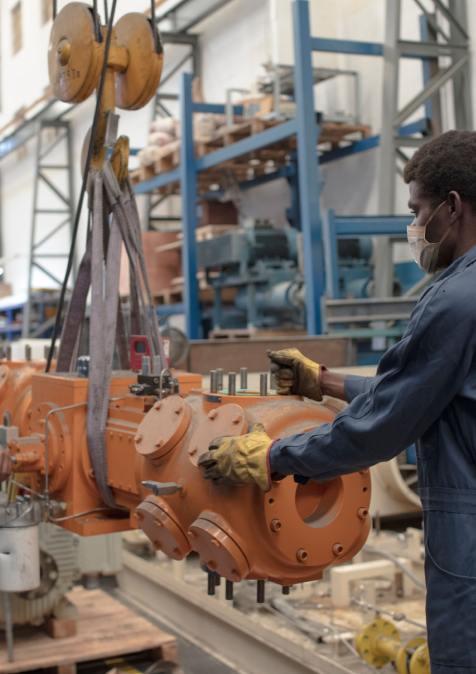
In this episode, we interviewed Mr. Arkebe Oqubay Metiku, British Academy Global Professor, SOAS University of London around Africa's industrial policies and their impact on growth. We discussed key elements such as innovation, regional collaboration, sustainability, and intellectual property protection. Mr. Arkebe shared his insights on pivotal sectors like technology, manufacturing, and services, highlighting their role in driving economic prosperity. We also addressed how industrial policies foster collaboration among African nations through regional value chains. The episode touched on the complexities of a green industrial strategy, examining trade-offs between economic growth, environmental sustainability, and social equity.

Speakers

Ahmed Ouhnini
Senior Program Officer, Policy Center for the New South
Ahmed Ouhnini is an Economist at the Policy Center for the New South. His research area covers agricultural economics, human and social development. Previously, he has worked as a researcher at the Paris School of Economics (PSE) and has also a record of working in consulting services in Morocco. Ahmed holds an engineering Diploma in Agriculture and Rural Development from the National School of Agriculture of Meknes and a Master’s Degree in Law, Economics and Management from the Paris 1 Pantheon Sorbonne Institute of Development. ...
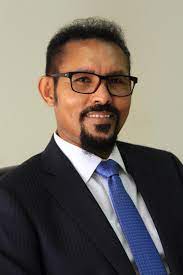
Arkebe Oqubay Metiku
British Academy Global Professor, SOAS University of London
 Arkebe Oqubay (PhD) is a distinguished scholar-practitioner. He is a British AcademyGlobal Professor at SOAS University of London. He is a former Senior Minister and hasserved as a Special Advisor to three successive prime ministers of Ethiopia. He has been atthe centre of policymaking in Ethiopia for over 30 years, successfully leading bold reformsand playing a pivotal role in Ethiopia’s economic transformation. He is the former Mayorof Addis Ababa, recognized for transforming the city. He has led the boards of key publicenterprises, including Ethiopian Airlines. Dr Arkebe’s research focuses on structural transformation,catch-up, green transformation, and industrial policy with a focus on Africa. DrArkebe currently gives policy advice to, and consults for, African gover ...
RELATED CONTENT

  • From

    17
    9:00 am November 2026
    In person registrationOnline registrationIndustrialization in North Africa is entering a new phase shaped by global megatrends, the green and digital transitions, evolving value chains, and the growing need for resilient and competitive production systems.Against this backdrop, the Policy Center for the New South and the United Nations Industrial Development Organization (UNIDO) are convening The Future of Industrialization: Building Future-Ready Industries in North Africa on November 17, 2026, at the Policy Center for the New South in Rabat.The event will present key insights from the Industrial Development Report 2026 (IDR26) and bring together policymakers, industry leaders and experts to discuss the region’s industrial opportunities, constraints and policy priorities. The ...
  • Authors
    Aziz Ajbilou
    Ouidade Sabri
    November 4, 2026
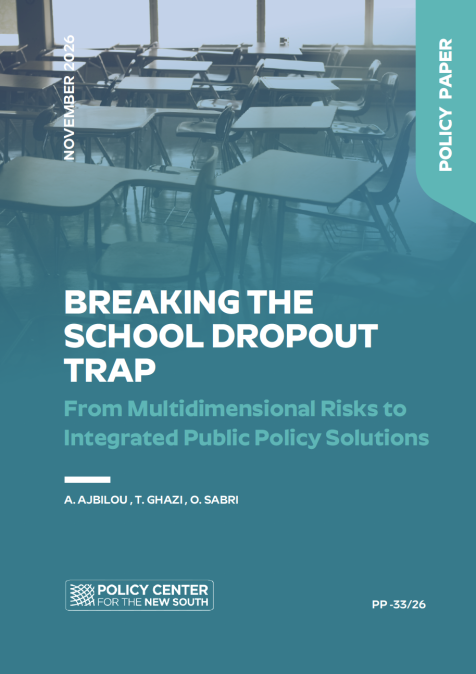
    School dropout remains a major challenge for education systems and public policy, with lasting consequences for human capital, labor market integration, social cohesion, and long-term economic growth. Despite sustained efforts to expand access to schooling, many countries continue to experience high dropout rates, particularly at key transition points in lower- and uppersecondary education. Policy responses have often relied on fragmented, sector-specific interventions—addressing ed ...
  • Authors
    Bambang Brodjonegoro
    November 2, 2026
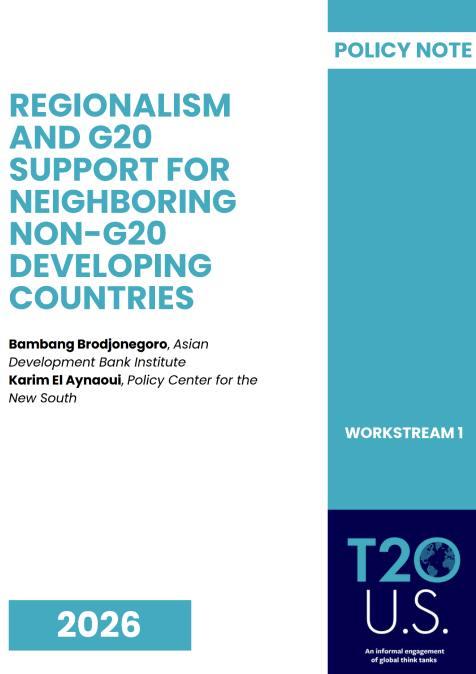
    This policy note was published as part of the T20 U.S. 2026 Workstreams, under the workstream “Fostering Trade and People-Centered Economic Growth,” which brings together policy experts to develop recommendations for G20 policymakers. The Group of Twenty (G20) accounts for most of the world’s output, yet its decisions shape the prospects of 174 United Nations Member States without G20 membership, among them the great majority of least developed countries and small states. Many ...
  • October 15, 2026
    The Policy Center for the New South, in partnership with The Asian Network, is organizing a webinar titled “Emerging Powers and the Remaking of Global Order” to examine the growing role of emerging powers and the Global South at a time of profound transformation in the international sys...
  • Authors
    Florent Parmentier
    October 12, 2026
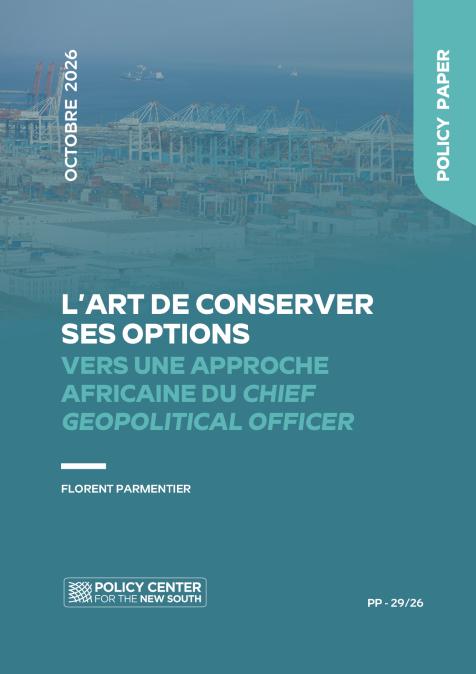
    Cet article soutient que le Chief Geopolitical Officer (CGO) doit être repensé à partir de l’expérience des entreprises africaines. Dans un environnement multipolaire et fragmenté, leur principal défi n’est pas seulement la gestion des risques, mais la préservation de plusieurs options stratégiques simultanément selon une logique de hedging. Trois modèles de CGO sont à distinguer : l’intermédiation (Office chérifien des Phosphates (OCP), Tanger Med), l’intégration régionale (Ethiopi ...
  • October 09, 2026
    Can Nigeria’s Dangote refinery help strengthen Africa’s energy security amid disruptions to global supply routes? This discussion considers how expanding local refining capacity can reduc ...
  • October 8, 2026
    This paper was originaly published on Higher Education Policy Journal This article critically assesses the alignment between Morocco’s public guidance schemes for international students and its national development goals. Specifically, it investigates the capacity of these mechanisms to transform student mobility from a potential ‘brain drain’ into a tangible ‘brain gain’. Employing a qualitative case study approach, we conducted a systematic content analysis of 204 mobili ...
  • Authors
    Marie-Noelle Nwokolo
    October 6, 2026
    The author of this opinion, Marie-Noelle Nwokolo, is a 2024 alumna of the Atlantic Dialogues Emerging Leaders Program.In September 1978, delegations from 138 countries gathered in Buenos Aires, Argentina, around a powerful idea: developing countries had knowledge, experience and capabilities worth sharing with one another. The Buenos Aires Plan of Action gave institutional form to what we now call South-South Cooperation, part of a wider post-colonial effort by developing ...
  • Authors
    October 2, 2026
    Le Cameroun dispose d'importants gisements de minerais, notamment de fer, de la bauxite, d'or, de cobalt, de nickel, de manganèse, de calcaire, de marbre, de diamants, entre autres. L'industrie minière du pays est restée dominée par l'exploitation artisanale et à petite échelle, en particulier l'orpaillage, tandis que les hydrocarbures ont représenté l'essentiel des recettes issues des industries extractives. Le pays cristallise ainsi le paradoxe africain : malgré l’ampleur et la di ...