Advancing Financial Inclusion and Gender Equity: Job Creation and Economic Empowerment in Africa

February 21, 2025

In this episode, Sibahle Magadla discusses key strategies for advancing financial inclusion and gender equity in Africa. She highlights the role of financial inclusion in driving economic growth, emphasizes the importance of promoting gender equality in finance and employment, and tackles the issue of youth unemployment by advocating for job creation.
RELATED CONTENT

  • Authors
    December 3, 2025
     Global GDP growth has proven resilient in 2025, despite the shocks caused by the trade policies implemented by United States President Donald Trump in the first year after his return to office. The gloomy projections offered by multilateral and private institutions in the first quarter of 2025 have given way to revised levels mostly in the 2.5% to 3% range for the year. ...
  • November 25, 2025
    This Policy Paper analyses the Fourth Industrial Revolution (4IR) through the critical lens of technological colonialism. It argues that the fusion of physical, digital, and biological technologies is not merely a technical phenomenon but a civilizational shift reshaping the foundations of global power. The article traces a historical continuum from previous industrial revolutions, demonstrating how patterns of inequality and extraction persist, now transposed into the digital realm ...
  • September 19, 2025
    Pierre Nguimkeu, Director of the Africa Growth Initiative at Brookings, examines Africa’s digital transformation and its impact on work, education, and the economy. From mobile technology ...
  • Authors
    September 19, 2025
    Le constat est unanime et est constamment souligné : le modèle de développement en vigueur au Maroc a atteint ses limites. La Vision Royale, refusant « un Maroc à deux vitesses », vient formaliser au plus haut niveau cette préoccupation systémique, documentée par une décennie de rapports officiels. La  Vision de Sa Majesté le Roi Mohammed VI est un hymne à une dynamique de croissance dont les retombées doivent être plus équitablement réparties et à un développement te ...
  • Authors
    September 16, 2025
    Les questions des inégalités sociales et des inégalités territoriales sont profondément liées.  Les politiques publiques ne peuvent réduire l’une sans s’attaquer à l’autre.  Le phénomène des inégalités peut s’accentuer avec la fragilité de la situation socio-économique de certains territoires d’autant que le développement territorial n’est pas spontanément équitable. La réduction de ces inégalités, un des enjeux majeurs des politiques publiques, oblige à con ...
  • September 11, 2025
    Ce travail apporte un éclairage critique sur l'alignement des dispositifs publics d'orientation des étudiants marocains à l'étranger avec les ambitions de développement du pays. Il interroge la capacité de ces mécanismes à transformer la mobilité étudiante d'une potentielle "fuite des cerveaux" en un véritable "gain de cerveaux". S'appuyant sur une étude de cas qualitative, nous avons mené une analyse de contenu systématique (cartographie) de 204 programmes promus par le ministère d ...
  • Authors
    Zakaria Elouaourti
    August 7, 2025
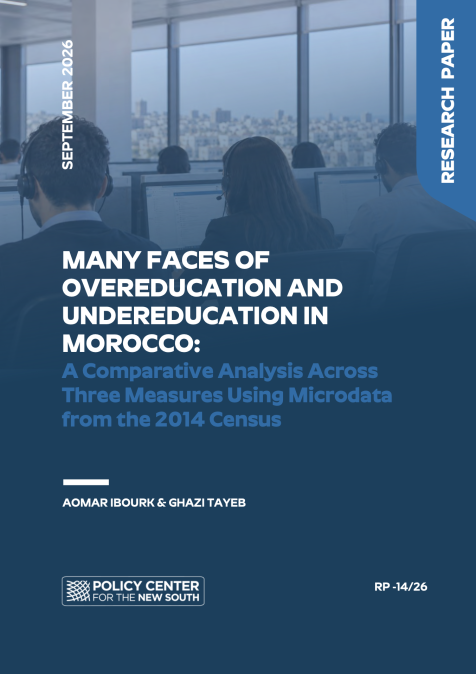
    This paper was originally published on tandfonline.comYouth’s life paths have become increasingly challenging, especially for those classified as ‘Not in Education, Employment, or Training’ (NEET), who comprise 31.2% of North Africa’s youth population. This paper contributes to the growing discourse on the NEET phenomenon by exploring its structural and psychosocial dimensions in North Africa, with a specific focus on gender. Using a rich micro-level dataset of 7,815 individuals age ...
  • Authors
    Isabela Carvalho
    April 30, 2025
    The author of this opinion, Isabela Carvalho, is a 2018 alumna of the Atlantic Dialogues Emerging Leaders Program. In today’s interconnected world, knowledge plays a vital role in driving change and shaping solutions. Yet despite the rise of digital tools and global collaboration, persistent gaps in how knowledge is managed and shared continue to limit the Global South’s ability to fully harness its potential. Strengthening resilient knowledge ecosystems fosters inclusive ...
  • Authors
    March 7, 2025
    Chaque jour, en moyenne, les femmes marocaines consacrent près de cinq heures à des tâches domestiques (cuisine, ménage, courses, soins aux enfants, etc.). Elles assurent plus de 90 % du temps total consacré aux tâches domestiques par l’ensemble des hommes et des femmes. Ce travail non rémunéré représente des services indispensables qui participent au bien-être matériel des personnes et des foyers sans pour autant apparaître dans la production nationale, telle que mesur ...