Publications /
Paper in Academic Journals
Back
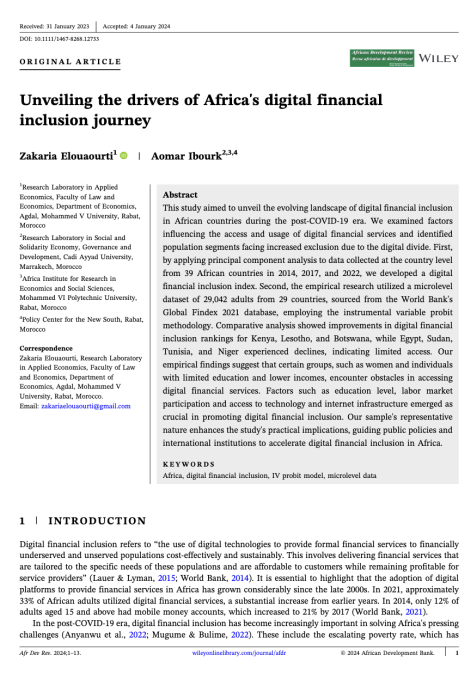
Unveiling the drivers of Africa’s digital financial inclusion journey
Authors
Zakaria Elouaourti
January 31, 2024

This Paper was originally published on onlinelibrary.wiley.com

This study aimed to unveil the evolving landscape of digital financial inclusion in African countries during the post-COVID-19 era. We examined factors influencing the access and usage of digital financial services and identified population segments facing increased exclusion due to the digital divide. First, by applying principal component analysis to data collected at the country level from 39 African countries in 2014, 2017, and 2022, we developed a digital financial inclusion index. Second, the empirical research utilized a microlevel dataset of 29,042 adults from 29 countries, sourced from the World Bank's Global Findex 2021 database, employing the instrumental variable probit methodology. Comparative analysis showed improvements in digital financial inclusion rankings for Kenya, Lesotho, and Botswana, while Egypt, Sudan, Tunisia, and Niger experienced declines, indicating limited access. Our empirical findings suggest that certain groups, such as women and individuals with limited education and lower incomes, encounter obstacles in accessing digital financial services. Factors such as education level, labor market participation and access to technology and internet infrastructure emerged as crucial in promoting digital financial inclusion. Our sample's representative nature enhances the study's practical implications, guiding public policies and international institutions to accelerate digital financial inclusion in Africa.

RELATED CONTENT

  • Authors
    June 8, 2026
    The energy shock caused by the war between the United States and Israel and Iran has highlighted the need for Africa to refine more of its own crude oil. Africa is a net hydrocarbon exporter, but remains stuck in the old colonial economic model: it mostly exports raw materials and imports refined products. Africa exports about 2.6 billion barrels of crude oil every year, and imports about 1.4 billion barrels of refined products. This is a problem for two reasons. First, Africa ...
  • Authors
    Karim El Mokri
    Idriss El Abbassi
    June 8, 2026
    Bientôt disponible en vente sur amazon et Livremoi. Le monde du travail est engagé dans un processus de mutation sans précédent. La quatrième révolution industrielle, portée par l’intelligence artificielle (IA) et la robotisation, a été le point de commencement d’une ère nouvelle où les repères économiques et sociaux se redéfinissent à une vitesse inédite. Ces technologies suscitent un engouement légitime et offrent des perspectives prometteuses, mais requièrent une vigilance a ...
  • June 5, 2026
    Driven by its mission to reflect on and analyze the major geopolitical, economic, and societal transformations shaping the contemporary world, and with a view to contributing to knowledge-sharing and disseminating the main outcomes of its research program, the Policy Center for the New South regularly publishes collective volumes addressing issues of particular importance to Morocco, Africa, and the broader Global/New South. In this spirit, the Center has recently released two volum ...
  • June 4, 2026
    Cet épisode revient sur les principaux enseignements du chapitre consacré au secteur extérieur marocain, en mettant en lumière le paradoxe d’un déficit commercial structurel persistant combiné à une forte résilience des équilibres externes. Badr Mandry explique comment les transferts de...
  • June 1, 2026
    Cette interview met en lumière le rôle central du secteur textile et de l’habillement dans l’économie marocaine, tant en matière d’emploi que d’exportations. Notre économiste, Mr. Fahd Azeroual revient sur son évolution historique, ses principaux défis, notamment la dépendance aux impor...
  • Authors
    Irene Wanjiru Kariuki
    May 27, 2026
    The Organisation for Economic Co-operation and Development estimates that Africa loses as much as USD 60 billion each year in illicit financial flows (IFFs). Undoubtedly, the IFFs strip substantial amounts of resources from African countries, and the immediate impact is a reduction in national expenditure and investment. This translates into inadequate public services, including hospitals, schools, national security, and transport infrastructure. It also contributes t ...
  • Authors
    May 22, 2026
    This paper, the fourth in a research series on services-led growth in the Global South, examines Egypt’s potential for growth and economic transformation through the integration of services into Global Value Chains (GVCs). It employs a new taxonomy that classifies services into Knowledge Services (KS), Enabling Services (ES), and Local Services (LS) and applies OECD 2025 Trade in Value-Added (TiVA), Trade in Employment (TiM), and input-output databases to benchmark Egypt against Mor ...
  • May 20, 2026
    La participation des femmes au marché du travail au Maroc demeure l'un des défis les plus structurels du développement économique et social du pays. Avec un taux d'activité féminin de seulement 19 % en 2023, contre 69 % pour les hommes (HCP, 2024), le Maroc présente l'un des écarts de genre les plus prononcés parmi les économies en développement (Banque mondiale, 2024). Ce Research Paper propose une analyse économétrique rigoureuse et multiniveaux des déterminants de cette participa ...
  • Authors
    Eugène Berg
    May 19, 2026
    L’Organisation pour la coopération et le développement économiques (OCDE), forte de 38 membres, a longtemps fait figure d’Organisation regroupant les « démocraties industrielles développées ». Cette image n’est plus vraie, du fait de l’adhésion en son sein de pays, qualifiés jadis en développement, et que l’on considère souvent comme faisant partie du « Sud global ». C’est ainsi que l’ont intégrée : le Mexique (1994), qui lui a donné un Secrétaire général, Angel Gurria, la Corée du ...