Publications /
Policy Brief

Back
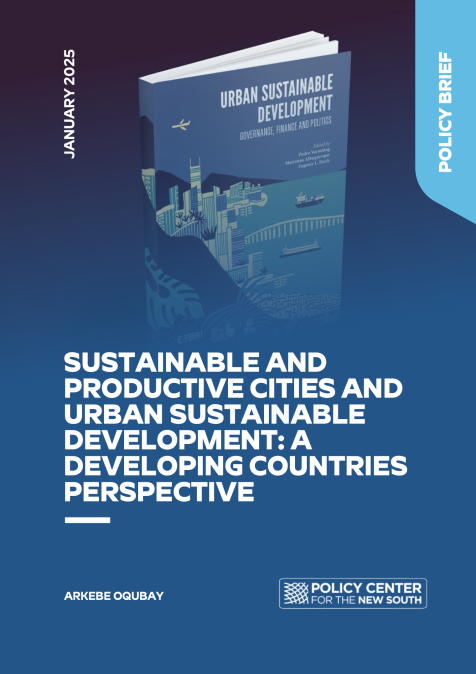
Sustainable and Productive Cities and Urban Sustainable Development: A Developing Countries Perspective
Authors
Arkebe Oqubay
January 20, 2025

This paper, included in the report "Urban Sustainable Development: Governance, Finance and Politics.", was originally published on:https://cebri.org/en/doc/356/cebri-and-rio-g20-committee-publish-urban-sustainable-development-governance-finance-and-politics

 © Vormittag, Pedro, Marianna Albuquerque & Eugénie Birch (Eds.). 2024. Urban Sustainable Development: Governance, Finance and Politics. Rio de Janeiro: CEBRI.


The article discusses the role of sustainable and productive cities as drivers of global transformation. Cities, as the heart of human civilizations, not only propel economic development and serve as technological and innovation hubs but also inspire hope and optimism for the future. They contribute over 80 percent of the global economy and nearly 100 percent to all scientific and technological breakthroughs. Rapid urbanization has been a primary force in the demographic shift that impacts global transformation. With their unparalleled resilience and innovation ability, cities are also at the forefront of significant global challenges, such as the COVID-19 pandemic and climate change, finding sustainable solutions. Cities are not just essential to the 2030 Agenda for Sustainable Development and the Paris Climate Agreement, endorsed by all United Nations member countries, but are the subject and primary actors in implementing it. By recognizing the importance of making “cities and human settlements inclusive, safe, resilient and sustainable” (Goal 11), the 2030 Agenda underscores the importance and impact of cities in shaping the future.

However, in shaping global transformation, cities face significant challenges in releasing their full potential, including financial, governance, and political constraints. A G20 Summit in Rio de Janeiro led by Brasil could be instrumental in promoting city transformation and urban sustainable development as essential components of the development agenda, empowering cities to take charge of their transformation. The objectives of the paper are: (1) to present urbanization and urban transformation as a framework; (2) to explain why and how cities should strive to be not only productive but also sustainable to promote their national development strategies, to achieve Sustainable Development Goals (SDGs) and the net zero agenda; (3) to further discuss the dynamics of city transformation with a focus on Addis Ababa’s transformation as a case study; and (4) to learn from city leadership experiences. The article will explore critical questions: What specific strategies can cities implement to become productive and sustainable cities? What examples of successful city transformation and leadership experiences can be learned from? Given the urbanization wave, population growth, and the lagging structural transformation, these questions have significant implications for cities in emerging and developing economies or the Global South.

This article is enriched by the author’s over three decades of experience in development policymaking and transformation, including serving as the former mayor of Addis Ababa and former minister of urban development. This unique perspective, combined with extensive scholarly and research work drawing from development economics, urban development, and international political economy, provides a comprehensive understanding of the issues at hand. The paper is structured into four sections covering the above mentioned themes, supplemented by an introduction and conclusion. The author’s unique perspective is a critical element that makes this paper a valuable resource for understanding urban transformation.
RELATED CONTENT

  • Authors
    Abderrahmane Mebtoul
    December 1, 2013
    L’intégration du secteur informel ne peut être réalisée sans l’existence d’un Etat de droit et elle nécessite une cohérence des politiques de développement, qui s’impose plus que jamais face à l’ampleur des économies parallèles. L’intégration du secteur informel ne pourra pas se faire non plus sans une sérieuse amélioration du niveau d’éducation et une véritable réduction des inégalités hommes/femmes ...
  • Authors
    Ian Lesser
    November 18, 2013
    This policy brief argues for a closer relationship between Morocco and the United States. Morocco’s geo-economic position is evolving in ways that will shape U.S. and international interests in the country and open new avenues for cooperation. Key drivers of change in this context include Morocco’s stake in greater economic integration in the Maghreb, a growing role in Africa, new energy and infrastructure projects, and the emergence of Morocco as a hub for communications around th ...
  • Authors
    Mihoub Mezouaghi
    November 1, 2013
    Le discours sur la « colocalisation » est chargé de bonnes intentions à l’attention des pays du sud de la Méditerranée qui, depuis quelques années, réclament avec insistance une contrepartie à l’accès à leur marché (notamment en matière de transfert de technologie pour permettre d’accélérer leur industrialisation). La « colocalisation » est alors présentée comme une « forme avancée de la délocalisation ». Mais, ce discours s’adresse en même temps à l’opinion publique française lorsq ...
  • Authors
    John B. Richardson
    Armando Marques Guedes
    Xavier de la Gorce
    Anne-François de Saint Salvy
    Paul Holthus
    November 29, 2012
    This paper examines the challenges posed by human activity on the Atlantic Ocean itself, and around its coasts, looking at it not so much as a vast expanse separating the Americas from Africa and Europe but rather as a shared resource and an important connector. All littoral states face a common challenge in maintaining its value as a foundation for sustained “blue growth” in the years to come. In Chapter 1, Armando Marques Guedes traces the evolution of the economic activities that ...
  • Authors
    Françoise Nicolas
    January 1, 2011
    La montée en puissance de la Chine et de l’Inde domine les débats économiques depuis quelques années déjà. Poursuivant une stratégie d’internationalisation résolue, les entreprises chinoises et indiennes sont désormais présentes dans bon nombre de régions du globe. Ce dynamisme n’a pas manqué de susciter des inquiétudes mais aussi des espoirs, notamment dans le monde en développement, où ces deux pays sont perçus comme des partenaires potentiellement plus bienveillants que les pays ...
  • Authors
    Kassim Bouhou
    September 17, 2010
    Before the 9/11 events, US-Maghreb relations were growing stronger, especially after the United States had long left the floor to the Maghreb’s “natural” European partner. Therefore the American action in this region was in line with a mechanism previously set off by Clinton Administration member, Stuart Eizenstat, which aimed at reducing intra regional obstacles and stimulating American investments towards an area where Americans were little-represented. Hence Washington seemed mor ...
  • Authors
    Flore Gubert
    September 1, 2010
    The potential synergy between development and migration has become a key feature of most international migration politics. However, this relationship is far from evident. Flore Gubert helps better understand the complexity of this relationship through the comparison of two regional contexts (Mexico and North Africa), and shows how the political and economic context prevailing in the countries of origin modifies the link between migration and development. This Note de l'Ifri is the ...
  • From

    06
    11:00 am October 2026
    Dans un environnement international reconfiguré, les économies à revenu intermédiaire poursuivent leur processus de convergence dans des conditions plus exigeantes. La fragmentation géopolitique et la réorganisation des chaînes de valeur mondiales modifient les logiques d'insertion productive, tandis que les tensions sur le système monétaire international pèsent sur le financement des économies en développement. L'accélération des transitions technologique et énergétique redistribue par ailleurs les avantages comparatifs et exige des capacités d'adaptation que tous les pays ne peuvent mobiliser au même degré. Les moteurs classiques du rattrapage se trouvent fragilisés, et le risque d'enlisement dans le piège du revenu intermédiaire se pose de manière plus pressante.C'est dans ...
  • From

    24
    5:30 pm September 2026
    Dans cet épisode d’Africafé, Amadou Diop analyse les défis de sécurité maritime auxquels font face les pays de l’Afrique atlantique, de la piraterie aux trafics transfrontaliers. Il souligne la nécessité de mutualiser les moyens et de partager l’information entre États. L’échange aborde aussi le potentiel économique de cet espace et les conditions d’une coopération maritime plus cohérente, notamment dans le cadre de l’Initiative atlantique du Maroc. ...