Publications /
Opinion
The author of this opinion, Marie-Noelle Nwokolo, is a 2024 alumna of the Atlantic Dialogues Emerging Leaders Program.
In September 1978, delegations from 138 countries gathered in Buenos Aires, Argentina, around a powerful idea: developing countries had knowledge, experience and capabilities worth sharing with one another. The Buenos Aires Plan of Action gave institutional form to what we now call South-South Cooperation, part of a wider post-colonial effort by developing countries to increase their room for maneuver in an international system in which less wealthy states had limited bargaining power.
Nearly five decades later, that idea deserves to be taken more seriously, not less. One enduring habit of international development is to assume that countries with the most money also have the most relevant answers. Yet money and useful knowledge do not always reside in the same place. A government trying to extend healthcare with scarce doctors, industrialize with limited capital, or digitize services across a large informal economy may have much to learn from countries that confronted similar constraints within recent memory.
The pool of such experience has expanded dramatically. South-South merchandise trade reached $7.2 trillion in 2025, with its share of world merchandise trade rising from 11% in 2000 to 28%. Yes, one might say that trade is commercial exchange, not development cooperation. But its extraordinary growth signals a wider shift: developing countries now account for a much larger share of global production, investment and technological activity, and many possess firms, technologies and hard-won development experience that other developing countries can draw on.
The development literature already recognizes much of this. UNCTAD has long argued that South-South relationships should strengthen productive capacities, technological learning and domestic linkages. Research on policy transfer shows that development models travel imperfectly and require adaptation to local institutions and incentives. More recent scholarship has also challenged the comfortable assumption that South-South relationships are inherently horizontal or free of hierarchy. The unresolved problem is more specific: How does relevant external experience become a capability that is actually owned and exercised locally? This is the conversion problem.
Development cooperation frequently speaks the language of transfer: knowledge transfer, technology transfer, technical assistance and skills transfer. Transfer tells us that something moved, but it tells us much less about what changed at the destination. Technology can arrive without local engineers acquiring the ability to maintain or modify it. Officials can be trained while their institution continues to operate exactly as before. A foreign factory can employ workers while domestic firms remain unable to enter its supply chain.
Conversion, however, is the process through which externally sourced knowledge, technology, or practice becomes an embedded local capability: a firm, institution, or workforce can reliably perform a function, adapt it as circumstances change, and improve it with declining dependence on the original partner.
This builds on, but goes beyond, familiar arguments about productive and absorptive capacity. Productive-capacity approaches ask whether economies acquire the resources, entrepreneurial capabilities and production linkages needed to produce and diversify. Absorptive-capacity approaches ask whether firms and institutions can recognize and use external knowledge. The conversion question focuses on the cooperation process itself: through which channels does capability accumulate, who comes to possess that capability, and can they exercise and reproduce it after the original transfer?
That distinction matters because South-South cooperation may possess an advantage at the first stage: relevance. Countries that have solved development problems under comparable constraints can sometimes offer technologies, institutions and policy experience closer to the realities of other developing economies. Relevance, however, is only the beginning. Experience must still be adapted, then embedded. Those stages can fail independently.
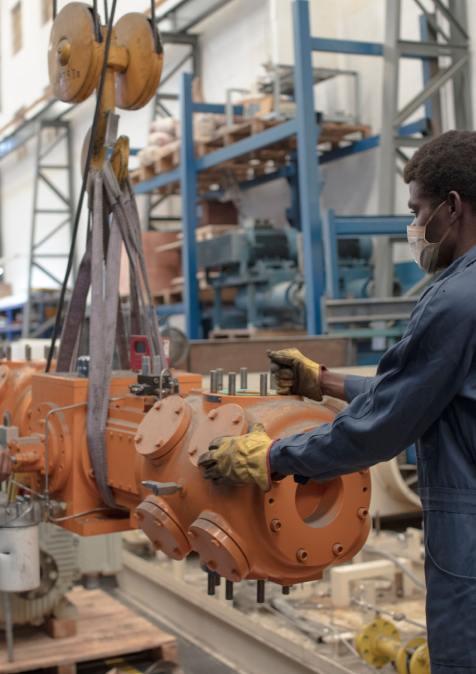
Research on pharmaceutical manufacturing in Kenya, Tanzania and Uganda illustrates why the channel matters. Nitsan Chorev’s study of South-South pharmaceutical technology transfer found that the growing use of Southern sources of know-how coincided with a shift from learning that primarily strengthened individuals to channels that strengthened capabilities within firms. In Uganda, cooperation between a domestic pharmaceutical company and India’s Cipla, supported by the Ugandan state, helped create the capabilities required for more sophisticated local production. The bigger point is that knowledge transfer only goes so far. What matters is whether that knowledge becomes embedded in the institutions and firms that need to use it.
The China-Zambia renewable-energy technology-transfer program provides another glimpse of conversion. Supported by UNDP and Denmark, it combined technology transfer with standards, regulatory reform, financing mechanisms, testing and training facilities. More tellingly, some graduates of Zambia’s solar center later supported a separate program electrifying rural health centers. Knowledge acquired through one partnership was subsequently exercised in addressing another domestic development problem. That is a more demanding indication of capability than the number of people trained.
Indeed, responsibility also shifts toward the receiving country. More partners create more choices; state capacity determines what countries extract from those choices. Governments need to identify the functions they want to build, distinguish useful experience from fashionable models, negotiate around domestic priorities, coordinate implementation, connect foreign firms to local suppliers and learn as programs unfold. Agency, in this sense, is not simply a diplomatic posture. It depends on having the institutional machinery to make good use of the choices available.
We should be concerned if, five years after a targeted South-South partnership, governments cannot say what they can now produce, export, manage, or solve better because of it. The radical insight of Buenos Aires was that development knowledge need not flow in one direction. The next step, however, is—and should be—more demanding: to distinguish the movement of knowledge from the creation of capability.
The most valuable South-South partnerships will convert relevant experience into capabilities that take root locally - in domestic institutions, firms and workforces - and can be adapted and improved over time. They should leave countries able to do more for themselves and enter the next partnership from a stronger position.