Publications /
Policy Paper

Back
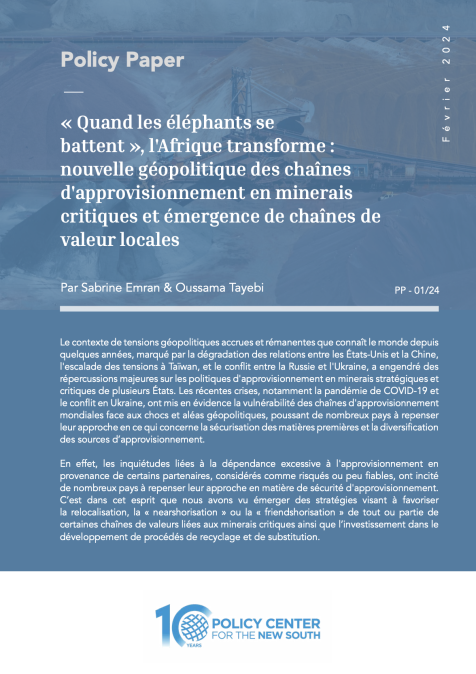
« Quand les éléphants se battent », l'Afrique transforme : nouvelle géopolitique des chaînes d'approvisionnement en minerais critiques et émergence de chaînes de valeur locales
February 20, 2024

Le contexte de tensions géopolitiques accrues et rémanentes que connaît le monde depuis quelques années, marqué par la dégradation des relations entre les États-Unis et la Chine, l'escalade des tensions à Taïwan, et le conflit entre la Russie et l'Ukraine, a engendré des répercussions majeures sur les politiques d'approvisionnement en minerais stratégiques et critiques de plusieurs États. Les récentes crises, notamment la pandémie de COVID-19 et le conflit en Ukraine, ont mis en évidence la vulnérabilité des chaînes d'approvisionnement mondiales face aux chocs et aléas géopolitiques, poussant de nombreux pays à repenser leur approche en ce qui concerne la sécurisation des matières premières et la diversification des sources d’approvisionnement.

En effet, les inquiétudes liées à la dépendance excessive à l'approvisionnement en provenance de certains partenaires, considérés comme risqués ou peu fiables, ont incité de nombreux pays à repenser leur approche en matière de sécurité d'approvisionnement. C’est dans cet esprit que nous avons vu émerger des stratégies visant à favoriser la relocalisation, la « nearshorisation » ou la « friendshorisation » de tout ou partie de certaines chaînes de valeurs liées aux minerais critiques ainsi que l’investissement dans le développement de procédés de recyclage et de substitution.


RELATED CONTENT

  • Authors
    Florent Parmentier
    October 12, 2026
    Cet article soutient que le Chief Geopolitical Officer (CGO) doit être repensé à partir de l’expérience des entreprises africaines. Dans un environnement multipolaire et fragmenté, leur principal défi n’est pas seulement la gestion des risques, mais la préservation de plusieurs options stratégiques simultanément selon une logique de hedging. Trois modèles de CGO sont à distinguer : l’intermédiation (Office chérifien des Phosphates (OCP), Tanger Med), l’intégration régionale (Ethiopi ...
  • Authors
    Paul Isbell
    October 9, 2026
    In the first seven Policy Briefs of this ongoing series of analysis on Pan-Atlanticism: The Atlantic Basin in a Multipolar-Transnational World, we developed the argument that the strategic significance of the Atlantic Basin is on the rise for a range of international actors (states, regions and non-state agents) and from distinct political or ideological perspectives. In addition, in the most recently published Policy Brief -- “The U.S. and the Current International Reconfiguration: ...
  • Authors
    Lina Jaoid
    October 8, 2026
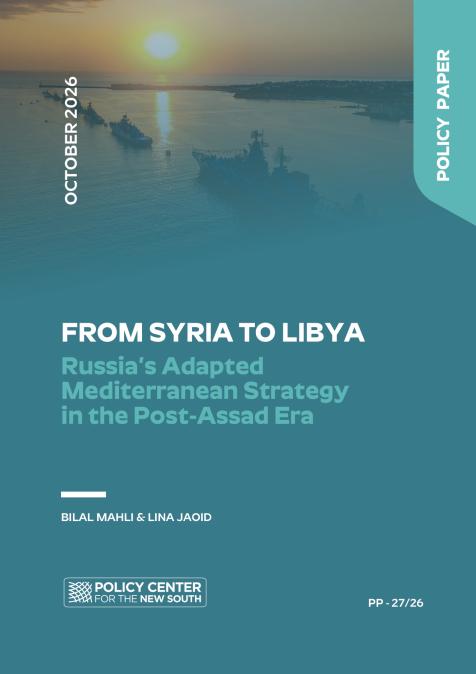
    In the two years since the fall of Bashar al-Assad in Syria, Russia has restructured its Mediterranean presence. Although Russia’s limited and increasingly conditional access to the Khmeimim and Tartus facilities in Syria has been preserved, its presence in the country has morphed from Assad’s ‘patron-client’ configuration to a more negotiated engagement. Simultaneously, Russia has upgraded its force-projection and logistical infrastructure in eastern Libya, giving it an access path ...
  • Authors
    Marie-Noelle Nwokolo
    October 6, 2026
    The author of this opinion, Marie-Noelle Nwokolo, is a 2024 alumna of the Atlantic Dialogues Emerging Leaders Program.In September 1978, delegations from 138 countries gathered in Buenos Aires, Argentina, around a powerful idea: developing countries had knowledge, experience and capabilities worth sharing with one another. The Buenos Aires Plan of Action gave institutional form to what we now call South-South Cooperation, part of a wider post-colonial effort by developing ...
  • September 28, 2026
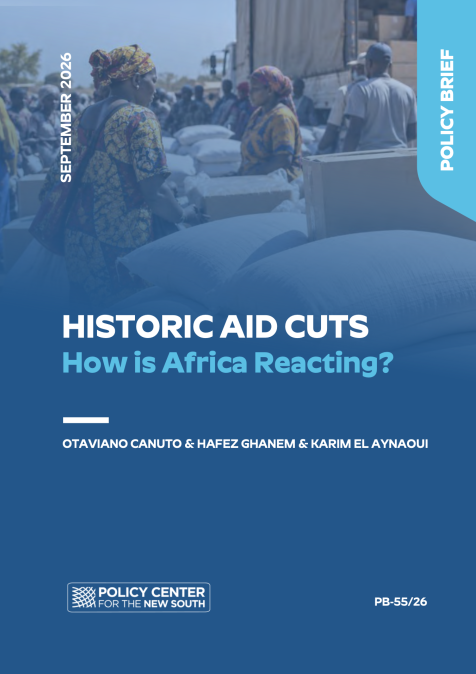
    This paper was initially published in French on the website of the Fondation Jean-Jaurès. There was a historic decline in Official Development Assistance (ODA) in 2025. Foreign aid to developing countries from members of the OECD-DAC fell by some 23%, the largest decline on record and the second consecutive annual decline. Aid to Africa fell by more than 25%. The International Monetary Fund (IMF) described this decline in ODA to Africa as “a shock like no other.” It differ ...
  • Authors
    Marianna Albuquerque
    September 23, 2026
    The author of this opinion, Marianna Albuquerque, is a 2022 alumna of the Atlantic Dialogues Emerging Leaders Program.As world leaders gather in New York for the 81st United Nations General Assembly, climate change returns to the center of multilateral diplomacy under markedly different circumstances. The debate is no longer confined to whether the world must decarbonize, but increasingly centers on how the transition will happen, who will bear its costs, who will capture ...
  • Authors
    Meryam Amarir
    August 13, 2026
    Recent crises in the Middle East, particularly attacks targeting commercial vessels in the Red Sea and tensions surrounding the Strait of Hormuz, have highlighted the vulnerability of the main strategic corridors of global trade. Rather than fundamentally disrupting the organization of trade flows, these crises are accelerating an ongoing transformation driven by the search for more resilient connectivity chains, the diversification of trade routes, and the development of logistics ...