Publications /
Policy Paper

Back
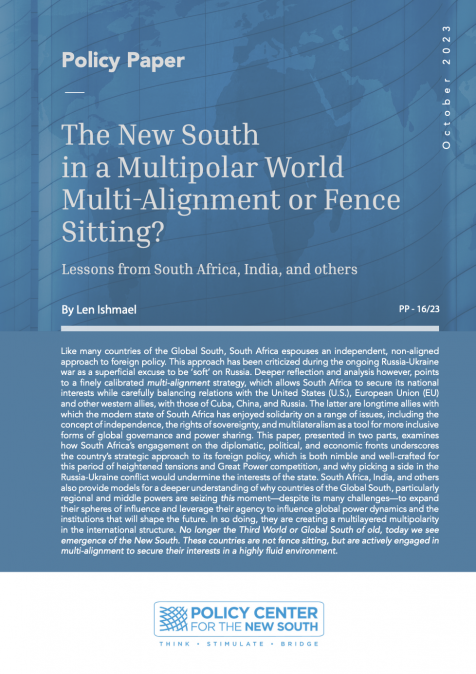
The New South in a Multipolar World Multi-Alignment or Fence Sitting?
Authors
October 23, 2023

Like many countries of the Global South, South Africa espouses an independent, non-aligned approach to foreign policy. This approach has been criticized during the ongoing Russia-Ukraine war as a superficial excuse to be ‘soft’ on Russia. Deeper reflection and analysis however, points to a finely calibrated multi-alignment strategy, which allows South Africa to secure its national interests while carefully balancing relations with the United States (U.S.), European Union (EU) and other western allies, with those of Cuba, China, and Russia. The latter are longtime allies with which the modern state of South Africa has enjoyed solidarity on a range of issues, including the concept of independence, the rights of sovereignty, and multilateralism as a tool for more inclusive forms of global governance and power sharing. This paper, presented in two parts, examines how South Africa’s engagement on the diplomatic, political, and economic fronts underscores the country’s strategic approach to its foreign policy, which is both nimble and well-crafted for this period of heightened tensions and Great Power competition, and why picking a side in the Russia-Ukraine conflict would undermine the interests of the state. South Africa, India, and others also provide models for a deeper understanding of why countries of the Global South, particularly regional and middle powers are seizing this moment—despite its many challenges—to expand their spheres of influence and leverage their agency to influence global power dynamics and the institutions that will shape the future. In so doing, they are creating a multilayered multipolarity in the international structure. No longer the Third World or Global South of old, today we see emergence of the New South. These countries are not fence sitting, but are actively engaged in multi-alignment to secure their interests in a highly fluid environment.

RELATED CONTENT

  • Authors
    Sous la direction de
    June 23, 2026
    Bientôt disponible en vente. L’Afrique atlantique émerge aujourd’hui comme un espace de réflexion stratégique majeur. Longtemps envisagée sous l’angle de sa fragmentation ou de sa marginalité relative dans les grands récits géopolitiques, cette façade maritime tend désormais à être appréhendée comme un ensemble en devenir, structuré par des dynamiques géopolitiques, économiques et sécuritaires de plus en plus intenses. C’est dans cette perspective qu’a été initié le Africa ...
  • June 22, 2026
    History devotes considerable attention to the rise and fall of great powers. Scholars have spent centuries analyzing why empires collapse, why nations decline, and why dominant states eventually lose their position. By comparison, relatively little attention has been devoted to a different question: what happens when a country succeeds beyond its own expectations? ...
  • Authors
    June 12, 2026
    It is a golden object—shining, impressive, 36.8 centimeters tall, crafted from 18-carat gold and bronze. A replica of a monumental four-meter-high work of art standing in Geneva’s Ariana Park, near the United Nations Office, it bears the title Reflections and Dreams, created by Azerbaijani artists Salhab Mammadov and Ali Ibadullayev. Hands rise from the earth, supporting a globe, reaching toward eternity. ...
  • Authors
    June 12, 2026
    This essay argues that the current debate about the future of the international monetary system is not really about Gulf currencies, oil pricing, or de-dollarization in the narrow technical sense. It is about something deeper and more important: whether institutional trust can survive when geopolitical certainty is eroding.The Gulf monarchies—Saudi Arabia, the United Arab Emirates, Qatar, Kuwait, Bahrain, and Oman—increasingly exist in a world where the United States no longer looks ...
  • June 10, 2026
    L’édition 2026 du Rapport annuel sur la Géopolitique de l’Afrique (RAGA) du Policy Center for the New South analyse un continent africain saisi par une double transformation : celle du système international, plus fragmenté, plus conflictuel et plus transactionnel ; et celle des environn...
  • June 5, 2026
    Driven by its mission to reflect on and analyze the major geopolitical, economic, and societal transformations shaping the contemporary world, and with a view to contributing to knowledge-sharing and disseminating the main outcomes of its research program, the Policy Center for the New South regularly publishes collective volumes addressing issues of particular importance to Morocco, Africa, and the broader Global/New South. In this spirit, the Center has recently released two volum ...
  • March 5, 2026
    This episode of Africafé explores the evolving dynamics of US-Africa relations, tracing their historical shifts from Cold War and War on Terror engagements to today’s focus on trade, investment, and strategic partnerships. Dr. Ian Lesser highlights how Africa’s role in US foreign policy...