Publications /
Policy Paper

Back
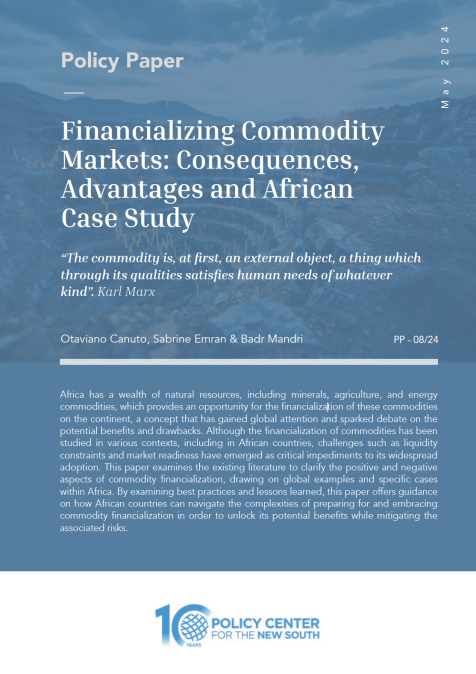
Financializing Commodity Markets: Consequences, Advantages and African Case Study
May 24, 2024

Africa has a wealth of natural resources, including minerals, agriculture, and energy commodities, which provides an opportunity for the financialization of these commodities on the continent, a concept that has gained global attention and sparked debate on the potential benefits and drawbacks. Although the financialization of commodities has been studied in various contexts, including in African countries, challenges such as liquidity constraints and market readiness have emerged as critical impediments to its widespread adoption. This paper examines the existing literature to clarify the positive and negative aspects of commodity financialization, drawing on global examples and specific cases within Africa. By examining best practices and lessons learned, this paper offers guidance on how African countries can navigate the complexities of preparing for and embracing commodity financialization in order to unlock its potential benefits while mitigating the associated risks.
RELATED CONTENT

  • Authors
    Edité par
    Idriss El Abbassi
    Lahcen Oulhaj
    Aziz Ragbi
    November 28, 2016
    Le présent ouvrage se propose d’apporter quelques éléments d’appui supplémentaires aux policy-makers pour une meilleure identification des défaillances des marchés au Maroc et une mise en place d’une stratégie de diversification et une politique industrielle efficientes, sans toutefois tomber dans la situation inverse où une stratégie mal définie et des outils mal choisis peuvent se traduire par une défaillance des politiques publiques. L’appréhension des difficultés qu’éprouve l’é ...
  • Authors
    Under the Supervision of
    Philippe Chalmin
    July 4, 2016
    Guinea’s bauxite, Moroccan phosphates, Nigerian Bonny Light, Zambian copper, Côte d'Ivoire’s cocoa, Ethiopian coffee or Madagascar’s vanilla: all are examples demonstrating that raw materials have a dimension that is as global as it is local. Global by the markets on which they are traded, local by their quality, a key element of their price, and their macroeconomic impact, particularly for Africa. In line with the 2016 CyclOpe report, which celebrates three decades of existence thi ...
  • Authors
    Silvia Colombo
    Mohamed El Harrak
    Nicolò Sartori
    May 27, 2016
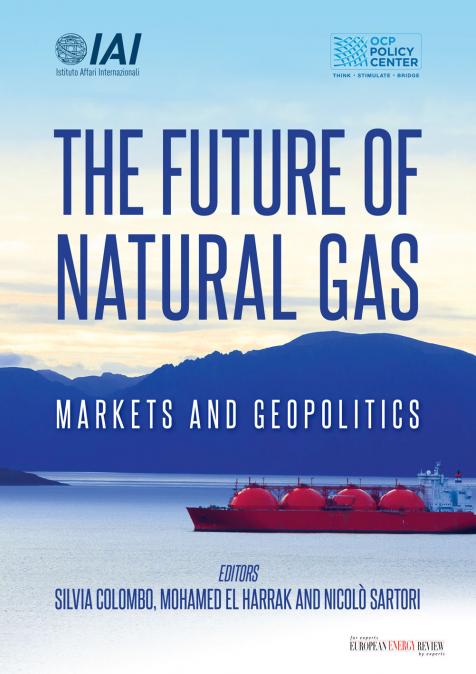
    Energy is at the core of the remarkable current transitions in the global economy and geopolitics, and natural gas plays a crucial role in these processes. In this context of rapidly evolving trends at the market level and developing dynamics between regional and global actors, The Future of Natural Gas aims at analysing the role of natural gas in the future energy mix by considering several key factors: the ambitious climate policies agreed by the international community, cost issu ...
  • Authors
    Russel Dinh
    January 27, 2016
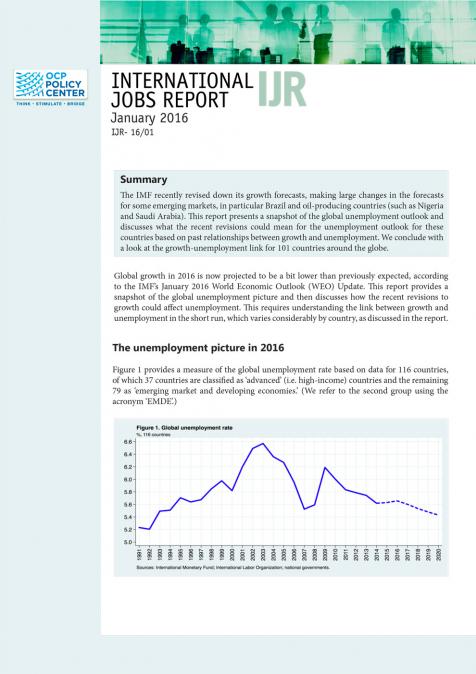
    The IMF recently revised down its growth forecasts, making large changes in the forecasts for some emerging markets, in particular Brazil and oil-producing countries (such as Nigeria and Saudi Arabia). This report presents a snapshot of the global unemployment outlook and discusses what the recent revisions could mean for the unemployment outlook for these countries based on past relationships between growth and unemployment. We conclude with a look at the growth-unemployment link f ...
  • Authors
    December 14, 2015
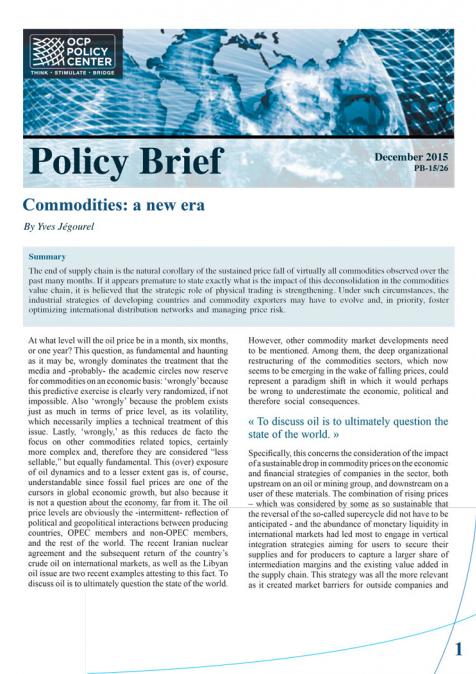
    The end of supply chain is the natural corollary of the sustained price fall of virtually all commodities observed over the past many months. If it appears premature to state exactly what is the impact of this deconsolidation in the commodities value chain, it is believed that the strategic role of physical trading is strengthening. Under such circumstances, the industrial strategies of developing countries and commodity exporters may have to evolve and, in priority, foster optimizi ...
  • Authors
    Karim EL MOKRI
    July 6, 2015
    « Les asymétries et l’instabilité du marché des matières premières dans les pays en développement : politiques et impacts sur le développement », une problématique d’un intérêt particulier pour ces pays, a fait l’objet d’un séminaire de recherche organisé par la Fondation pour les Etudes et Recherches sur le Développement International (Ferdi), les 24 et 25 juin 2015 à Clermont-Ferrand. Cet évènement a été tenu la veille du workshop co-organisé par la Ferdi et OCP Policy Center ...
  • Authors
    April 30, 2015
    Pour une économie ouverte, l’analyse des échanges internationaux recèle une importance capitale pour analyser ses perspectives de croissance. Bien des décisions individuelles portant sur la consommation, l’épargne et l’investissement sont, en effet, liées aux termes de l’échange. L’évolution de ces derniers, définis comme le rapport entre les prix à l’exportation et ceux à l’importation, est considérée comme un indicateur du pouvoir d’achat d’un pays et constitue une variable fort ...
  • January 26, 2015
    OCP Policy Center vient de rendre public le 10 janvier son premier Policy Brief de l’année 2015, qui traite de la question de la baisse significative des prix des produits pétroliers, ses causes, et ses conséquences macroéconomiques pour les producteurs et les consommateurs de ce produit.  Yves Jégourel, Senior Fellow à OCP Policy Center et auteur du Policy Brief en question, a accumulé une expertise dans le domaine de l’analyse des marchés des matières premières. Il ...