Publications /
Book / Report

Back
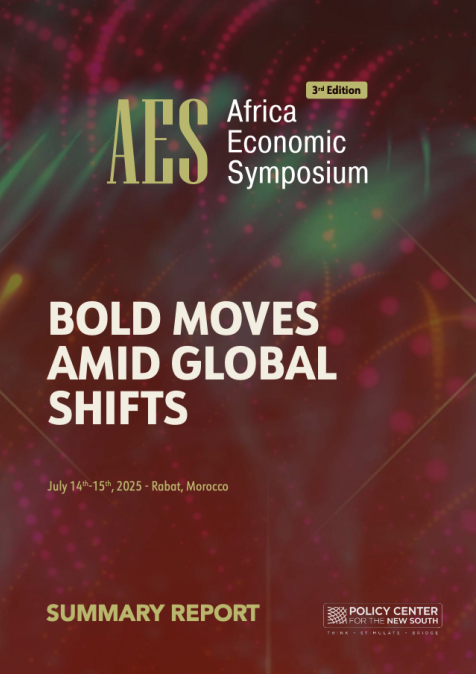
Africa Economic Symposium (AES) 3nd edition - SUMMARY REPORT
Authors
General rapporteur Mahmoud Arbouch
September 2, 2025

The Africa Economic Symposium (AES) has firmly established itself as one of the flagship annual events of the Policy Center for the New South, alongside the Atlantic Dialogues and the African Peace and Security Annual Conference (APSACO). Now in its third edition, AES continues to provide a unique platform for economists, policymakers, and academics from across the continent and beyond to exchange perspectives on the pressing macroeconomic and structural challenges facing Africa. Its mission remains to foster rigorous, evidence-based debates that inform policymaking and support long-term strategies for Africa’s development in an era of uncertainty. 

The 2025 edition, convened under the theme “Bold Moves amid Global Shifts,” explored the difficult policy trade-offs confronting African governments as they navigate a volatile global environment. The continent’s recovery from COVID-19 has been uneven, while debt pressures, supply chain disruptions, and geopolitical tensions weigh heavily on fiscal and economic resilience. Structural challenges such as persistent unemployment, low productivity, and the exclusion of Africa’s youth continue to hinder inclusive growth, even as policymakers are called upon to adapt to deep systemic uncertainty. 

The symposium underscored that many African states are increasingly resorting to short-term stabilization measures—such as accumulating reserves and postponing reforms—that may provide immediate security but risk delaying the structural transformation urgently needed. Against this backdrop, AES 2025 called for a careful balance between fiscal prudence, social investment, and the pursuit of sustainable growth, placing emphasis on reforming governance, improving macroeconomic management, and accelerating structural change. 

The discussions highlighted the urgent need to rethink Africa’s economic strategies in a shifting global order. From debt sustainability and the role of central banks to the promise of financial innovation, digital inclusion, and new instruments such as central bank digital currencies, the symposium emphasized that policy choices must align with long-term transformation goals. The debates also explored the opportunities and challenges of regional integration, trade connectivity, and development finance, all of which are essential levers for Africa’s resilience and prosperity. 

As in previous editions, the Annual Report on African Economies was launched alongside the symposium, offering an in-depth analysis of the continent’s macroeconomic dynamics and structural transformation pathways. More than just a publication, the report reflects the collective intellectual effort of leading scholars and practitioners, providing evidence-based insights to guide decision- makers. Together, the symposium and the report reinforced the Policy Center for the New South’s commitment to fostering forward-looking economic thinking that moves beyond short-term headlines to tackle Africa’s enduring challenges.

RELATED CONTENT

  • September 15, 2023
    The global economy is on the path to recovery following the dual challenges of the COVID-19 pandemic and Russia's invasion of Ukraine. While there are promising signs of short-term progre ...
  • Authors
    Pepe Zhang
    September 14, 2023
    This publication was originally published in Project Syndicate    WASHINGTON, DC – The world economy remains beset by challenges, from tight monetary, financial, and fiscal conditions to the effects of the war in Ukraine. These headwinds are impeding global growth – which is expected to slow to 3% this year, compared to 3.5% in 2022 – and damaging lives and livelihoods, with poverty and food insecurity on the rise, particularly in developing countries. In addressing ...
  • Authors
    September 7, 2023
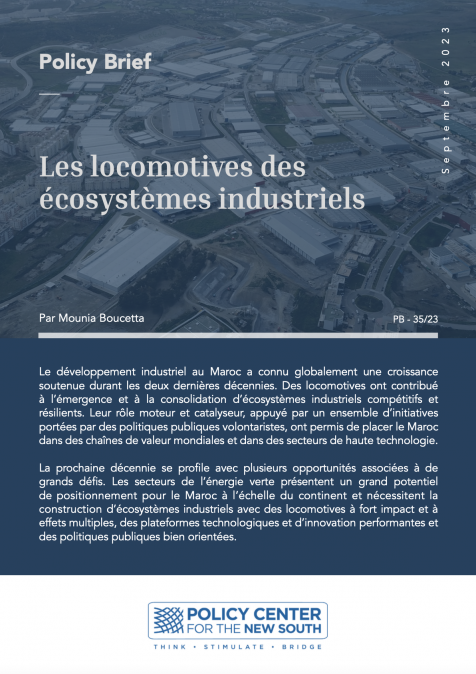
    Le développement industriel au Maroc a connu globalement une croissance soutenue durant les deux dernières décennies. Des locomotives ont contribué à l’émergence et à la consolidation d’écosystèmes industriels compétitifs et résilients. Leur rôle moteur et catalyseur, appuyé par un ensemble d’initiatives portées par des politiques publiques volontaristes, ont permis de placer le Maroc dans des chaînes de valeur mondiales et dans des secteurs de haute technologie. La ...
  • Authors
    Alfonso Medinilla
    September 5, 2023
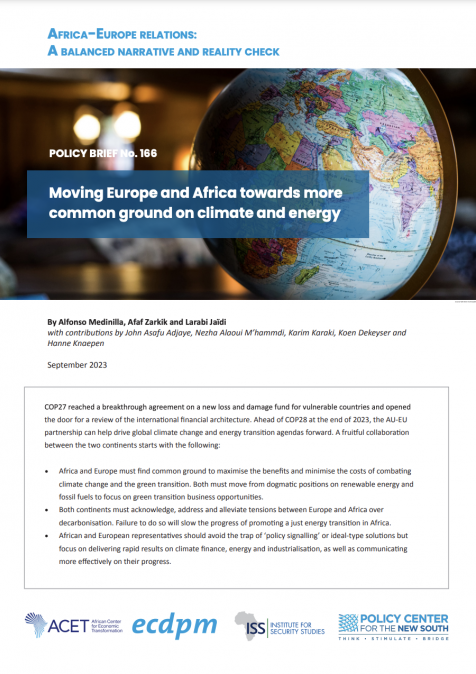
    This paper was originally published on ecdpm.org   COP27 reached a breakthrough agreement on a new loss and damage fund for vulnerable countries and opened the door for a review of the international financial architecture. Ahead of COP28 at the end of 2023, the AU-EU partnership can help drive global climate change and energy transition agendas forward. A fruitful collaboration between the two continents starts with the following: • Africa and Europe must find comm ...
  • Authors
    September 4, 2023
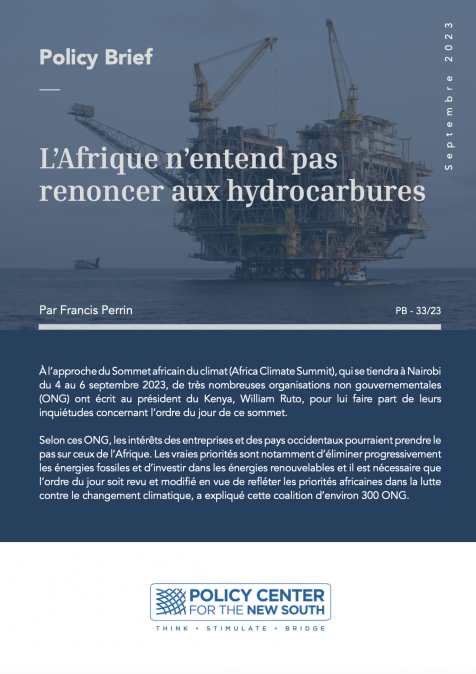
    À  l’approche du Sommet africain du climat (Africa Climate Summit), qui se tiendra à Nairobi du 4 au 6 septembre 2023, de très nombreuses organisations non gouvernementales (ONG) ont écrit au président du Kenya, William Ruto, pour lui faire part de leurs inquiétudes concernant l’ordre du jour de ce sommet. Selon ces ONG, les intérêts des entreprises et des pays occidentaux pourraient prendre le pas sur ceux de l’Afrique. Les vraies priorités sont notamment d’éliminer progressiv ...
  • Authors
    Jaime Bonet
    Geoffrey J. D. Hewings
    August 30, 2023
    This Book was originally published on springer.com   This book examines regional structural challenges on Colombia’s path to sustainable social cohesion and regionally inclusive growth. These challenges can be divided into three main groups: (i) those that focus on competitiveness and the supply side, (ii) those that arise from critical business cycle issues on the demand side, and (iii) those concerning environmental sustainability, employment and social inclusion.&nbsp ...
  • August 29, 2023
    Base erosion and profit shifting (BEPS) involving multinational companies is a complex, multi-dimensional problem resulting from loopholes and inconsistencies between countries’ tax systems. Addressing it requires coordinated action at the international level. Several organizations have taken initiatives in this direction, including the Organization for Economic Co-operation and Development (OECD), which, with the support of the G20, launched an ambitious project to combat BEPS in 2 ...
  • August 29, 2023
    In this conversation, Ms. Lina Khatib, the Director of SOAS University's Middle East Institute, delves deep into pressing regional issues. She highlights what policymakers can do to ensure the equitable distribution of economic development benefits and prevent any regression. Khatib als...