Publications /
Book / Report

Back
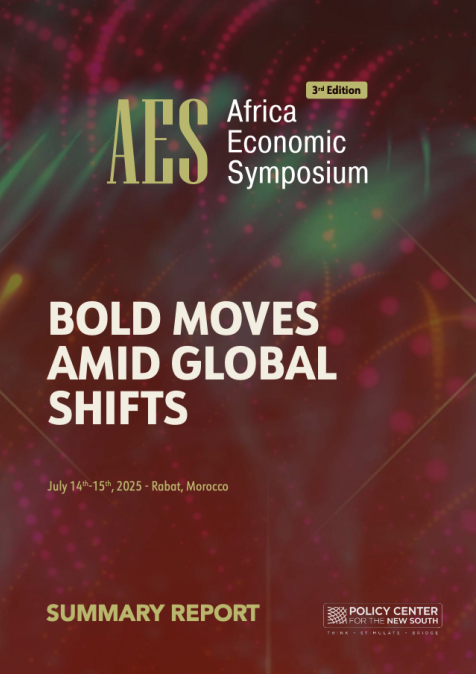
Africa Economic Symposium (AES) 3nd edition - SUMMARY REPORT
Authors
General rapporteur Mahmoud Arbouch
September 2, 2025

The Africa Economic Symposium (AES) has firmly established itself as one of the flagship annual events of the Policy Center for the New South, alongside the Atlantic Dialogues and the African Peace and Security Annual Conference (APSACO). Now in its third edition, AES continues to provide a unique platform for economists, policymakers, and academics from across the continent and beyond to exchange perspectives on the pressing macroeconomic and structural challenges facing Africa. Its mission remains to foster rigorous, evidence-based debates that inform policymaking and support long-term strategies for Africa’s development in an era of uncertainty. 

The 2025 edition, convened under the theme “Bold Moves amid Global Shifts,” explored the difficult policy trade-offs confronting African governments as they navigate a volatile global environment. The continent’s recovery from COVID-19 has been uneven, while debt pressures, supply chain disruptions, and geopolitical tensions weigh heavily on fiscal and economic resilience. Structural challenges such as persistent unemployment, low productivity, and the exclusion of Africa’s youth continue to hinder inclusive growth, even as policymakers are called upon to adapt to deep systemic uncertainty. 

The symposium underscored that many African states are increasingly resorting to short-term stabilization measures—such as accumulating reserves and postponing reforms—that may provide immediate security but risk delaying the structural transformation urgently needed. Against this backdrop, AES 2025 called for a careful balance between fiscal prudence, social investment, and the pursuit of sustainable growth, placing emphasis on reforming governance, improving macroeconomic management, and accelerating structural change. 

The discussions highlighted the urgent need to rethink Africa’s economic strategies in a shifting global order. From debt sustainability and the role of central banks to the promise of financial innovation, digital inclusion, and new instruments such as central bank digital currencies, the symposium emphasized that policy choices must align with long-term transformation goals. The debates also explored the opportunities and challenges of regional integration, trade connectivity, and development finance, all of which are essential levers for Africa’s resilience and prosperity. 

As in previous editions, the Annual Report on African Economies was launched alongside the symposium, offering an in-depth analysis of the continent’s macroeconomic dynamics and structural transformation pathways. More than just a publication, the report reflects the collective intellectual effort of leading scholars and practitioners, providing evidence-based insights to guide decision- makers. Together, the symposium and the report reinforced the Policy Center for the New South’s commitment to fostering forward-looking economic thinking that moves beyond short-term headlines to tackle Africa’s enduring challenges.


RELATED CONTENT

  • Authors
    Marie-Claire Aoun
    October 14, 2015
    Plusieurs facteurs bien connus sont à l’origine de l’effondrement des cours du brut depuis juin 2014. Face à une offre pétrolière excédentaire avec l’essor des pétroles de schiste américains, le ralentissement de la croissance économique des pays émergents, notamment des pays à forte intensité énergétique comme le Brésil, la Chine ou la Russie se traduit par une consommation pétrolière mondiale, toujours en croissance, mais à un rythme moindre que les années précédentes. A ces évolu ...
  • Authors
    October 2, 2015
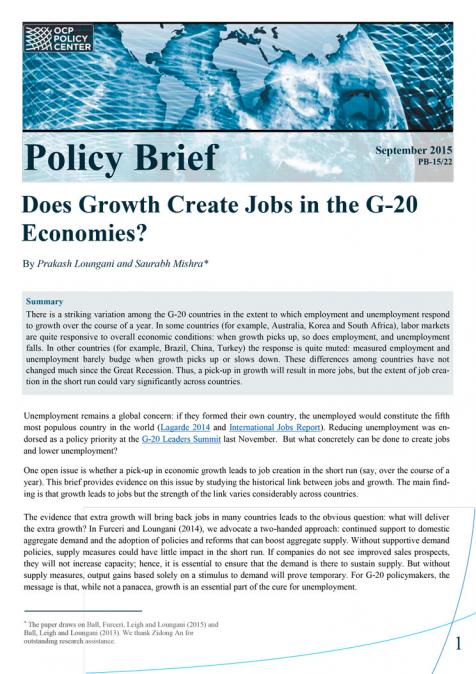
    Récemment parue parmi la série de Policy Briefs publiés par OCP Policy Center, une étude réalisée conjointement par Prakash Loungani et Saurabh Mishra a mis l’accent sur la réaction du chômage et l’emploi par rapport à la croissance économique dans les pays du G-20. L’objectif est de quantifier l’apport d’un point supplémentaire de croissance sur l’évolution du taux d’emploi, et sur le taux du chômage sur la période 1980-2014.  Sur la période 1980-2007, les ...
  • October 01, 2015
    This podcast is performed by Peter Sparding. TTIP negotiations, now well into their third year, are slower moving than many stakeholders in Europe and the United States had originally hop ...
  • Authors
    Rabah Arezki
    Akito Matsumoto
    September 22, 2015
    “It was the best of times, it was the worst of times.” With these words Charles Dickens opens his novel “A Tale of Two Cities”. Winners and losers in a “tale of two commodities” may one day look back with similar reflections, as prices of metals and oil have seen some seismic shifts in recent weeks, months and years. This blog seeks to explain how demand — but also supply and financial market conditions — are affecting metals prices. We will show some contrast with oil, where suppl ...
  • Authors
    Roger Nord
    September 18, 2015
    Sub-Saharan Africa’s trade flows increased sharply, multiplying by a factor of five over the past 20 years. Is this boom built on commodities only?  My answer is no ! Many countries have increased their integration in global value chains. But, it is also clear that sub-Saharan Africa still has some way to go. Increased trade boosts for growth Over the last two decades, the export-to-GDP ratio in sub-Saharan Africa increased from 20½ percent in 1995 to 27½ percent in 2013. Thi ...
  • Authors
    Saurabh Mishra
    September 1, 2015
    Les fonds souverains, objet de toutes les attentions au cours des années 2000, devraient voir leur rôle de « stabilisateur » de l’économie se renforcer dans les mois à venir, en raison de la chute du prix des matières premières. Ces véhicules d’investissement doivent cependant être coordonnés avec les outils traditionnels de la politique fiscale et ne peuvent affranchir les pouvoirs publics d’effectuer à plus ou moins long terme les ajustements budgétaires que ce nouvel environnemen ...
  • Authors
    August 25, 2015
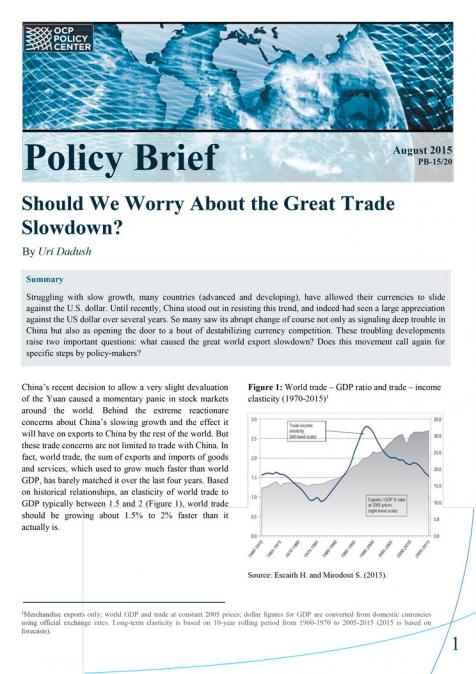
    Struggling with slow growth, many countries (advanced and developing), have allowed their currencies to slide against the U.S. dollar. Until recently, China stood out in resisting this trend, and indeed had seen a large appreciation against the US dollar over several years. So many saw its abrupt change of course not only as signaling deep trouble in China but also as opening the door to a bout of destabilizing currency competition. These troubling developments raise two important q ...